
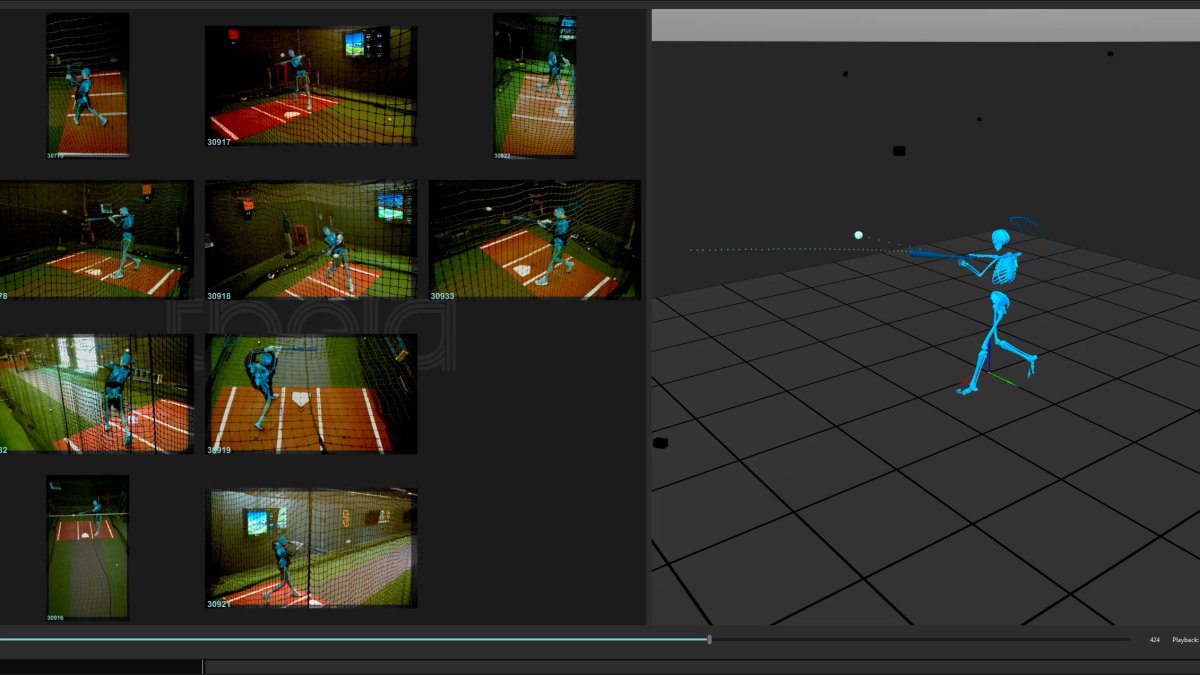
In the two years since the biomechanics lab at Point Loma Nazarene University opened, it’s become one of the most sought-after sports science research facilities in the world. For example, when motion caption company Theia developed a new markerless system it knew exactly who it wanted to work with.
“The lab is really phenomenal,” says Marcus Brown, CEO of Theia. “From our perspective, honestly, it’s just exciting that such a polished lab and that type of professional environment is open to being partners with us and to use this type of technology and provide us feedback. It’s a really, really exciting time for us.”
The PLNU lab, built in conjunction with the San Diego Padres and under the stewardship of Arnel Aguinaldo, tests new tech to judge its effectiveness. They decided to adopt this one, and it’s a little bit wild … using artificial intelligence to create a complete view of how the skeleton is moving during an athletic activity.
“Effectively what we’re doing is we’re teaching A.I. models to measure where your bones are located using just videos,” says Brown.
Typically, people like knowing where their bones are located because if you end up losing track of one something has probably gone horribly wrong. But, in a sporting context, this is something coaches have been looking for data on for a long time. One area this tech is being implemented is potentially mitigating the precipitous rise of pitcher arm injuries the last several years.
“A really strong indicator of performance is how much that elbow is cocking back, and you can measure that primarily by measuring just the bone locations,” says Brown. “If you want to go further you can do simulations, which will get you a little bit more detailed in terms of strain on tendons. But, what we provide is just high-fidelity bone tracking as well as the ball and the bat.”
That last part is the real innovation here and why coaches are so interested. The PLNU lab measures terabytes of data, from exit velocities to spin rate to ground force to hip torque. The scientists take all those data points, put them together to see how they all interact, then hand the information over to the coaching staff to determine how to get the athlete to best understand, accept, and implement it.
That is not an easy translation to make.
“Having an overload of data doesn’t do you any good. So, it’s how you can get the specific data that you need in order to inform the athlete how they can improve specifically,” says Brown.
This technology is designed to simplify the process as much as possible for faster and easier assimilation.
“At the end of the day, what this allows coaches and athletic trainers to do is to provide really solid feedback to the athletes to improve their game in one consolidated system,” says Brown.
For example, prior to adopting this technology the lab would use special tracking tape wrapped around a baseball to see how it moves in space, or have a hitter use a special bat affixed with sensors. Now, players can come in with their own gear and get more personally specified data than ever before.
In a way, the system provides both the cause and the effect. If a player wants to change their launch angle coaches can show them exactly how their body is moving now and what they need to do to get to where they want to be.
“It really attenuates the voices and allows them to put their spice on it and cue up that athlete exactly as they want to,” says Brown.
For more information on the Biomechanics Lab, click here.