
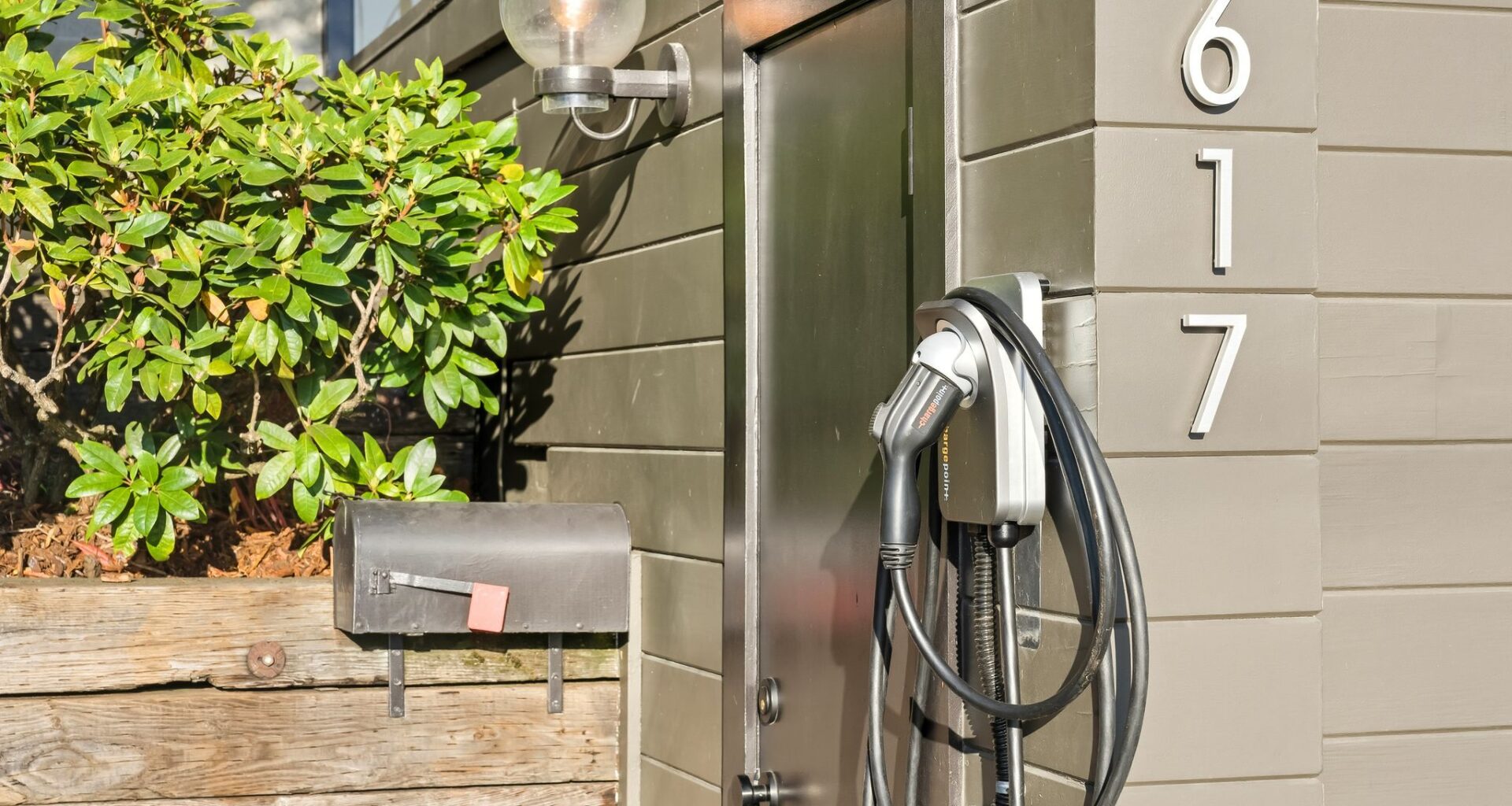
A real estate listing photo shows an electric vehicle charger at a Berkeley home.
Courtesy Megan Micco
The San Francisco Bay Area has one of the highest electric vehicle adoption rates in the world. So it’s no surprise that EV chargers are an in-demand feature for homebuyers. Now, some real estate agents say such chargers have evolved from a “nice to have” to a “must have” feature that can tip a potential deal in a seller’s favor.
As gas prices climb, electric car drivers who installed home chargers are currently experiencing a nice return on that investment. But would that ROI also stretch to an increase in home value — and potential higher sale price? That can very much depend on the home’s specifics.
What real estate agents are seeing
Amanda Jones is a real estate agent for Compass who primarily works in San Francisco. She was an early EV adopter: She bought an all-electric Mercedes a decade ago with an 83-mile range, which once left her stranded on the Bay Bridge. The ensuing tow didn’t put her off: today, she and her husband each have a Tesla at home.
Article continues below this ad
These days, she said most of her clients want to see an EV charger installed and ready to go in the house. When buyers narrow down their search to three or four houses, she said, the one that’s ready for them to pull in and start charging their car on move-in day can make or break a deal.
An electric car charger “is becoming a requirement on all deals,” she said. “It is for sure a check box most buyers want checked. I think it is 100 percent worth it.”
San Francisco Chronicle Logo
Make us a Preferred Source to get more of our news when you search.
Add Preferred Source
• Read: How rising gas prices from the Iran War are changing the math on owning an EV in California
• Read: What’s the return on investment for building an ADU in California?
Article continues below this ad
Even for sellers who don’t plan to install a charger, one agent I spoke to recommends they get a quote from an installation company to include in the disclosure to buyers.
Listing photo showing an EV charger at a Berkeley home. Real estate agents say EV chargers are an increasingly desirable home feature.
Courtesy Megan Micco
What are the costs to install?
Installing an electric car charger can be pricey. Level 1 chargers can be plugged into a standard electrical outlet, and you can buy them online in the $100 to $400 range. But they’re slow: cars charged on Level 1 get about 5 miles of range per hour of charge, meaning you either need a short commute or to commit to regular overnight charging for 8 hours or longer.
Level 2 chargers are what really motivate buyers, said Megan Micco, a real estate agent who specializes in single-family homes in the inner East Bay.
Article continues below this ad
“A standard 120V outlet isn’t worth mentioning in a listing,” she said.
A Level 2 charger is evolving into a standard expectation in single-family homes in the $1.2 to $2.5 million range, Micco said. She compared it to air conditioning: Once a nice-to-have, but now most buyers in warmer parts of the Bay expect it to already be there.
Some electric cars are sold with a Level 2 charger included, in which case you might be on the hook for as little as a few hundred dollars for the installation. Buying one out of pocket costs around $500 to $700, and they need to be professionally installed, which can cost another $400 to $1,200 and up.
The “up” comes into play in places like Berkeley, Micco said, where older homes may require a $3,000 to $8,000 panel upgrade to support a Level 2 charger.
That’s part of why buyers like to see chargers already installed, according to Jones: They signal that the seller has already made the appropriate electrical upgrades and dealt with any potential hassles with PG&E.
Article continues below this ad
“That’s very calming for a buyer,” she said. “If you already have that power upgrade, you’re stoked.”
• From 2025: How much money do you really save by owning an electric car in California?
• Read: PG&E is delaying ADU construction in California, builders and homeowners say
What’s the ROI on an EV charger?
With gas prices well above $6 a gallon across California, people who switch from gas-powered cars to comparable electric ones start getting a return on their investment right away. Per previous Chronicle reporting, if you swap out your Toyota Corolla for a Nissan Leaf, you’ll save about $90 a month on fueling costs; if you replace your BMW X5 with a Rivian, you’ll net a little over $150 a month.
Article continues below this ad
In the first scenario, you’d offset the cost of a $1,500 Level 2 charger purchase and installation in about a year and a half. In the second, you’d start netting a return on your investment after 10 months. Not bad.
But what about the increase in your home value?
“I would say it’s an immediate 1 for 1 for getting your money back when you go to sell,” Jones said.
A representative for real estate website Zillow said an increasing number of homes for sale in the region mention EV chargers. In the San Francisco metro area, 5% of all listings in 2025 mentioned them, up nearly 14% from the year before. In San Jose, about 5% of all listings referenced EV charging, up 11% year-over-year.
Nationwide, homes that mention EV charging in their listing description sold for 1.5% more than comparable homes that didn’t, according to Zillow.
Andy Orion, a real estate agent specializing in the Peninsula, said that might be correlation instead of causation: homes with chargers likely have other upgrades as well, like the updated electrical panel, which also contribute to the price increase.
“On the buy side, the majority of my clients, more than 75%, want a car charger,” he said in an email. “They consider this a ‘nice to have’ or ‘very nice to have’ feature, but not a ‘must have’ feature.”
As far as price, he said, the charger makes the house more attractive to buyers, but in his experience doesn’t directly correlate with a price increase.
Chargers in multifamily homes
For multifamily homes, the feasibility and cost of a charger can be particularly varied.
Jones said one of the first things she gets asked by clients shopping for condos or townhomes and commuting to Silicon Valley is whether there’s a place to charge their cars.
And unlike for single-family homes, where the lack of a charger has not been a deal-breaker for his buyers, Orion said he’s seen buyers pass on condos without one, since the cost and difficulty to install can be much greater.
In multifamily homes, California law says an HOA must allow you to install an EV charger, but it can require an architectural review and safety compliance process and you’re on the hook for the cost. Because a charger has to be wired directly into your meter, the cost can increase dramatically if the meter is far from your assigned parking spot. A friend of mine in Southern California recently had a simple installation done: his meter was a little less than 100 feet from his condo parking spot, so installing a Level 2 charger came out to just over $3,000.
I also live in a condo and got a quote. That’s how I found out my building’s meters are located in a locked basement, directly adjacent to the elevator shaft and under another person’s kitchen floor. Running the wire would involve blasting up a floor through the concrete, running a big, ugly conduit across my lobby, and blasting through yet more concrete to get through the trash room and multiple beams in the garage. The installer gave me a rough quote: $10,000.
This is where personal finance gets personal. If I swapped my compact crossover SUV for a Tesla Model Y, it would take more than 5½ years of charging before I got my investment back (assuming gas and electricity costs remained the same as they are now for that long, which is a big assumption). And while I could envision commanding a small premium for my unit with an electric charger, I’m not convinced I’d see a 100% return on my investment there.