
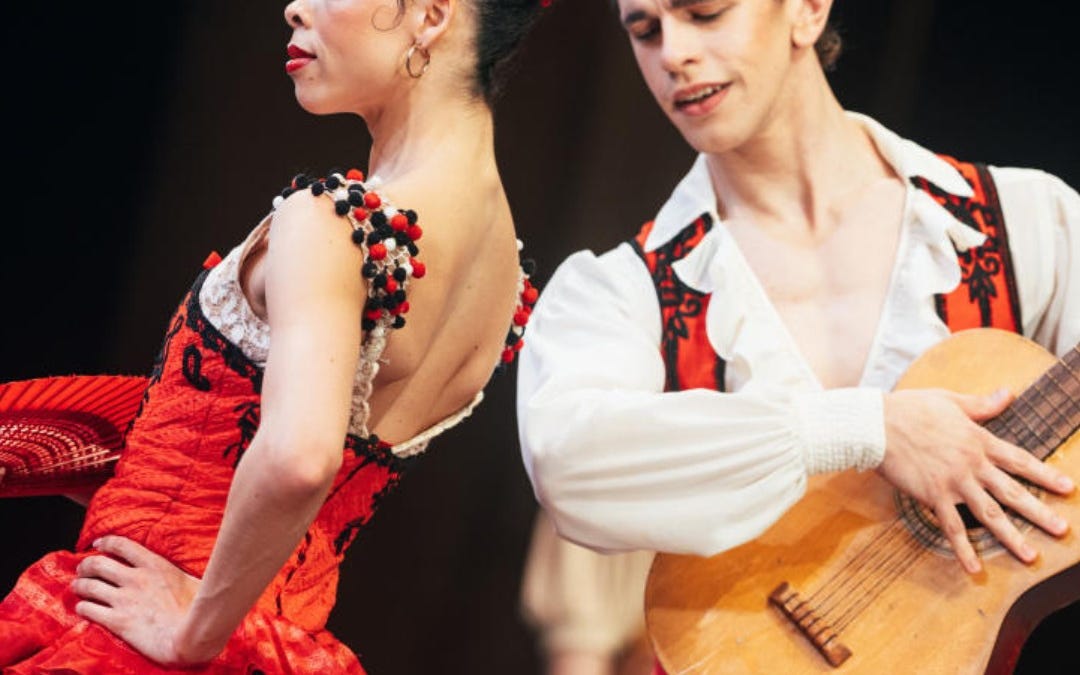
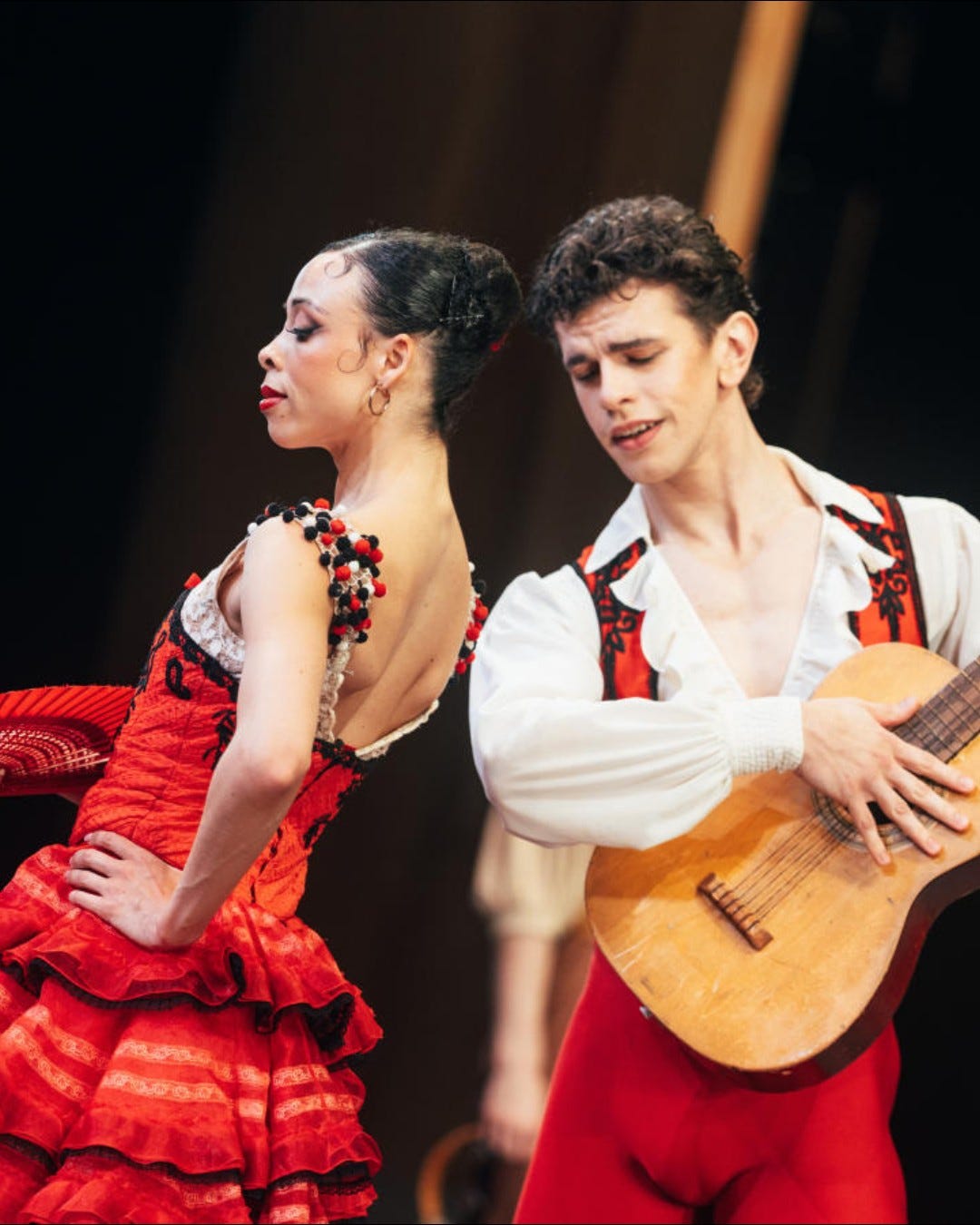
Nikisha Fogo and Joshua Jack Price in San Francisco Ballet’s “Don Quixote.” Photo by Lindsey Rallo.
I’m still away (far away), helping a family member with an emergency through at least June 20th. Back in March, I had requests from readers to compare and contrasts dancers in San Francisco Ballet’s “Don Quixote.” My current break from the dance scene gave me a chance to pull together thoughts on the dozen or so casts I caught in “Don Quixote,” William Forsythe’s “Blake Works,” and the all-Balanchine program this past season, and of course I had one name top of mind: Joshua Jack Price. As I wrote in a review just published by Fjord:
San Francisco Ballet delivers one of the most intense home seasons in the dance world, a scheduling crucible that artistic director Tamara Rojo, in her four years of leadership, has tried to change without success. Because the company shares the magnificent War Memorial Opera House with the San Francisco Opera, and the singers occupy the theater all summer and fall, the Ballet can only use the stage from December through May. So, while most troupes prepare a spring season and perform it, then move on to prepare a fall season and perform it, San Francisco Ballet dancers spend August through November creating and rehearsing ballets for all six programs all at once. Come December, they blast through a month of “Nutcrackers,” then launch themselves into everything from Petipa classics to wildly un-balletic contemporary works with less than two weeks between each program to fine-tune roles they learned back in October. In this recent season’s most extreme turn-around, the dancers whiplashed from an all-Forsythe program to “Don Quixote” in just eleven days.
Is this a recipe for forging some of the most physically resilient and stylistically adaptable dancers on the planet, or a sure-fire way to rack up workers’ comp claims? Whichever the case, it makes for a roller coaster ride, followed by an end-of-season tsunami of dancer posts on Instagram, the highlights blurring into one chaotic memory. And yet, while snapshots from “La Sylphide,” “Diamonds,” and “Mere Mortals” crowd my brain, there’s one standout image I can’t forget: Joshua Jack Price as Basilio in “Don Q.”
It was certainly a surprise to see him cast for the March run, especially opposite one of the company’s most confident principals, Nikisha Fogo, as Kitri. Hailing from Australia, and having come to the SF Ballet School from a Prix de Lausanne scholarship, Price has shown great promise since his apprentice days, but he hadn’t danced many principal roles, let alone a full-length. Perhaps a bias for a danseur noble “look” has worked against him. Price is below medium height, with beefy quadriceps and a large head that carries impish eyes, a wide mouth and prominent ears. For “Don Q,” he cut his curly hair close on the sides and pulled it off his forehead to create a swaggering pompadour. Traipsing about the stage as that mischievous young barber in sunny Spain, he suddenly became the sexiest guy within 100 miles of the Golden Gate Bridge. Of course, the impression had as much to do with his dancing as his coiffure.
What instant stardom! Within five minutes, it was apparent that far from being nervous to partner the wily Fogo, Price’s ease on stage, born from unshakeable command of his bodily instrument, was helping her relax, too. It turns out Price is a Baryshnikov type, his compact biomechanics so efficient and his proprioception so sure that his low-arabesque pencil turns in Act One looked like they could drill a hole straight into the center of the earth. His pirouettes are not just secure but musical, so natural is his ability to speed or slow them. His jumps have terrific height—landing his double saut de basque to the knee, he threw his head dramatically back, nothing to lose. In pure strength, he had no trouble carrying Fogo, a tall dancer, halfway across the stage in a one-armed lift. (For that matter, Fogo had no trouble carrying herself—what a clean, lovely adage she gave us in the difficult Act Two dream scene.) Through it all, Price merged with his character’s moment, teasing in the Act One flirtations and tender in the Act Two gypsy scene, which in former artistic director Helgi Tomasson’s staging adds a swooning guitar-strumming duet for the lovers set to interpolated music.
The rest of the review, with notes on Wona Park, Joseph Walsh, Esteban Hernandez, Katherine Barkman, and many other dancers is here.
(And my apologies for any frustrations, but it is indeed paywalled, because subscriptions are what keep the publication going—and what in turn keeps me writing without bringing my family to financial ruin.)
As much as I love ballet, I equally love the most cutting-edge experimental dance.
(I recently sent my “looking back on the year” highlights to Germany’s Tanz magazine—no idea why they ask for these in June—and what remained most vividly in mind from the past 12 months was gizeh muñiz’s unclassifiable solo “Fishblod” at ODC Theater’s State of Play festival last August.)
I do get to return to the Bay Area for three days next week, to take a breather from this family emergency. And during those days off, I play to attend the final night of Gravity/Circo Zero x ROT’s three-day extravaganza of the experimental, “Prefigure,” at San Francisco’s Joe Good Annex.
The first two days, Monday June 1 and Tuesday June 2, are full of workshops with artists like Monique Jenkinson, AKA the drag king Fauxnique, and a “queer theory buffet” of artist’s talks. Then on Wednesday, June 3, at 7:30 p.m., an event called “Salmagundi” is offering an irresistible smorgasbord of raw new work by some of the city’s most interesting dance artists, including Clarissa Rivera Dyas & ainsley e. tharp, Johnny Huy Nguyen, and Gabriele Christian.
Full info is here.
One thing I know: It will not be alive. See you at the Joe Goode Annex June 3?

Graphic from Gravity/Circo Zero x ROT