
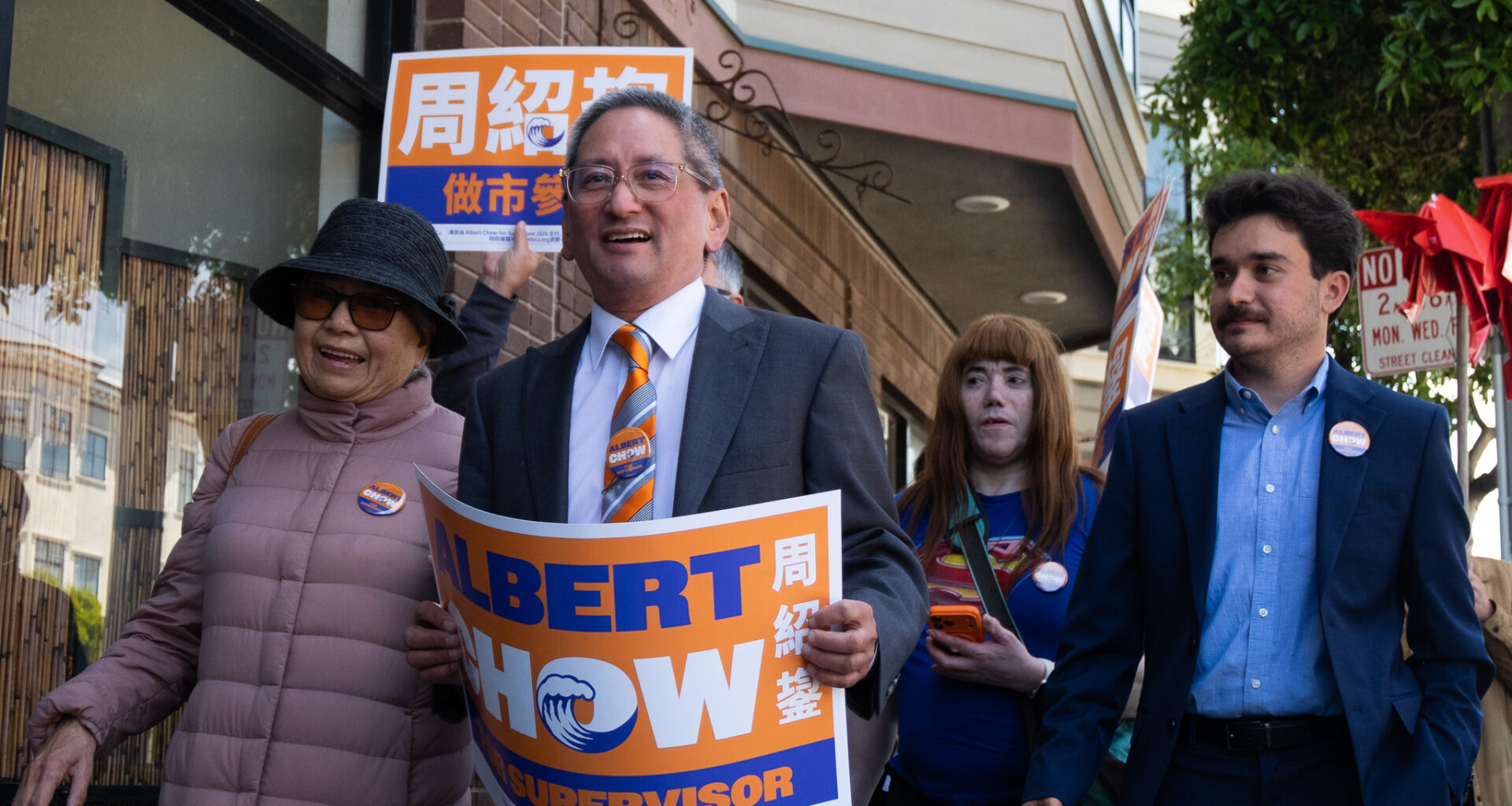
Mission Local has been following the District 4 candidates on the campaign trail. Read dispatches on Alan Wong, Natalie Gee, and David Lee.
The Sunset, in Albert Chow’s estimation, has become a red light district. And he wants to put a stop to it.
“Every other street, you see another red light,” said the candidate for District 4 supervisor at a recent rally, referring to the L-Taraval project. “Do we need these red lights?”
“No,” responded some 30 campaign volunteers.
“Do we need to get our left lanes taken away?” Chow said, referring to the change where drivers can’t turn left onto Taraval Street from the avenues.
“No,” the crowd responded.
“Do we need to have walk-along boarding islands and lose 140 spaces in parking?” said Chow, referring to the structures designed to help passengers get on and off the light rail more safely.
“No,” they said, louder this time.
It was the final stretch of Chow’s run for District 4 supervisor and the mood was buoyant. Great Wall Hardware, Chow’s business on Taraval Street and 28th Avenue, was nearly rebuilt after the fire that closed it in 2024. Exposed wire and plastic tarps were still around, but Chow said it would reopen in five to six weeks.
Meanwhile, announced Otto Pippenger, Chow’s campaign consultant, the campaign had identified some 9,000 voters who said they would cast their ballot for Chow.
Was this announcement a move to hype up volunteers in the room so that they sign up for more shifts on the last days before the June 2 election? Perhaps. But in a primary election where the expected voter turnout is about 25,000 in District 4, 9,000 votes are a lot.
“Mr, Chow here is in a very good place,” Pippenger said to Chow’s supporters.
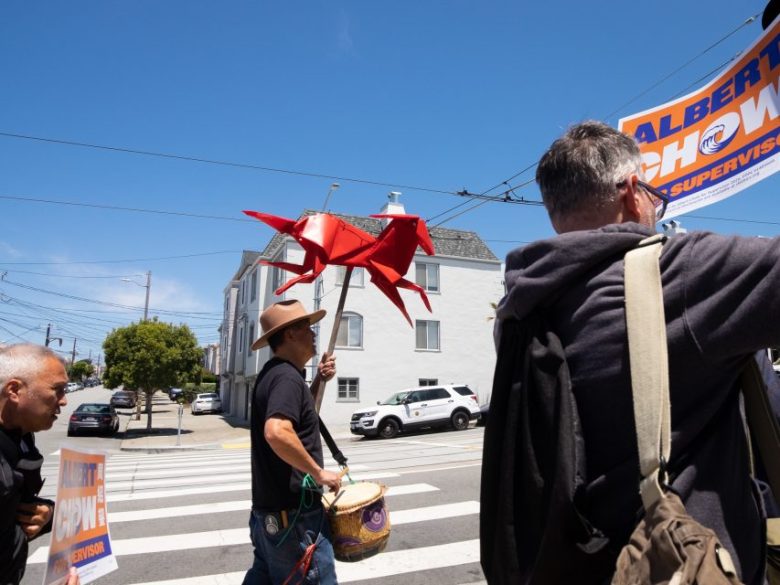 Chow’s supporters march to Parkside branch library on May 27, 2026. Photo by Junyao Yang.
Chow, president of the nonprofit People of Parkside Sunset, does not have government experience, which he considers a point of pride. “I am neither a progressive. I’m neither a moderate. I’m not a NIMBY, I’m not a YIMBY,” Chow said. “That’s going to drive City Hall crazy.”
“That means I’ll be a tie breaker. And guess what? All eyes will be on us,” he continued. “We will drive the conversation. We will drive the decisions. And for once, they will look at us as important.”
Supporters in the room — many of them familiar faces from the fight to recall Joel Engardio, District 4’s former supervisor — seemed to largely share Chow’s sentiment that the city of San Francisco, as a whole, has failed to respect Sunset residents.
“We’re the property owners. We pay our property taxes, but we get so little back,” Chow said.
“Yeah!” echoed the audience.
In half an hour, Chow’s supporters filed out of the door, formed a parade, and marched five blocks up Taraval Street to the Parkside library ballot dropbox, where they planned to turn in their ballots, en masse. “Albert Chow, he knows how! Albert Chow, vote him now!” they chanted, with Chinese drums beating in the background.
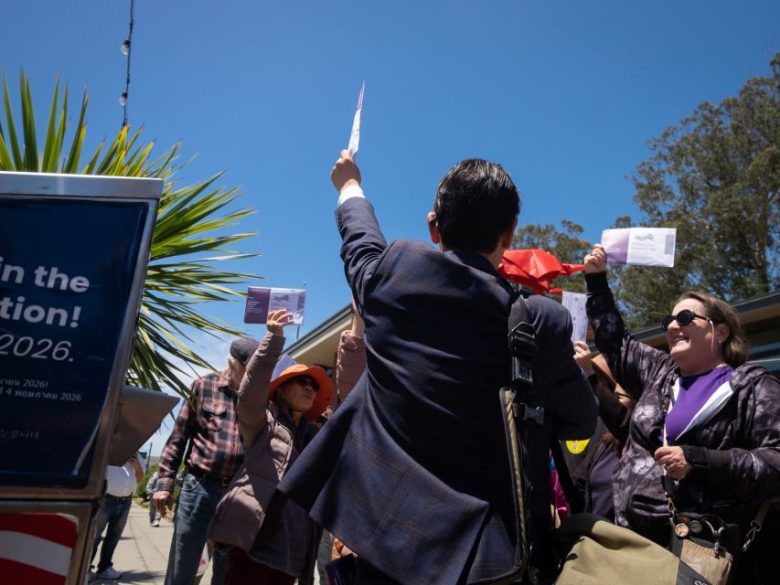 Albert Chow’s campaign consultant Otto Pippenger leads supporters to hold up their ballots before dropping them off in the ballot box outside of Parkside branch library on May 27, 2026. Photo by Junyao Yang.
At 3:15 p.m. on Wednesday, Chow, having shed the suit and orange tie that matched his campaign fliers, arrived at the intersection of 47th Avenue and Lincoln Way, just two blocks away from the Great Highway, to begin canvassing.
He parked his pickup truck and pulled out a dolly borrowed from his wife, who once used it to haul photography equipment for weddings. Now, it’s a handy tool to carry window signs, campaign flyers and a strawberry-flavor Gatorade.
As he walked down 47th Avenue, Chow pointed at a blue house. He had done work there some 15 years ago, as a general contractor. “I was crawling underneath the house, and there was so much rotten wood I couldn’t figure out what was holding the house up.”
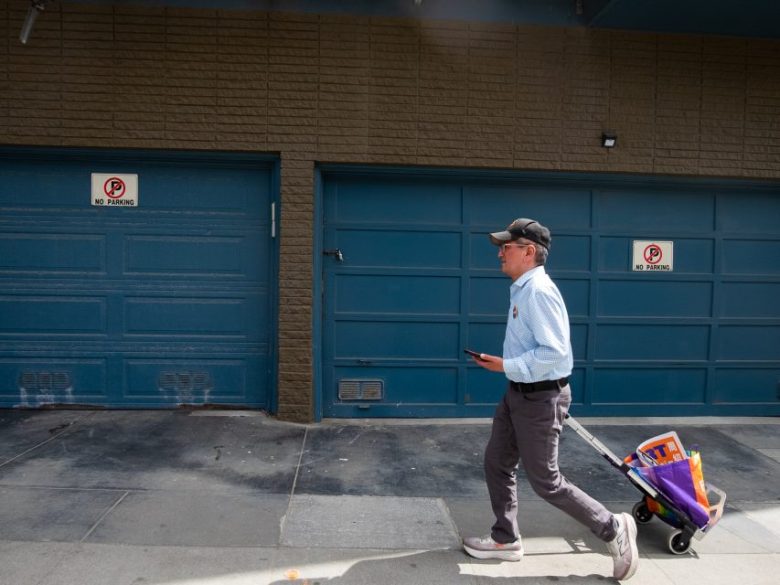 Albert Chow knocks on doors in the Outer Sunset on May 27, 2026. Photo by Junyao Yang.
Chow has been going door-to-door talking to Sunset residents about this campaign for months now, he said. At first, he would start his pitch by talking about himself and his policy priorities. But, he said, “99 percent” of the voters he talked to only had one thing on their mind: the Great Highway.
“That’s it,” Chow said. “Very few people ask about family zoning. Very few people would even ask about public safety. No, Great Highway.” So now, that’s what he opens with.
Chow’s position that the newly created Sunset Dunes park should be turned back into the Great Highway on workdays has been so unwavering and public, that he did not bother trying to get support from Sunset Dunes advocates.
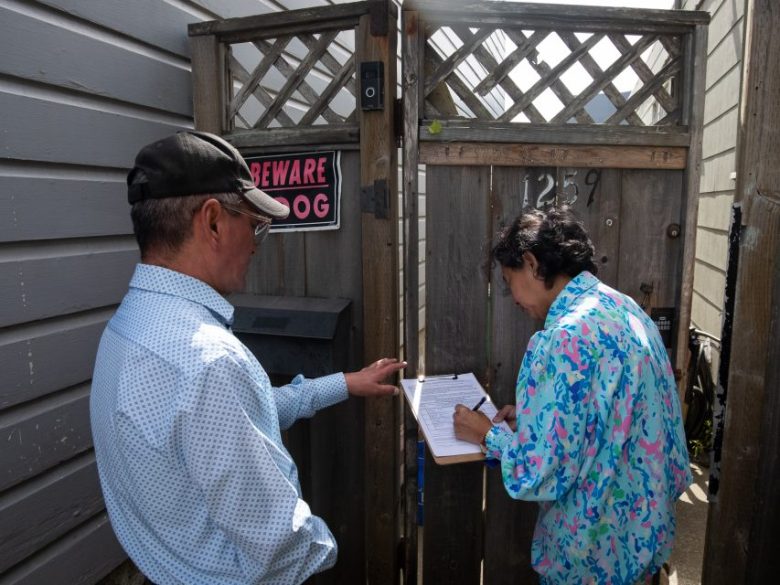 Albert Chow talks with a resident in the Outer Sunset and convinces her to sign the petition to reopen the Great Highway on weekdays. Photo by Junyao Yang.
As Chow continued down 47th Avenue, residents who answered their doors to talk to him showed a wider spectrum of thoughts on the issue.
One flat-out disagreed with Chow and closed the door on him. Another said that Chow’s platform was too weak — he wanted the Great Highway open to cars 24/7, instead of only on weekdays. Another resident, who described himself a “transplant” in tech, told Chow that while it was “lame” that Prop. K closed the road to cars even if most District 4 voters hated it, it was “a loss that we have to accept.”
Chow disagreed on the acceptance part.
Along with his campaign literature, he carried a clipboard with a petition for a November ballot measure to bring car traffic back on the Great Highway on workdays.
“Out of all the candidates, I’m the only one with a petition,” Chow told a woman in a floral shirt. “They want to close everything, and that’s not good for the families,” she said.
By the end of the conversation, she had agreed to vote for him, and signed the petition.
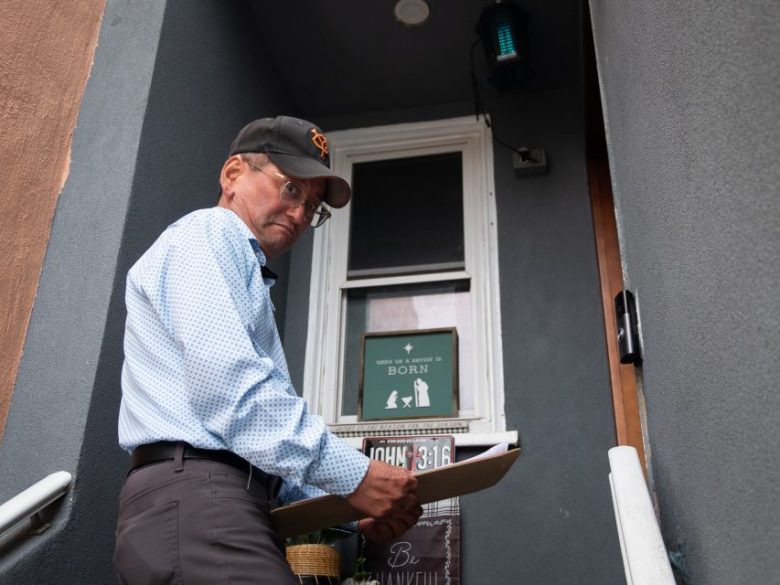 Albert Chow makes a silly face to the camera on May 27, 2026. Photo by Junyao Yang.
For a man running on a platform of grievances, Chow kept things light. If someone agreed to take a campaign sign, he handed it over with a joking order to “take this sign and you can make the world’s biggest paper airplane afterwards.” He marveled at the original curved glass windows at a voter’s home. “You know how they do that?” Chow said. “They make a wooden radius barrel and then take glass and let it just melt.”
On the sidewalk, Chow ran into a man named Anthony, carrying a blue-eyed baby in his arms. “She may be surfing Sunset beach one day,” said Anthony, and the two shared a laugh. They bonded over their Hawaii connections (Anthony man was from Hawaii, Chow has family there) and a city regulation that fines businesses that fail to paint over graffiti.
Anthony, who has lived in the Sunset for over 20 years, regards himself as a local. And Chow quickly introduced his own Sunset history: living in the Sunset for almost 50 years and being the president of the People of Parkside Sunset for nearly two decades.
“My big thing is I want to keep little places like the gem association around the corner open,” Anthony said, referring to the San Francisco Gem and Mineral Society’s nondescript storefront on Judah Street. “They got tagged recently and it wasn’t their fault.”
“That’s the stupidest law,” Chow responded with enthusiasm. His hardware storefront was also tagged a month ago, he continued, and Chow was frustrated when the Department of Public Works issued a graffiti notice. “That’s double victimization.”
Chow’s solution? An ordinance to require anyone caught doing graffiti to do “community service and clean stuff up,” he said.
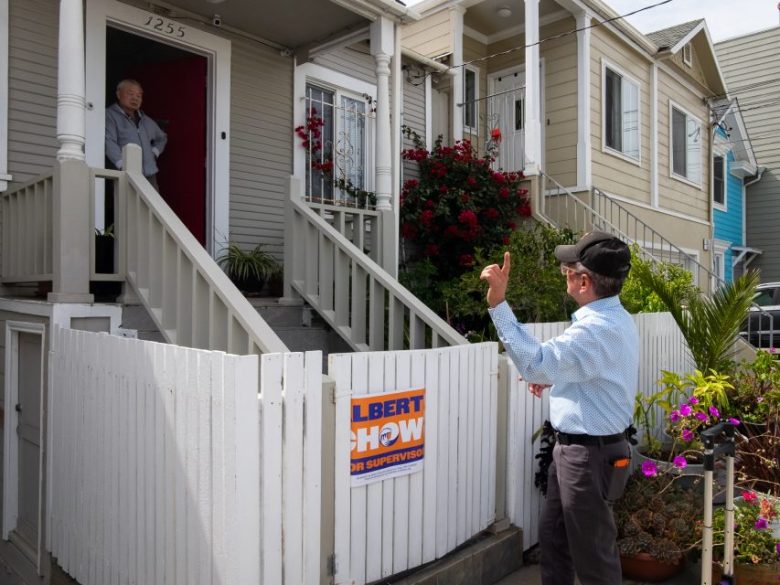 Albert Chow talks with a voter in Cantonese and convinces him to put a window sign on his gate. Photo by Junyao Yang.
After two hours, a little sunburnt around the neck, Chow stopped for the first time to drink some Gatorade before continuing to 46th Avenue.
Days before the June 2 election, does he think he has benefitted from the frontrunners spending resources attacking each other?
“Oh yeah! I have been keeping my message the same, and they are kind of tearing each other down,” Chow said. “I’m sitting in the middle and the missiles are flying over my head in both directions. It’s hurting both their reputations because they are screaming at each other.”