
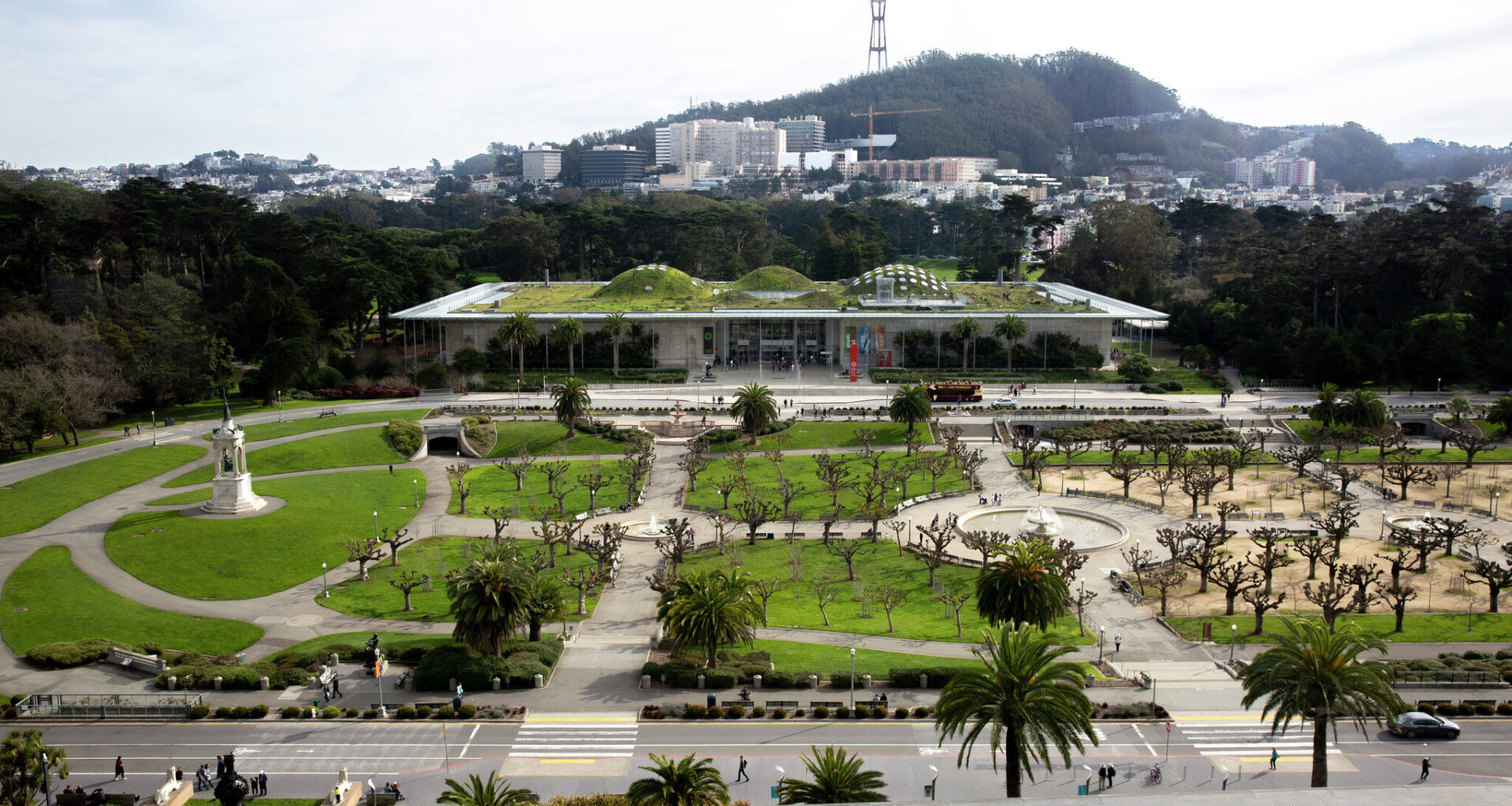
The California Academy of Sciences, pictured in 2019, is laying off 53 employees amid a financial crisis. It’s the third round of layoffs in five years under former Executive Director Scott Sampson, who abruptly resigned on May 14.
Santiago Mejia/S.F. Chronicle
If you’ve visited the Morisson Planetarium at the California Academy of Sciences, you’ve most likely seen a show I helped create. Maybe the award-winning “Big Astronomy,” which played across the U.S. and around the world from Japan to South Africa?
We filmed in Chile, giving our viewers a glimpse of parts of the universe they’ve never seen through the world’s most powerful telescopes.
I created computer graphics for the project to illustrate the science and bring it to life on the planetarium’s dome. It took months before something rewarding even began to take shape.
Article continues below this ad
Now, a catastrophic failure of leadership at the academy is threatening to turn the lights off on projects like these.
The academy’s leadership sees the Visualization Studio — our small team of eight artists, production staff and engineers that creates the planetarium shows — as a cost to be cut. In April, 53 employees, including my entire team, found out we were being laid off. Many of us were not even told by our managers. Instead, we found out from the Chronicle.
San Francisco Chronicle Logo
Make us a Preferred Source to get more of our news when you search.
Add Preferred Source
It’s the third round of layoffs in five years under Executive Director Scott Sampson, who abruptly resigned on May 14. With each wave of layoffs, the academy loses pieces of its soul: the minds and hands behind the museum’s attractions, from the aquarium to the planetarium.
Cutting the very things that make the academy unique will come at a steep cost to its reputation, mission, legacy and long-term viability. Sure, the existing shows that members and repeat guests have already seen can be replayed, but for how long?
Article continues below this ad
We suspect the academy’s leadership envisions replacing our team with AI-generated content. That would make a mockery of the institution’s mission.
During the nearly two decades our team has existed, we have honed our craft — not just the technical abilities to create images for the planetarium dome, but more importantly, our ability to use these skills to tell deeply examined stories about science. We routinely collaborate with researchers to access their data and results and turn them into visualizations that are meaningful to our audiences.
It’s gratifying to take something abstract and turn it into a beautiful visual that our guests can engage with. Science can be challenging; our goal is to help the public understand and spark interest in learning more.
Our work also has a life outside the dome, making appearances in exhibits, presentations and material available to educators. As a planetarium in a natural history-focused institution, we have been leaders in expanding the ability of our medium to speak about subjects beyond astronomy, helping people understand the world they see around them and their place in it.
Institutional knowledge like this is not a luxury item. It cannot just be turned off and then back on when convenient. When it is lost, that loss is deeply felt and enduring.
Article continues below this ad
This same theme is playing out across the academy: leadership gutting the teams needed to create and maintain exhibits that will draw people in and allocating ever more resources to a growing debt burden and astronomical refinancing fees caused by financial mismanagement and excessive executive pay and bonuses.
Sampson was paid nearly $885,000 last year, including a $157,500 bonus that is incomprehensible in light of the institution’s dire financial situation, and bigger than the annual salary of many of the positions he claimed the academy had to lay off.
In 2023, my colleagues and I formed a union, Cal Academy Workers United, precisely because we feared the institution’s leadership was steering us off course and undermining its very mission: to regenerate the natural world through science, learning and collaboration. Poor financial stewardship, misplaced priorities and mismanagement, having critically eroded trust between senior leadership and staff, are jeopardizing the very survival of the academy.
Sampson’s resignation came as my colleagues and I were circulating a petition calling for a vote of no confidence in him from the academy’s Board of Trustees. His exit presents an important opportunity for trustees to correct course and stop destroying the academy’s ability to tell stories about science in a voice uniquely its own. Rented content and AI will fail at creating the authentic human voice and unique experience our visitors expect.
Guest opinions in Open Forum and Insight are produced by writers with expertise, personal experience or original insights on a subject of interest to our readers. Their views do not necessarily reflect the opinion of The Chronicle editorial board, which is committed to providing a diversity of ideas to our readership.
Read more about our transparency and ethics policies
The institution now faces an existential choice about what kind of stories it wants to tell the world about itself. Will that story be one of forfeiting its standing as a world-class museum?
Article continues below this ad
My colleagues and I invite our new leadership to work together with us to tell a different story — one in which we navigate the current crisis together and share the burden of sacrifices in such a way that we can preserve what makes the academy special for the people who work here, for our visitors and for those around the world who look to us for inspiration and leadership.
Matt Blackwell is a senior digital artist on the Visualization Studio team at the California Academy of Sciences, where he has worked on original planetarium productions for 17 years.