
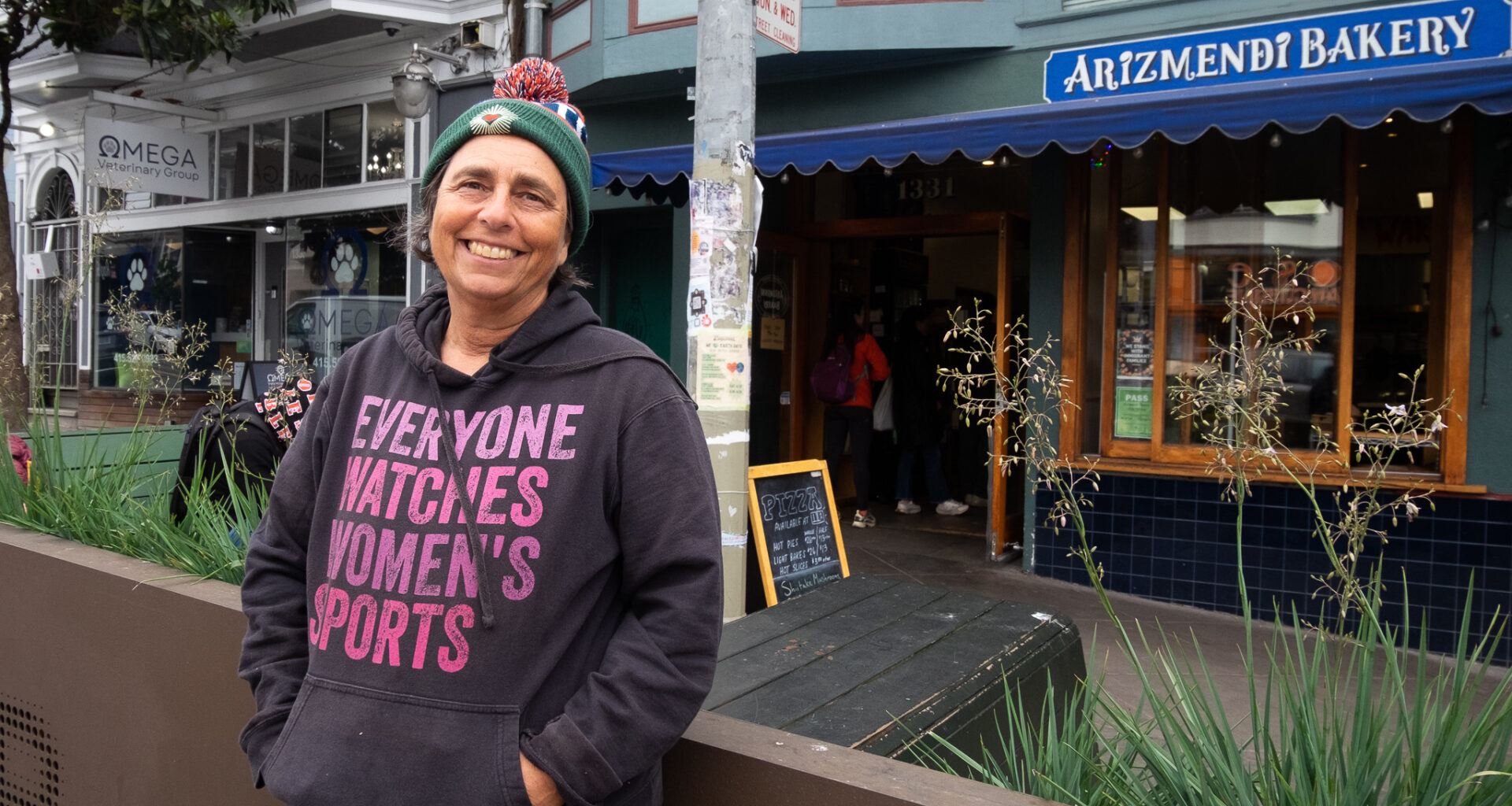
For the last few years, Martha Ehrenfeld, 60, has been living in the Inner Sunset on borrowed time: In 2021, her wife, Carla, announced that she wanted to move back to the east coast to be closer to family.
Ehrenfeld, the longtime president of the Inner Sunset Park Neighbors association, had just finished working on the renovation of the Goldman Tennis Center in Golden Gate Park. She wasn’t ready to go.
“Give me five years,” Ehrenfeld asked her.
She did. Now, in early June, Ehrenfeld is leaving for a small town in Maine.
A native New Yorker, Ehrenfeld moved to San Francisco in 2002.
“When I just moved here, I would go for a run in Golden Gate Park and see these giant, weird plants,” she said. “I’m like, ‘Wow, I’m not in New York anymore.’”
The city was urban, yet so close to nature, she remembered. In New York City, she said, “it costs a lot of money to get to nature.”
Soon after her arrival, a friend took her to Berkeley Bowl, the East Bay grocery store famous for its extensive produce section.
Berkeley Bowl was the opposite of the “kind of sad” supermarkets on the east coast. There were fresh fruits, mango salsa and an entire row of mushrooms! When her friends back home asked if she would ever move back, Ehrenfeld replied, “I can’t! There’s a giant bin of ripe avocados in the supermarket.”
When she first moved, the Inner Sunset had not yet become as popular as it is now, she said. Her “hipster friends” in the Mission would joke that they were “going out to the suburbs to meet you.”
“I wonder if I’d still have service,” teased another friend.
This failed to bother her. On days when the wind was blowing the right way, she could hear the foghorn on the Pacific Ocean.
Growing up in New York City in the ’80s, Ehrenfeld never had a chance to create a community on her block. This time, she vowed, “I’m going to get to know my neighbors. We are going to have big parties.”
“But I realized that unless you have a dog or children, there’s no easy entry,” she said. “I had to find other ways to get to know my neighbors.”
So when the Inner Sunset Park Neighbors association was looking to get the word out about a new farmers market in 2009, Ehrenfeld volunteered to give out flyers. By 2011, she became the association’s president.
Her Inner Sunset neighbors welcomed her. They told her with pride that theirs was one of the only few neighborhoods in the city that managed to get PG&E to put utility wires underground. That’s because enough neighbors got together and organized, they said, “You are benefitting from our hard work.”
Ehrenfeld is the type of person who radiates warmth. When we met on a recent Tuesday, I reached out to shake her hand, and she looked at me like I was being silly. “Oh come on, we are neighbors! Give me a hug,” she said with a wide smile.
As we walked down Ninth Avenue, she demonstrated the perfect amount of nosiness for a neighborhood association president.
Seeing doors open at Maggie & Mac’s, a new restaurant that is taking over the space of a brewery, Ehrenfeld walked straight in, sizing up the space and asking the construction workers when it will open.
Down the street, an artist was painting a mural on a utility box, and Ehrenfeld made sure she took pictures of the art and the artist from every angle to share later.
By the time Ehrenfeld joined, Inner Sunset Park Neighbors had already successfully started the Inner Sunset farmers market and organized community events like Inner Sunset Sundays, a monthly block party with vendors and music between Ninth and 10th avenues.
But the members had plenty of other projects that they were working on.
“When there’s an issue, it can get members excited,” Ehrenfeld said.
For example, when the botanical garden proposed charging an entrance fee, neighbors banded together and showed up at meetings.
“It’s the only place in the whole park I can let my baby crawl and not worry about dog shit,” Ehrenfeld remembered a neighbor saying.
In the end, the entrance fee was waived for city residents.
What always gets neighbors engaged is traffic planning, she added. Residents, transit riders, bikers, pedestrians and drivers all get involved.
In 2006, when the SFMTA considered removing a left-turn lane on Seventh Avenue to make way for a bike lane, people were resistant, Ehrenfeld said.
“A lot of people on Golden Gate Heights saw our neighborhood as a place to drive through,” she recalled. “They were very upset that their way of life was going to be impacted in some ways.”
The neighborhood may age out of its fixation on parking and driving, Ehrenfeld said. Today, pedestrian safety, traffic calming and bike infrastructure seem to be more popular with Inner Sunset residents.
As more young families moved to the neighborhood, she said, “they’re thinking, ‘When can I let my daughter go get ice cream at Hometown Creamery by herself?”
Ehrenfeld is a fan of walkability and transit for other reasons. For years, she said, she has felt that the Inner Sunset would be “a great place to age in place,” because of its walkability and proximity to public transportation.
“The retirement plan was, I was going to buy an apartment up there” — at this, Ehrenfeld pointed to Luke’s Local, the new grocery store on Ninth Avenue — “and turn it into co-housing with all my friends. “Then, whatever was down below would be our cafeteria.”
Now, she is moving with her wife to Damariscotta, a coastal town in Maine with a population of 3,000. The nearest big city, Boston, is a 3.5-hour train ride away.
Instead of walking to her corner store on 6th Avenue and Irving Street — KJ produce, run by two brothers who she lovingly calls “the Yemeni boys” — she has to get in the car and drive 15 minutes to go to the nearest town.
She is going to trade all of those for “the seasons and the apples and cider donuts, warm days, cold nights,” she said. “It’s gonna be different.”
This May we have a $50K match!
Mission Local has been growing its local coverage: We’re designating reporters to five neighborhoods — the Tenderloin, Richmond, Sunset, Bayview, and the Mission to provide free, first-rate neighborhood reporting.
Having reporters on-the-ground, asking questions is what makes Mission Local stand out — it’s our biggest strength, and we intend to bring that to every neighborhood we cover.
Our goal this May is to raise $125,000 — the price of adding a reporter to one neighborhood for one year. If you donate to our fundraiser today, your gift is doubled thanks to the match.