
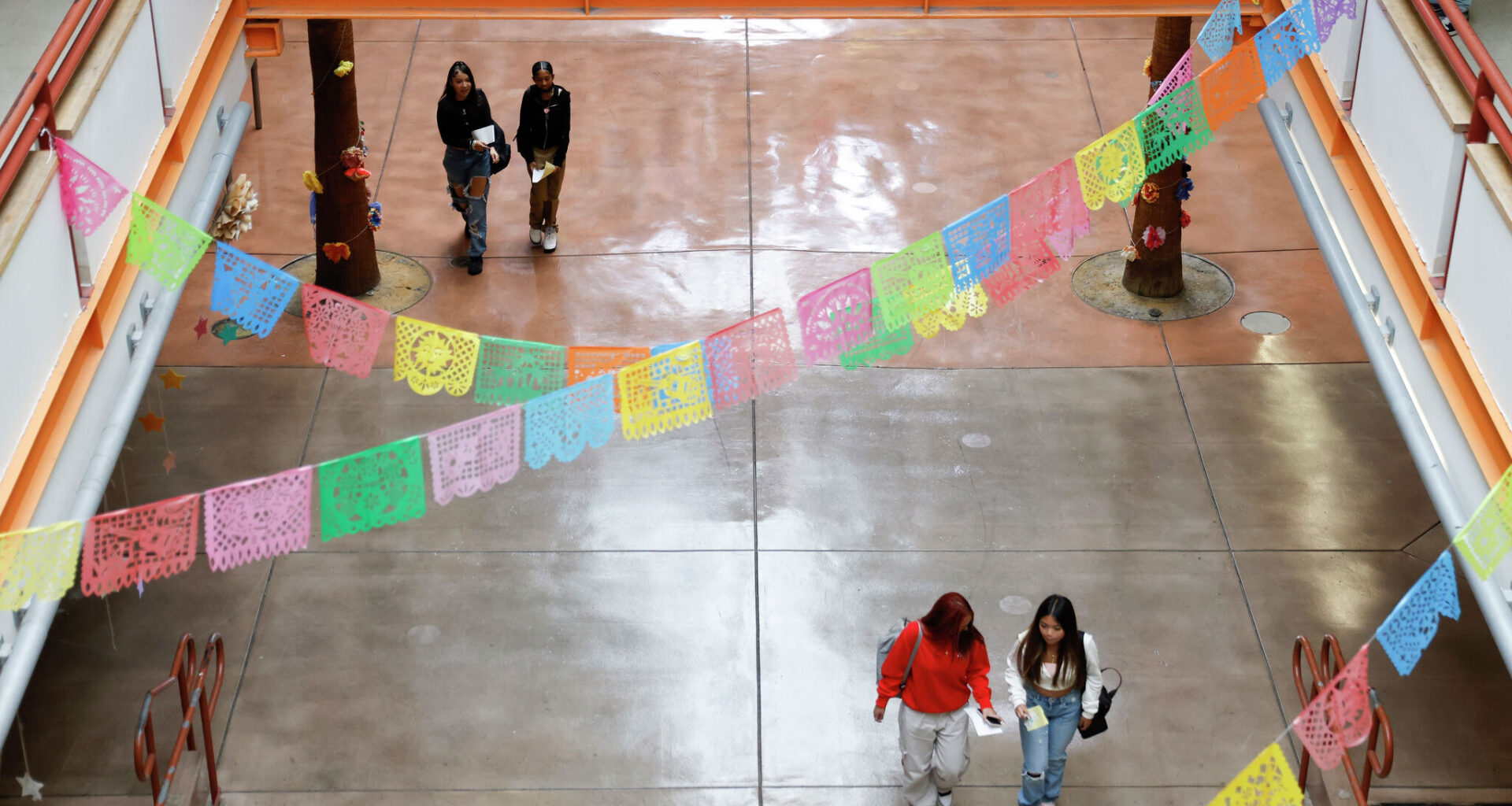
John O’Connell Technical High School in San Francisco was the site of a seminar on ethnic studies that has created a stir in the community.
Jessica Christian/S.F. Chronicle
An ethnic studies training session at San Francisco’s John O’Connell High School has drawn snide social media comments and significant controversy, with critics lambasting the session’s content, which promoted the idea of “adult supremacy” — or teachers acting as oppressors and students as the oppressed.
The training, sponsored by Teachers 4 Social Justice and titled “Ethnic Studies Everywhere,” was part of an April 26 conference, with topics focused on supporting educators across many subjects to incorporate the coursework into their subject areas despite the pushback seen locally and nationally.
One of the workshops, “Youth as Knowledge Producers: Challenging Adults Supremacy Through Ethnic Studies,” addressed so-called “adultism” — or the disrespect or perceived inferiority of young people who the adults believe should yield to the authority of their elders.
Article continues below this ad
“Due to systemic power dynamics inherently the relationship between students and educators is an oppressive one,” according to part of the training’s visual presentation circulating on social media.
“You can’t make this stuff up,” said a “3rd generation” San Franciscan on a social media thread about the training. “Now, teachers and parents are oppressors.”
San Francisco Chronicle Logo
Make us a Preferred Source to get more of our news when you search.
Add Preferred Source
Teachers 4 Social Justice did not immediately return requests for comment.
The uproar increases the target on San Francisco’s back as Superintendent Maria Su heads to Washington next week, summoned by a congressional committee to testify about the school district’s policies and practices, specifically those connected to the perceived “culture war” simmering across the country.
Article continues below this ad
She is expected to answer questions related to transgender issues, LGBTQ instruction, sexual health education and ethnic studies, which veers solidly into the Trump administration’s campaign against race-based instruction and diversity programs.
Confusion, however, surrounded the recent ethnic studies training in San Francisco, with some believing the district organized and paid for it. San Francisco Unified School District administrators confirmed that the district neither paid for the conference nor played any role in the content or promotion of it.
“Outside organizations can use and rent SFUSD facilities for events,” said district spokesperson Laura Dudnick. “People can choose to participate in non-SFUSD events outside of their contractual work time.”
The San Francisco teachers union promoted the one-day training through its newsletter. It’s unclear how many district or outside educators attended.
Ethnic studies has been a hot button issue in San Francisco and in districts across California in recent years, with communities divided on how to teach the class, with some pushing for a curriculum that focuses on ideology and student activism while others promoted a version centered on the appreciation of other cultures.
Article continues below this ad
A state law initially added a semester of the course to high school graduation requirements starting with the class of 2029, but a lack of appropriated funding delayed implementation.
San Francisco adopted a year-long ethnic studies requirement for graduation, starting with the class of 2028, with a new off-the-shelf curriculum in place this year, replacing a home-grown version that district officials said had evolved, with some parents complaining it had become more about political activism and “ideology over education.”
The issue remains controversial, with opposition to the course continuing in the community. The Friends of Lowell (High School) Foundation has filed a legal notice against the district over what they say is an “illegal and unvetted” curriculum as well as a “civil rights burden” imposed by the year-long course mandate.
In recent years, Bay Area schools have seen an increase in politically motivated instruction and the opinions of staff and educators publicly displayed. That has included student walkouts, bolstered by teachers and their unions, as well as posters and staff clothing reflecting beliefs, including candidates, government policies and the war in Gaza.
In San Francisco, district officials have said employees have the right to engage in political activity “on their own time, and at their own expense.”
Article continues below this ad
Su’s summons to the House of Representatives Committee on Education and the Workforce is likely to include a broad range of questions on the role of education in the lives of students.
In June 2025, she offered at least part of her thinking.
“Teaching should be about teaching students how to think,” she said. Not what to think.