
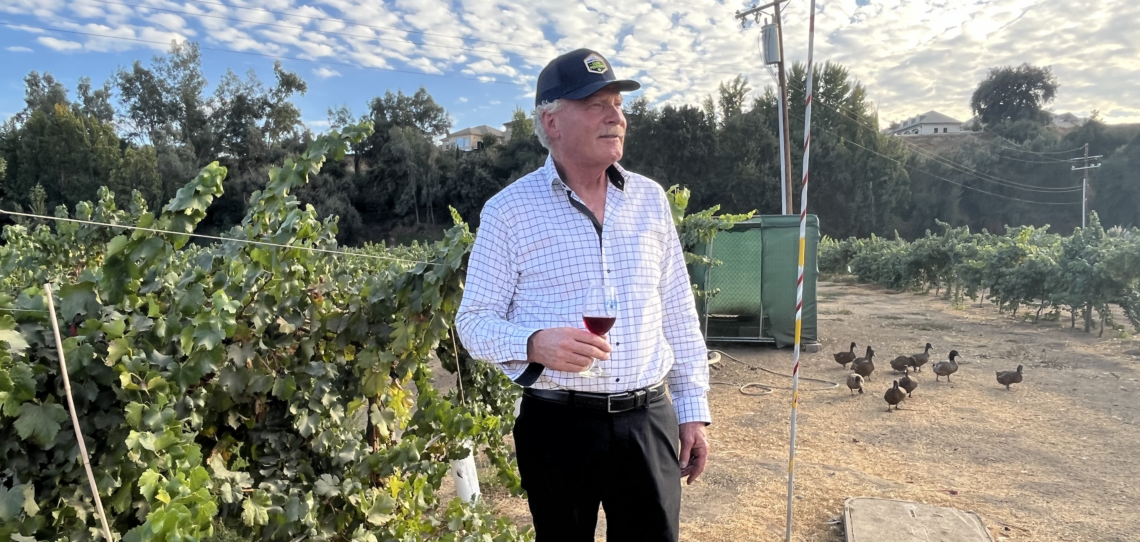

Dr. Kevin Lester, a semi-retired orthopedic-surgeon, launched Lesterland Winery in 2023, turning a hobby into a commercial venture. Photo by Frank Lopez
published on June 1, 2026 – 5:07 PM
Written by Frank Lopez
The U.S. wine industry is facing a familiar challenge: more money, less wine.
According to the 2026 BMO Wine Market Report, the total U.S. wine market value grew 3% to more than $115 billion in 2025. But that growth came alongside another consecutive year of declining volume. In 2024, wine volume fell 4% to 362 million 9-liter cases — roughly the same total as a decade ago, even as the number of U.S. wineries has grown by nearly 50%.
Over the past decade, the amount of wine entering the U.S. market from California has declined by nearly 25%.
A local view of a national problem
For Kevin Lester, the numbers reflect a reality he sees every day.
Lester, owner of Fresno-based Lesterland Winery, launched the business about three years ago, drawing on 40 years of winemaking experience and grapes grown on his own property. He said he has sold about four barrels of wine this year, but that has not been enough to keep pace with production, leaving a growing inventory backup in storage.
“Many wineries have been closing in the last few years,” Lester said.
Demand weakens across the board
The entire alcoholic beverage sector continues to face weakening demand, driven by layoffs, rising fuel prices, anti-alcohol messaging among younger consumers and broader economic and political uncertainty, according to the BMO report.
Lester said he has watched the pressures build from multiple directions. Higher-end wines continue to sell reasonably well, though often at lower prices, while lower-end wines have struggled significantly. Many vineyards have been removed from production in recent years as demand has weakened, he said. He believes further removals could reduce supply enough to stabilize the market within a year or two.
Younger drinkers looking elsewhere
Younger consumers are at the center of the industry’s challenges. Lester said that generation is drinking less wine than its predecessors, often opting for hard seltzers, CBD-infused beverages and spirits.
“Wineries are doing little alternative things like CBD and non-alcoholic wine,” Lester said. “I went to a wine bar recently and it was packed on a Saturday night. It may be that the local market is OK, but the California industry is way down.”
Nationally, the data reflects that shift. Sales of flavored wines grew 12% in 2025 to more than 35 million cases, while sparkling wine sales fell 3% to 31 million cases, according to the report. The BMO report also notes that disruptions from the COVID-19 pandemic have continued to affect the industry even as consumer spending on wine has increased overall.
Small wineries adapt
Small wineries are finding ways to adapt. Nearly 20% of wineries producing fewer than 5,000 cases annually are now active in the private-label segment, according to the report — a growing share pursuing alternative revenue.
Lesterland occupies a niche in that landscape, serving local farmers, friends and consumers seeking locally produced products. Lester’s wines are sold in local restaurants, including Veni Vidi Vici in Fresno, though he said sales have been slow — a restaurant he supplied with two cases about two months ago has yet to sell through them, despite active promotion.
Still betting on wine’s future
Despite the headwinds, Lester is not ready to write off the category.
“Wine has been around for thousands of years and has been a party favorite and wedding favorite. Our generation isn’t going to change that. It will come back,” Lester said.
He said consumers are showing increasing interest in wines from smaller wineries, and he remains optimistic about the spring and wedding season ahead, when wine sales typically climb.