
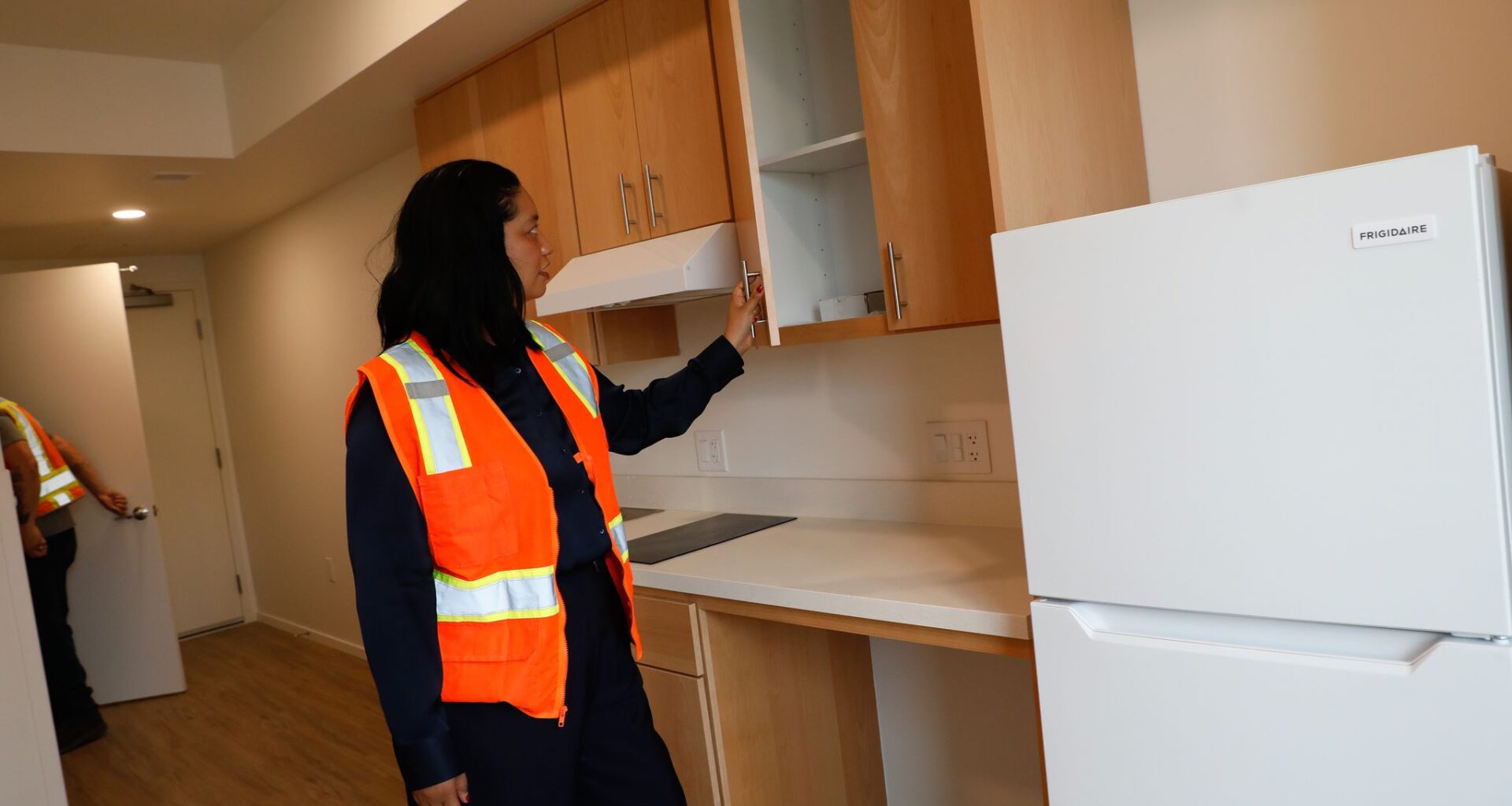
Tiffany Bohee, president Mercy Housing California, looks over a residential unit at a Mercy Housing affordable senior housing project at 1633 Valencia on Friday, November 7, 2025, in San Francisco.
Lea Suzuki/S.F. Chronicle
The first affordable housing development from a new nonprofit-private sector partnership is testing whether Bay Area developers can achieve what the industry has struggled to do for decades: build housing faster and for less money.
At 1633 Valencia St., on the edge of the Mission District and Bernal Heights, the numbers suggest they can.
The 145-unit project for formerly homeless seniors was completed in just 19 months at a cost of roughly $525,000 per apartment — about half the per-unit price tag often associated with new affordable housing developments in San Francisco. By the time city leaders joined developers for a ribbon-cutting ceremony Tuesday in front of the red-brick and blue-tiled facade, the building was already 95% leased.
Article continues below this ad
As traditional government funding for affordable housing grows scarcer and construction costs remain stubbornly high, the inaugural project from the Bay Area Housing Innovation Fund, backed by private developers and companies like Apple, offers a glimpse of what it takes to speed up and cut costs for income-restricted housing projects. Occupants of 1633 Valencia make less than 50% of the area median income and pay 30% of their income in rent.
The question now is whether those results can be repeated. Several similarly funded developments are moving through the pipeline, setting up new test cases for whether the San Francisco project’s combination of flexible private financing and construction innovation, including the use of prefabricated components, can be replicated at a scale large enough to meaningfully expand the region’s affordable housing supply.
San Francisco Chronicle Logo
Make us a Preferred Source to get more of our news when you search.
Add Preferred Source
Apple helped launch the Housing Innovation Fund in 2024, contributing to an initial $50 million investment along with partners like the Sobrato Organization, a Silicon Valley developer, and the San Francisco Housing Accelerator Fund, a nonprofit that provides flexible capital to projects using innovative construction and financing approaches. Late last year, the Housing Accelerator Fund committed another $50 million to the Housing Innovation Fund.
1633 Valencia was developed by nonprofit Mercy Housing California, with the Housing Accelerator Fund acting as a financing and development partner.
Article continues below this ad
Jimmy Valencia, superintendent Cahill Contractors uncovers a ceramic installation by David Baker Architects’ De Bakker Clay at a Mercy Housing affordable senior housing project at 1633 Valencia on Friday, November 7, 2025, in San Francisco.
Lea Suzuki/S.F. Chronicle
To date, the Housing Innovation Fund has stretched about $40 million across three projects in the Bay Area. In addition to 1633 Valencia and a 100% affordable, 195-unit transit-oriented development in San Jose, which broke ground last week, it has backed a 121-unit project in Santa Cruz that is slated to finish construction in August. Projects that qualify under the fund’s cost and time goals exceed its current capacity, said accelerator fund CEO Rebecca Foster. She expects its portfolio will grow to more than eight projects representing more than 1,000 new homes over the next year, with the average per-unit construction cost landing at about $625,000.
For Foster, 1633 Valencia is “proof that we can and must fundamentally change how affordable housing gets financed and delivered.”
With rents in high-cost markets like San Francisco experiencing double-digit increases over the past year, Foster said the region and its corporate stakeholders have arrived at an inflection point, and that housing financing tools such as the Innovation Fund stand to help the region grow more sustainably.
“With rent starting to skyrocket again,” said Foster, “it’s a really important moment for our base of amazing corporations that have benefited from this hotbed of innovation and the unique, diverse, vibrant community that we have here in San Francisco, to really roll up their sleeves and say, ‘Okay, how am I part of the solution to these affordability challenges?’”
Article continues below this ad
Mayor Daniel Lurie applauded the project team in a statement on Tuesday for transforming a plot of land that “used to sit largely unused” into a site where “people can age with dignity, build connections with their neighbors, and find the stability they need to thrive.”
Solar panels are seen installed on the roof at a affordable senior housing project at 1633 Valencia on Friday, November 7, 2025, in San Francisco.
Lea Suzuki/S.F. Chronicle
At 1633 Valencia, the strategy for addressing the complexities of affordable housing construction was to bring in David Baker Architects and contractor Cahill at the same time as one team, using a construction method known as design-build. That allows construction to begin on portions of the project sooner and helps to control costs.
Mercy Housing, Cahill and David Baker had joined forces previously at a nearby permanent supportive housing project known as the Tehanan, which they delivered in under three years at a cost of roughly $400,000 per unit. By reusing building plans that had already been designed, engineered, permitted and constructed, the team was able to lower costs and risk. Paired with the use of prefabricated components and upfront financing from the Innovation Fund, the team was able to meet the goals it set for the Valencia Street project.
Article continues below this ad
“We are constantly looking for ways to build smarter, faster, and with greater impact for residents,” said Tiffany Bohee, president of Mercy Housing. “1633 Valencia reflects what’s possible when trusted partners come together with a shared commitment to innovation and equity.”