
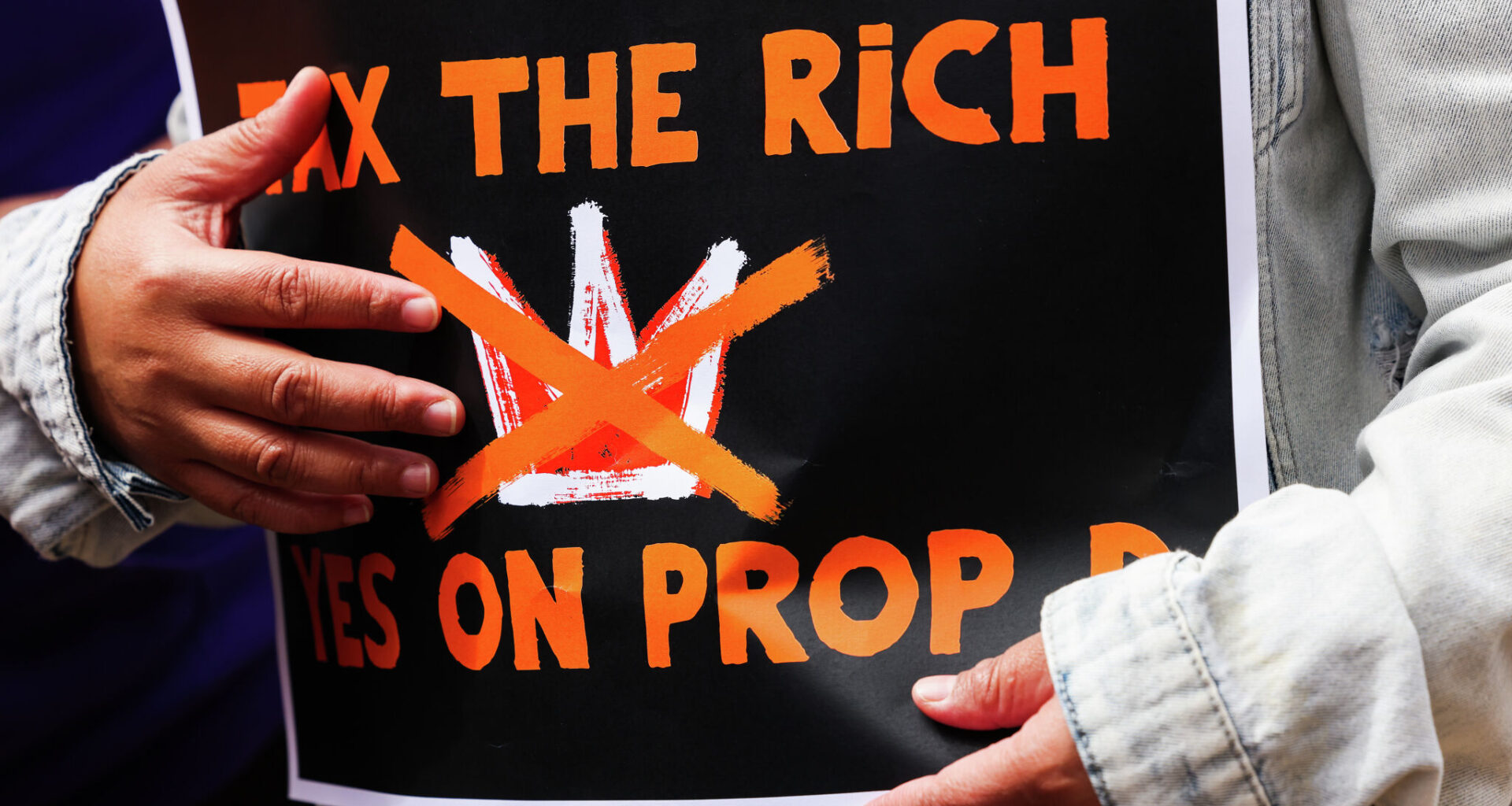
San Francisco public sector unions hold a rally and march to oppose the 127 layoffs being implemented by Mayor Daniel Lurie’s administration at San Francisco General Hospital in San Francisco on Wednesday, April 15, 2026. Lurie is trying to eliminate the city’s recurring budget deficits. Workers will also reiterate their support for Proposition D, the June ballot measure that would raise taxes on companies with highly paid CEOs.
Yalonda M. James/S.F. Chronicle
San Francisco Mayor Daniel Lurie speaks to members of the media following the resignation of District 4 Supervisor Beya Alcaraz, in San Francisco, Friday, Nov. 14, 2025.
Stephen Lam/S.F. Chronicle
A San Francisco ballot measure designed to boost funding for city services by hiking taxes on large companies with highly paid CEOs was trailing in early returns Tuesday despite a big push from local public-sector unions.
Proposition D, which its supporters called the Overpaid CEO Act, was behind with only 44.6% of the vote, though more ballots were left to count.
Article continues below this ad
The measure would increase a local tax on big businesses with top executives who make more than 100 times the median pay of their employees. Prop D would also change the way the tax is calculated so that it’s based on the compensation of all workers at the affected companies, not just those in San Francisco.
Scott Mann, a spokesperson for the Yes on D campaign, was optimistic on Tuesday night.
San Francisco Chronicle Logo
Make us a Preferred Source to get more of our news when you search.
Add Preferred Source
“Tonight’s early returns are no surprise as we expected early ballots in San Francisco to favor the opposition,” Mann said. “Thousands of votes are still to be counted, we are hopeful and this race is far from over.”
The measure was advanced by labor groups, which said it would provide San Francisco with a vital revenue source after the city’s long-running budget woes were exacerbated by funding cuts from the Trump Administration. An estimated $250 million to $300 million in annual revenue could be generated by the tax, providing an influx of cash at a time when San Francisco faces massive recurring budget deficits.
But critics, including the Chamber of Commerce, warned that Prop D could imperil San Francisco’s fragile economic recovery by prompting businesses to reduce their presence in the city or raise prices for consumers. A recent report from the city’s chief economist found that over the next 20 years, Prop D could leave San Francisco with 944 fewer jobs on average and reduce gross domestic product by $206 million.
Hoping to defeat Prop D, the chamber backed a competing measure, Proposition C, that would extend tax relief to more small businesses and accelerate a previously scheduled increase in the same “overpaid executive” tax that Prop D would raise. But Prop C failed after voters rejected it with 64% of the vote.
Article continues below this ad
If both Prop C and Prop D had gotten more than 50% support in the final tally, only the measure with the most votes will go into effect.
David Harrison, the chamber’s director of public policy, told the Chronicle on Tuesday night that regardless of the final outcome for Prop D, voters had already shown that there “is not a sweeping mandate for new business taxes in San Francisco.” He said the chamber was disappointed to see Prop C fail, but the main point of the campaign was to highlight “how dangerous Proposition D would be for the city’s recovery and future.”
“We’re pleased with the initial results, even if that means C isn’t where we would hope it would be,” Harrison said.
The dueling business tax measures set up a costly political battle between organized labor and big business, with unions campaigning aggressively to pass Prop D while wealthy tech leaders and large companies spent heavily to defeat the measure. Backers and opponents of both measures raised about $10 million before Election Day, making it among the most expensive ballot fights in recent San Francisco history.
Mayor Daniel Lurie tried to prevent Prop C and Prop D from reaching the ballot by urging business and labor to strike a compromise. When that effort failed, he came out against both measures, saying they were evidence of a “broken system” that favored political insiders over average residents. He subsequently proposed a November measure that would raise the threshold for many initiatives to qualify for the ballot via signature drive.
Article continues below this ad
Lurie was sharply critical of Prop D in a May 21 social media video in which he said the measure threatened the city’s economic recovery from the pandemic. He expressed concern about job losses, citing the recent city economist report, and potential business departures that he said could lead to a “a bigger deficit and cuts to services” in the long run.
Lurie also threw cold water on Prop C, which he dismissed as “a poison pill” solely intended to invalidate Prop D.
“This kind of dueling ballot fight is just designed to confuse voters, and it’s San Franciscans who pay the price,” Lurie said.
He wasn’t the only prominent public figure to enter the debate over Prop C and Prop D. Sen. Bernie Sanders, I-Vt., endorsed Prop D, as did Speaker Emerita Nancy Pelosi, several gubernatorial candidates and a supermajority of the Board of Supervisors.
On the other side, a committee opposing Prop D and supporting Prop C received major contributions from the moderate political group Neighbors for a Better San Francisco Advocacy, venture capitalist Michael Moritz, Google co-founder Sergey Brin and crypto billionaire Chris Larsen, among others.
Article continues below this ad
Brin’s $500,000 donation to the anti-Prop D committee in May prompted congressional candidate Saikat Chakrabarti, a wealthy former tech engineer, to offset the money with his own half-a-million-dollar contribution in support of Prop D. He told the Chronicle at the time that he was trying to “fight back” against “tech oligarchs” seeking to “hoard more wealth and rig the system in their favor.”
Sarah Ravani contributed reporting.