
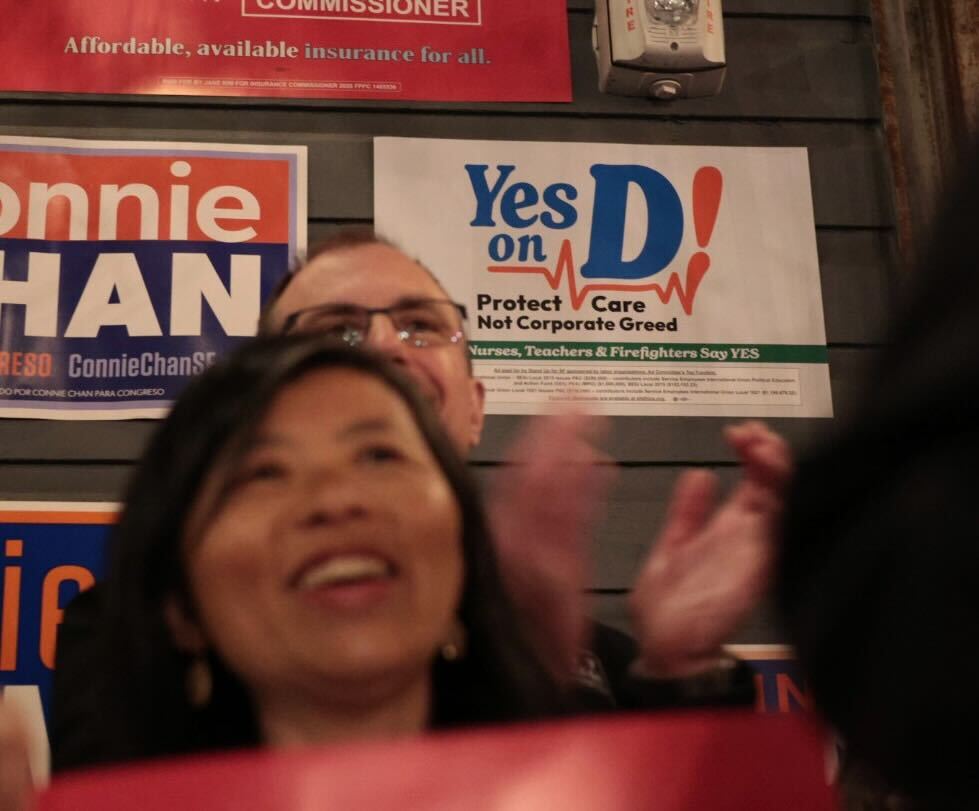
San Francisco’s Proposition D, dubbed the “Overpaid CEO Tax,” is still hanging on to a sliver of a chance of passing as of early Wednesday morning, after initial results.
But things were not looking great: The measure, which would increase business taxes on firms whose top executive makes 100 times more than their median employee, was losing 45-55 as of 11:45 p.m. Tuesday, the night’s final results drop.
It needs to get over 50 percent of the vote to win. Over 12,000 votes separate the yeses and the nos.
Labor unions who backed the measure kept the faith Tuesday evening as the yes votes crept up from about 43 percent to 44 percent. Still, the remaining votes would need to split heavily in favor of Prop. D for it to pass — a tall order.
Prop. D was meant to raise revenue for the city, which is facing a two-year deficit of over $600 million. To balance the budget, Mayor Daniel Lurie has laid off 127 city workers and is proposing cuts to nine more filled positions and hundreds of vacant ones. City-funded programs, including several health clinics, are also on the chopping block.
Unions hoped that Prop. D funds, predicted to be $300 million per year, would help stave off cuts to vital city services. At least $3.3 million went into the Yes on D campaign, most of which came from unions SEIU 1021, SEIU 2015 and IFPTE 21, who count large numbers of city employees in their ranks.
Focused on tiding the budget over, the measure brought labor unions, progressives, and even some city moderates together.
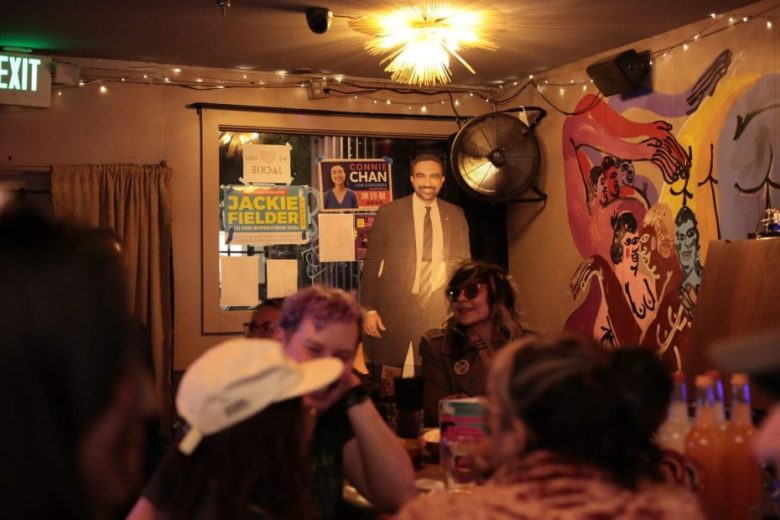 A cardboard cutout of New York City Mayor Zohran Mandami watches over the Progressive Unity election party at El Rio on June 2, 2026. Photo by Abigail Vân Neely.
“We don’t have Zohran, but we have Prop. D,” said Marisela Mares, the lead organizer of the San Francisco Rising Fund, at an election night party for various progressive groups at El Rio in the Mission.
A cardboard cutout of New York City’s Mayor Zohran Mandami watched over the crowd from behind the bar. “Adore him down,” Mares said.
Mares focused on getting “mujeres trabajadoras” out to vote for the measure she believes will promote affordability, Mandami’s battle cry.
Two miles away at a Prop. D party in the Castro, both current District 5 Supervisor Bilal Mahmood and his former competitor Dean Preston came out in support of the measure.
Prop. D’s proponents, Mahmood said, “were the only ones who presented a holistic solution to close the city’s deficit.”
“A tax is not the reason why a grocery store or a pharmacy decides to leave the city,” Mahmood added. “They go when customers can’t afford their products.”
Connie Chan, who had the most to celebrate Tuesday night after pulling ahead in the No. 2 spot for the November congressional run-off, was spotted at the Prop. D party instead of her own when the first ballot results dropped.
The better news for labor groups was the apparent death of the rival measure Proposition C, which was placed on the ballot by the San Francisco Chamber of Commerce: Only 35 percent of initial ballots favored C, which would also need over 50 percent to pass.
Prop. C would have mostly kept the current tax system intact, but raised the revenue threshold for having to pay the tax from $5 million to $7.5 million. It also contained a “poison pill” to eliminate Prop. D if it received more votes, but that appears unlikely.
Lurie — sitting at a 74 percent approval rating — became the face against Prop. D and graced its critics’ mailers. Opponents put $6.6 million into the Yes on C, No on D campaigns.
Much of that money came from perennial donors to pro-business politics — billionaires Chris Larsen, Michael Moritz and political pressure group Neighbors for a Better San Francisco — while others came from firms who would have to pay up under the new structure, including Gap, Comcast, DoorDash and Safeway.
Dozens celebrated Prop D. lagging behind its target in early results at a Hayes Valley party hosted by the political group GrowSF and briefly attended by Lurie.
“Our evil propaganda worked!” laughed George Correa, who works at an AI company he declined to name. He was one of many tech professionals in the crowd. A GrowSF staffer reminded them that younger, more progressive votes, typically cast later, could change the tide.
The city’s business community said the measure risked the city’s post-pandemic recovery.
Much of the anti-D ad campaign focused on telling voters their local grocery store would shut if the tax passed.
At a press conference on Monday, Lurie insisted that the passage of Prop. D would not change anything for his office this budget cycle because the tax wouldn’t go into effect until 2028: “We’re going to be a city that spends what it has,” he said, and not bank on “future potential ballot measures.”
As of early Wednesday morning, that potential is greatly diminished.
Oscar Palma and Sarah Hopkins contributed reporting.