
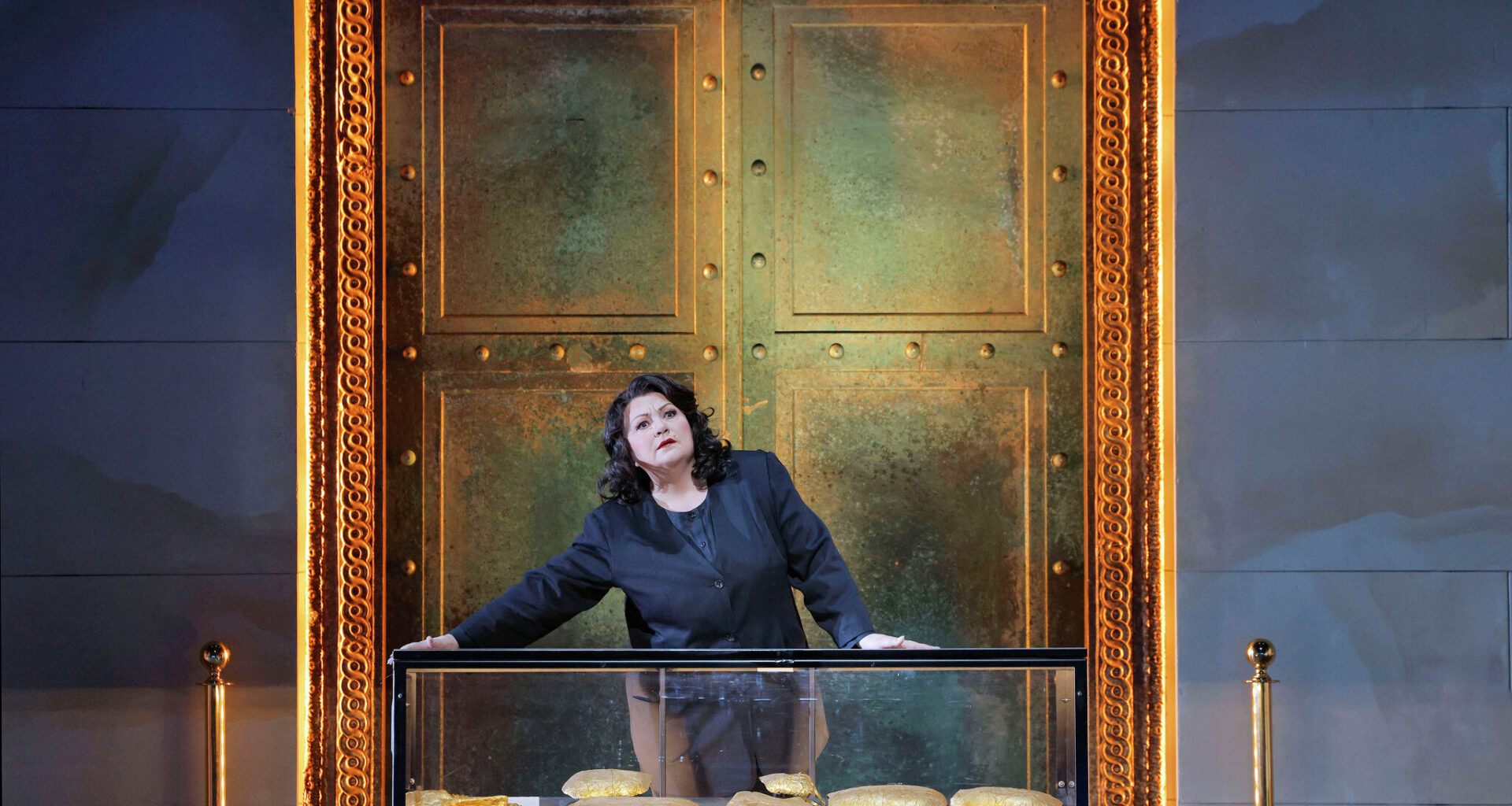
S.F. Opera will revive Keith Warner’s staging of Strauss’ “Elektra” from June 7-27.
Cory Weaver/San Francisco Opera
Russian soprano Elena Pankratova has sung “Elektra” in some of Europe’s leading opera houses, from Vienna and Amsterdam to Dresden, Lyon and Naples.
Now, she brings the demanding title role to San Francisco Opera for the first time.
“Elektra”: San Francisco Opera. 2 p.m. Sunday, June. 7. Through June 27. $35-$434. War Memorial Opera House, 301 Van Ness Ave., S.F. www.sfopera.com
When Pankratova makes her company debut in “Elektra” on Sunday, June 7, she will embody the vengeful heroine in her 17th production of Richard Strauss’ 1909 one-act opera, a relentless masterpiece of love, betrayal and murder.
Article continues below this ad
“All of (my Elektra’s) were very different. Some of them were intelligent and some of them were stupid,” Pankratova told the Chronicle with a boisterous laugh. “But it’s an absolutely special experience.”
Running through June 27 at the War Memorial Opera House, Pankratova will sing under Music Director Eun Sun Kim’s baton in Keith Warner’s updated staging.
Elena Pankratova sings Elektra during a rehearsal for S.F. Opera’s 2026 production of Strauss’ “Elektra.”
Cory Weaver/San Francisco Opera
The opera centers on Elektra’s quest to avenge her father, King Agamemnon, who is murdered by her mother, Queen Klytämnestra, and her stepfather. In Warner’s unyielding 100-minute version of the bloody tale, Elektra becomes trapped in a museum overnight suggesting that the story’s crimes and conspiracies are products of her imagination rather than historical fact.
San Francisco Chronicle Logo
Make us a Preferred Source to get more of our news when you search.
Add Preferred Source
“This is a special situation. It’s well-thought through and, in a sense, it’s all about (Elektra),” Pankratova said. “I never expected to perform something like this.”
Article continues below this ad
First seen in San Francisco in 2017 under the direction of Anja Kühnhold, the production proved so popular that many attendees returned for multiple performances. Returning to the company nearly a decade later, Kühnhold said working with Pankratova this spring has been a “special and intense experience.”
“Through the staging sessions, we discovered many new facets of the character,” Kühnhold said of Elektra. “The interplay between the very subtle musical interpretation, where every note and phrase permeates the stage action, is a crucial element of this production, and it’s wonderful to see the meticulousness and passion with which Elena brings herself to this role.”
For Matthew Shilvock, the Opera’s general director, Pankratova’s impact has been equally striking..
“Hearing the clarity and intensity of her sound soaring over the massive orchestral forces is exhilarating,” he said.
A scene from Strauss’ “Elektra”
during a rehearsal at War Memorial Opera House with (l-r) Sadie Cheslak, Laura Krumm, Mary Hoskins, Caroline Corrales, Gabrielle Beteag and Alexandra Loutsion.
Cory Weaver/San Francisco Opera
That feat is no small accomplishment. Elektra is one of the more demanding roles in the soprano repertory, requiring a voice powerful enough to soar above nearly 100 musicians in the pit orchestra — the largest of any operatic work — while sustaining the character’s emotional intensity for most of the opera’s runtime.
Article continues below this ad
“This is one of the most taxing roles in the repertoire, not just in its vocal demands but the dramatic intensity required to portray a young woman grappling with deep psychological trauma,” Shilvock said. “It’s amazing to see someone with Elena’s experience take this on.”
Pankratova estimates that Elektra is onstage for 90 minutes, and said that maintaining the character’s presence and intensity during the extended span is among the opera’s greatest challenges.
“It’s not easy. Even if (the character’s) mother or sister are singing, you stay involved because you’re reacting to every word,” Pankratova noted. “Even if you sit with your back to the public, your back would be engaged. You can’t really switch off.”
Pankratova’s commitment to the role is hardly surprising given the path that brought her to it.
Born in 1970 in Yekaterinburg, Russia, she studied piano and conducting before switching to voice. After graduating as an opera and concert singer from the St. Petersburg Conservatory, she studied with the renowned Renata Scotto, among others.
Article continues below this ad
After her 2010 international breakthrough singing Die Färberin in Strauss’ “Die Frau ohne Schatten” at the Maggio Musicale Fiorentino, she reprised the role at La Scala in Milan (2012) and Teatro Colón in Buenos Aires (2013).
Elena Pankratova as Barak’s Wife, Michaela Schuster as Nurse and Emily Magee as Empress with an artist of the company in the Royal Opera’s production of Richard Strauss’s “Die Frau Ohne Schatten, ” directed by Claus Guth and conducted by Semyon Bychkov, at the Royal Opera House Covent Garden in London in March 2014.
Robbie Jack/Corbis via Getty Images
These performances were followed by debuts at the Bavarian State Opera in Munich and Covent Garden in London, with her outstanding interpretations earning her the “Casta Diva” opera prize as 2018’s best singer of the year.
In 2024, she made her house debut at New York’s Metropolitan Opera in Puccini’s “Turandot.” Of that performance as the title character, the New York Times’ Oussama Zahr described the soprano as an “uncommonly sensitive Turandot who turned the cliché of the icy princess on its head.”
The soprano insists she never dreamt of performing the roles she now sings regularly before finding international success.
Article continues below this ad
“I never felt studying voice in conservatory I would sing these kinds of roles,” she said, naming Altrud in Wagner’s “Lohengrin” and Isolde in Wagner’s “Tristan und Isolde,” in addition to Turandot. “If you are able to develop yourself, the roles will find you. You can’t choose them.”
Elena Pankratova sings Elektra during a rehearsal for S.F. Opera’s 2026 production of Strauss’ “Elektra.”
Cory Weaver/San Francisco Opera
When Pankratova sang Turandot in Florence in 2010, the artistic director of Fondazione Teatro Petruzzelli in Bari, Italy, happened to be in the audience. She recalled, “The next day, my agent called and said they wanted to give me the role of Elektra in two years.”
But because Pankratova believed “only goddesses sing that,” she suggested portraying the role of Elektra’s sister, Chrysothemis, instead. She reasoned she would be more ready to tackle Elektra in the distant future.
A year later, however, a contract had yet to arrive.
Then, Teatro Petruzzelli requested once again that Pankratova sing Elektra.
As the soprano tells it, she was perusing the score when, “The notes started talking to me. The phrases were so comfortable and logical … I was the right age and had enough experience singing big roles — Turandot, Sieglinde.
“I heard again the recordings of Birgit Nilsson and decided to say, ‘OK, I’ll do this,’ (and) it really became my role.”
Since then, Pankratova continues to embrace new roles with dramatic power, stamina and flexibility. She is looking forward to her first Brünnhilde in a production of Wagner’s “Die Walküre” scheduled for November in Buenos Aires.
In 2027, Pankratova will sing her 50th performance of Elektra at the Vienna Staatsoper.
“Where people are married for 50 years, they call it a golden menu,” Pankratova said. “My husband was joking and said, ‘When you sing your 50th Elektra, they should give you the golden axe!’”
Victoria Looseleaf is a freelance writer. This story has been provided in partnership with San Francisco Classical Voice.