
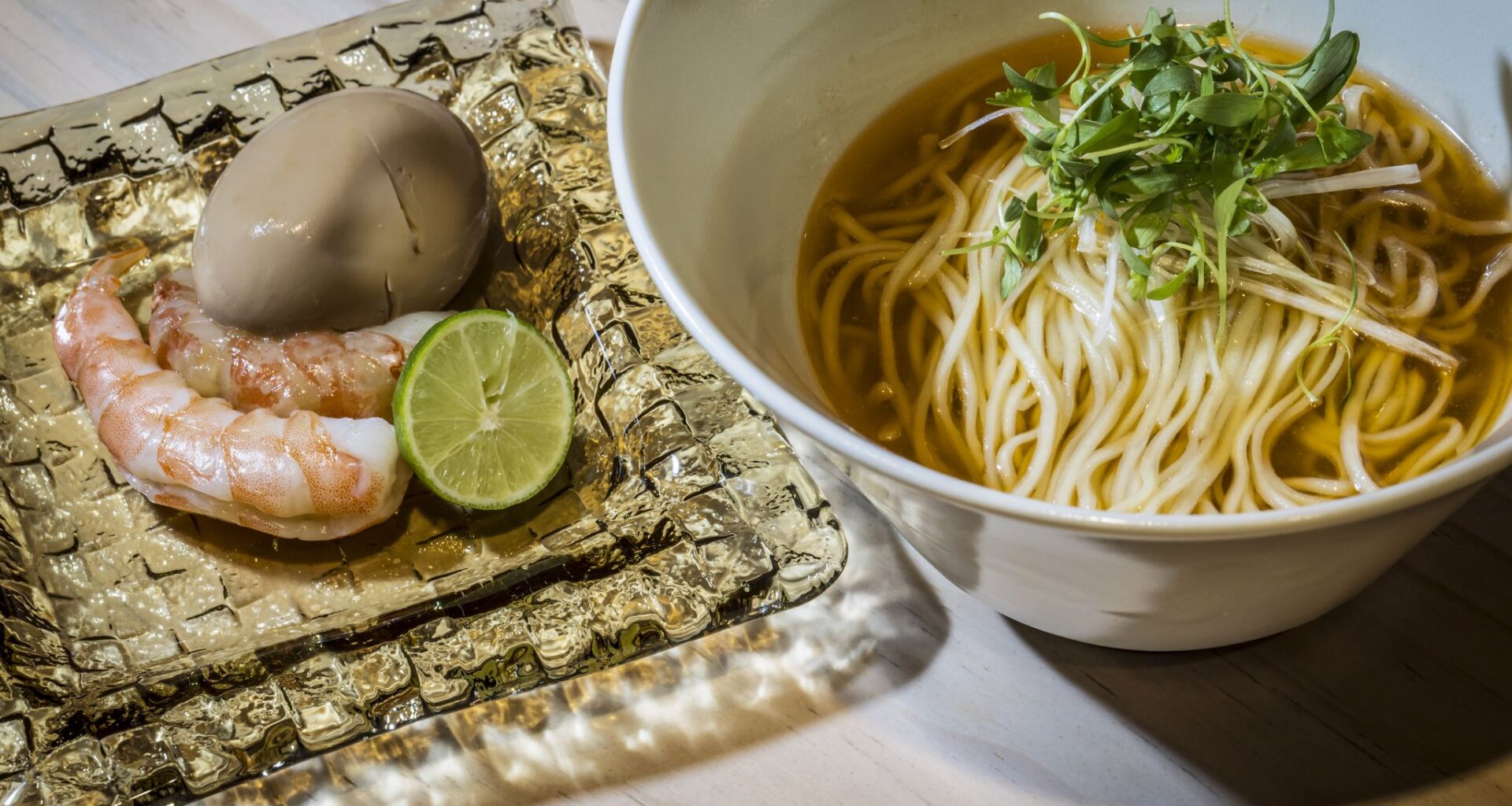
Ebi shio ramen served during a tasting-menu dinner at Noodle in a Haystack in San Francisco in 2022. The restaurant has closed.
Carlos Avila Gonzalez/The Chronicle
For the past four years, husband-and-wife team Clint and Yoko Tan have served an elaborate ramen tasting menu at their 12-seat counter, Noodle in a Haystack, a handful of nights a week. In that time, they estimate they’ve served about 4,000 diners. In a city filled with competitive reservations, it was one of the most elusive, with a monthly drop that was often snapped up in seconds.
At least 10,000 hopeful customers never made it off the waiting list before Noodle in a Haystack quietly closed last month.
Why close a restaurant named by both the New York Times and Bon Appetit as one of the best in the country just a year after it opened — and clearly with no shortage of eager customers? The Tans felt stuck. “It felt like we’ve been running in place the last few years. The crazy thing is, we’re booked as can be. We can’t do any more. And there’s nowhere to go with it,” Clint said.
Article continues below this ad
The couple spent nearly every waking moment at the restaurant and had steadily increased the prices to keep up with rising costs — the final menu, including a drink pairing, came out to $306 per person — yet were unable to hire full-time staff or buy equipment. As the toll on their health mounted, they saw no way to feasibly continue the Richmond District restaurant they had built from an underground popup out of their home in Daly City.
“No matter how many people want to come, no matter how much you charge, no matter how successful, no matter the accolades,” Clint said, “you can’t really catch up to those things.”
San Francisco Chronicle Logo
Make us a Preferred Source to get more of our news when you search.
Add Preferred Source
So the Tans are leaving the world of tasting menus and reservation drops behind. Their next project is a fast-casual restaurant called Mazé, which will open later this year or early next at Thrive City, the food-packed complex next to the Chase Center. Mazé will specialize in mazemen, a brothless style of ramen that’s relatively uncommon in the Bay Area. As a much larger restaurant connected to a professional sports arena in the fast-growing Mission Bay neighborhood, the Tans hope Mazé will be more sustainable than Noodle in a Haystack — and will mean more people can eat their food.
“If we kept along this path, doing a 12-seat restaurant, there’s only one way to go,” Clint said. “We didn’t want to go down that route. We wanted to get to what our mission originally was when we left our living room.”
Article continues below this ad
Clint and Yoko Tan preparing one of the courses at their first, impossible-to-book restaurant, Noodle in a Haystack.
Carlos Avila Gonzalez/The Chronicle
Neither of the Tans are professionally trained chefs. Clint, a San Francisco native who grew obsessed with ramen while traveling to Japan, and Yoko, a native of Japan, felt that finding exceptional ramen in the Bay Area was like looking for a noodle in a haystack (hence the name), and wanted to change that. They started out hosting sold-out popups in their living room in 2015, cycling through different ramen variations that required dozens of ingredients and countless hours to make: mapo tofu ramen, duck shoyu, tsukemen with oxtail, and a yuzu shio that got them into the finals of the World Ramen Grand Prix in 2017.
By 2022, after lengthy permitting delays, they graduated to the 12-seat restaurant on Geary Boulevard, serving a $125 tasting menu of dishes that pulled from different elements of ramen, culminating in a final course of an actual bowl of ramen. Former Chronicle restaurant critic Soleil Ho complimented the Tans’ “superior, even geeky, technique,” which “add (ed) up to a quality of ramen you won’t find anywhere outside of Japan. It will likely be the best ramen you’ve ever had.”
What made Noodle in a Haystack special — just two people preparing every dish for a dozen people a handful of nights a week — also made it unsustainable, in part because they did everything else too. They cleaned the toilets. They washed and dried their single set of dishes in a mad rush between seatings. Their young son sometimes slept at the restaurant. The couple woke up every day with sciatica or neck pain. The stress landed Yoko in the emergency room, twice. They began fantasizing about shutting down the restaurant and moving to Japan.
The Tans also charged more and more money over time to stay pace with increasing costs and to pay down the investment that initially funded the restaurant, most of it raised through a Kickstarter campaign.
Article continues below this ad
Clint Tan seared A5 Miyazaki strip loin for a dish at Noodle in a Haystack.
Carlos Avila Gonzalez/The Chronicle
The opportunity at Thrive City came about serendipitously. The Tans had often walked by the empty corner space with high ceilings, formerly wine bar GluGlu, on their way to Golden State Warriors games, Clint said, and dreamed of opening a restaurant there. “When you think about a ramen shop, the way that economics work, you need churn,” Clint said. “You need foot traffic. Thrive and that area, Mission Bay, I can’t think of a place that has more of that.”
Mazé, a 2,600-square-foot space, has seating for about 30 seats inside and 30 more on an outdoor patio. The menu is designed for a high-volume restaurant, with brothless mazemen especially suited to takeout and delivery.
Mazemen, which means “mixed noodles,” is a concentrated, “dry” style of ramen; few shops in the Bay Area are dedicated to it. “You can enjoy the noodles more,” Clint said. “They have more texture. The flavors are more intense.”
The Tans plan to serve several bowls of mazemen they have made over the years at Noodle in a Haystack. This may include a creamy tan tan (which they sold kits of during the pandemic) or a spicy version with yuzu kosho, chicharrón, lime, smoked fish powder and charred pork belly. They’re toying with the idea of a seasonal, chilled mazemen with a tomato-based dashi, burrata and mala chili crisp. Perhaps, Clint said, they’ll collaborate with Thrive City neighbor Fikscue for a barbecue mazemen mashup.
Article continues below this ad
Clint and Yoko Tan at their restaurant, which they opened in 2022 after hosting sold-out popups in their home.
Carlos Avila Gonzalez/The Chronicle
Mazé will also serve fried chicken, inspired by the one sold at Japanese convenience store Lawson, as well as doughnuts that Yoko has made for some Noodle in a Haystack dinners. The naturally leavened nama doughnuts, made with a special flour imported from Japan, have been described by Chronicle restaurant critic Mackenzie Chung Fegan as “a bouncy, ethereal miracle.”
Mazé will join a flurry of food-and-drink businesses, attached to new developments, invigorating this part of the city’s waterfront including Che Fico Pizzeria, the new Golden Rule bar and high-end steakhouse Miller and Lux at Thrive City as well as at the nearby Mission Rock and Pier 70 developments.
The Tans are also looking at spaces in San Francisco to open additional mid-range restaurants. They see spinoff potential in numerous Noodle in a Haystack fan favorites, from other ramen styles to Japanese cheesecake.
Article continues below this ad
“To be able to build these now is a lot more freeing. It gives us a little more hope that we can do something here instead of just saying, ‘Forget it. Let’s move back to Japan and disappear somewhere,’” Clint said.
“Which is still kind of my dream,” he added, “but it would be nice to leave something else behind.”