
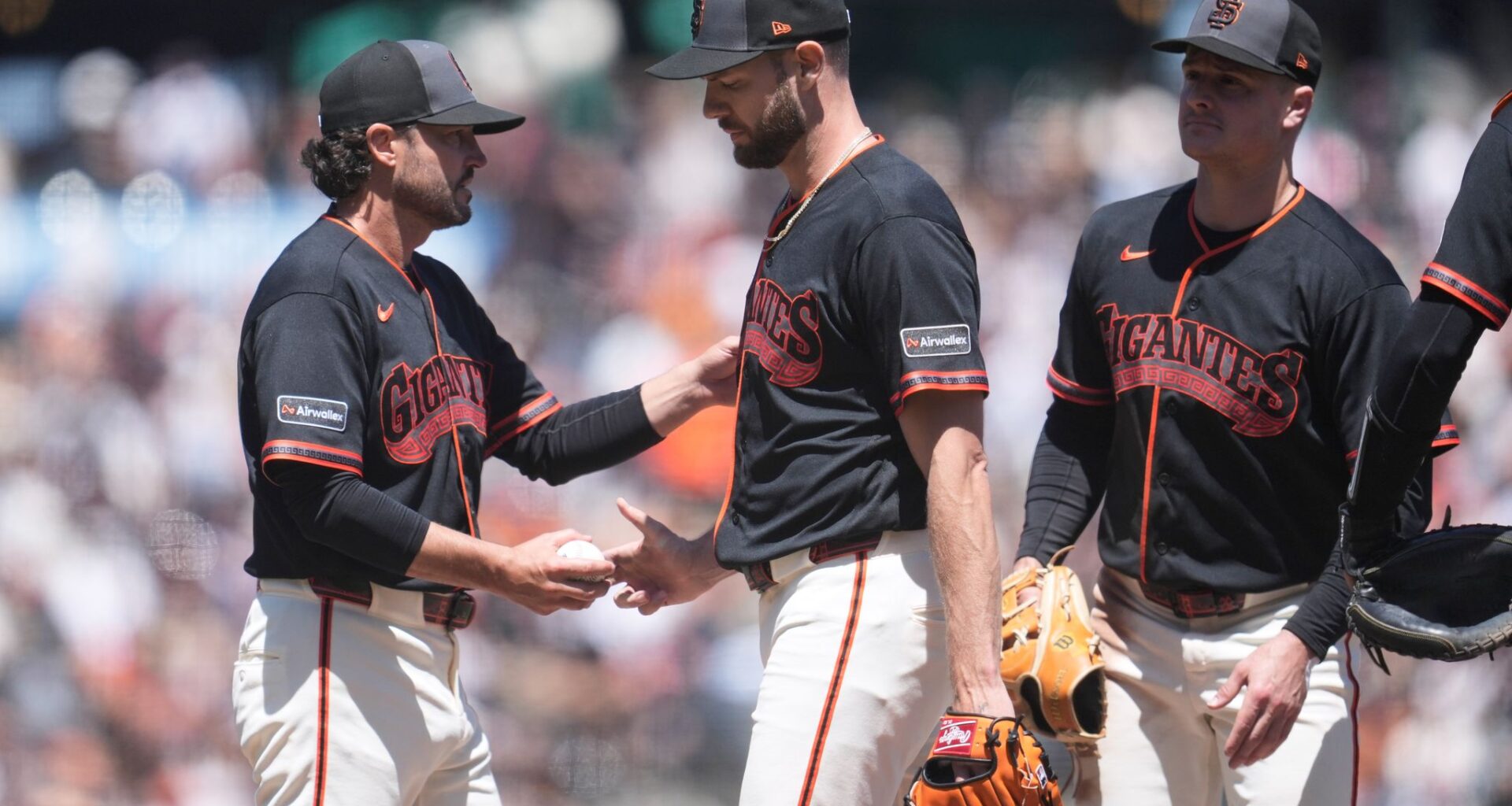
San Francisco Giants manager Tony Vitello, left, takes the ball from pitcher Adrian Houser, middle, during a pitching change in the fifth inning of a baseball game against the Chicago White Sox Saturday, May 23, 2026, in San Francisco.
Jeff Chiu/Associated Press
A quick glance at the underlying numbers shows no glaring red flags surrounding the San Francisco Giants’ pitching staff.
In some ways, this staff is doing exactly what they’re supposed to. They’ve even raised a few green flags: Opposing hitters aren’t barreling the ball much, nor getting hard contact. A 45.3% ground-ball rate ranks fifth in baseball, which fills the organizational objective to maximize their supposed strengths of defense and a pitcher-friendly ballpark.
Yet, the Giants’ pitching staff is in the midst of a downright ugly stretch dating to their 0-6 trip against the Philadelphia Phillies and Tampa Bay Rays at the end of April. In the five weeks since, the entire staff’s 5.30 ERA ranks 28th in baseball and their 4.53 fielding independent pitching isn’t much better (24th).
Article continues below this ad
What lies in the crater-sized gap between all that desired soft contact and utterly poor execution are a mess of inadequacies that indicate this bad stretch may keep going if no changes are made.
One shortcoming appears to be pitch sequence predictability and a lack of deception. While the staff has a handful of guys with swing-and-miss stuff — starter Robbie Ray and relievers Caleb Kilian, Erik Miller and Keaton Winn, for example — opposing hitters are going both in and out of the zone frequently to make contact against San Francisco’s entire arsenal.
San Francisco Chronicle Logo
Make us a Preferred Source to get more of our news when you search.
Add Preferred Source
Here’s a statistical breakdown: Their 26.4% called-plus-swinging strike percentage ranks 24th in baseball and they’re only generating a 9.8% swinging strike rate, ranking 26th. Opposing hitters are making contact on 65.0% of pitches out of the zone and at a 78.4% rate overall (in and out of the zone), which both rank sixth highest in the league.
Article continues below this ad
The natural thought may be that lots of contact can be good if it’s all slowly hit, but the old reliable batting average on balls in play (BABIP) stat tells us that has not been the case this year. Their .298 BABIP ranks fifth highest in the league, which means opposing teams are getting a lot of hits on balls put in play against the Giants. So much for the ground-ball hack.
Lack of deception shows also in their 4.07 walk-per-nine inning rate; there’s little the Giants have to offer that throws hitters off balance.
The double-header, double-walk-off fiasco in Philadelphia featured two extremes of just how predictable, or unimaginative, the Giants’ approach on the mound has been.
In Game 1, Ryan Walker, since demoted to Triple A, threw 13 consecutive sinkers while allowing the game-tying and game-winning runs. It was practically déjà vu in Game 2 when manager Tony Vitello stuck with righty Winn against lefty slugger Kyle Schwarber with the game-winning run aboard, and Schwarber smacked Winn’s seventh straight splitter of the at-bat to walk-off the double header.
Vitello said after the game that pitching coach Justin Meccage was calling from the dugout rails to throw something Schwarber might chase up in the zone, but Winn ultimately stuck with his best pitch. Walker said his other pitch, the slider, felt just fine to throw but that he doesn’t like to shake off the catcher, who was since-traded Patrick Bailey.
Article continues below this ad
Neither loss can only be blamed on regretful decision-making in the moment; the preparations leading up to it played a part, too.
That dreadful night in Philly has been par for the course in leverage situations for the bullpen or in jams for starting pitchers. Hitters are batting .250 against the Giants, tied with the A’s for fifth worst.
They have a 12.86 ERA with runners in scoring position, but the 19th-ranked 4.27 FIP paints a clearer picture of the pitching’s effectiveness.
The figures aren’t entirely surprising given that the pitching staff was somewhat a concern heading into 2026. The bullpen in particular lacks experienced high-leverage relievers and Walker, their most experienced closer, is currently tweaking his mechanics in Triple A.
The rotation has fallen short of expectation as well for reasons outside control. Logan Webb, off to a shaky start to the year, landed on the 15-day injured list with knee bursitis and Ray was tipping pitches in his scary start against the Arizona Diamondbacks and recognized a need to tweak mechanics after an iffy outing against the Chicago White Sox the next week.
Article continues below this ad
That doesn’t negate the disappointing returns as a group with new additions Tyler Mahle and Adrian Houser. The group’s 4.94 ERA is the second-highest mark in baseball this year.
The roots under the numbers show the pitching staff’s woes can’t be entirely focused on the guy on the mound.