
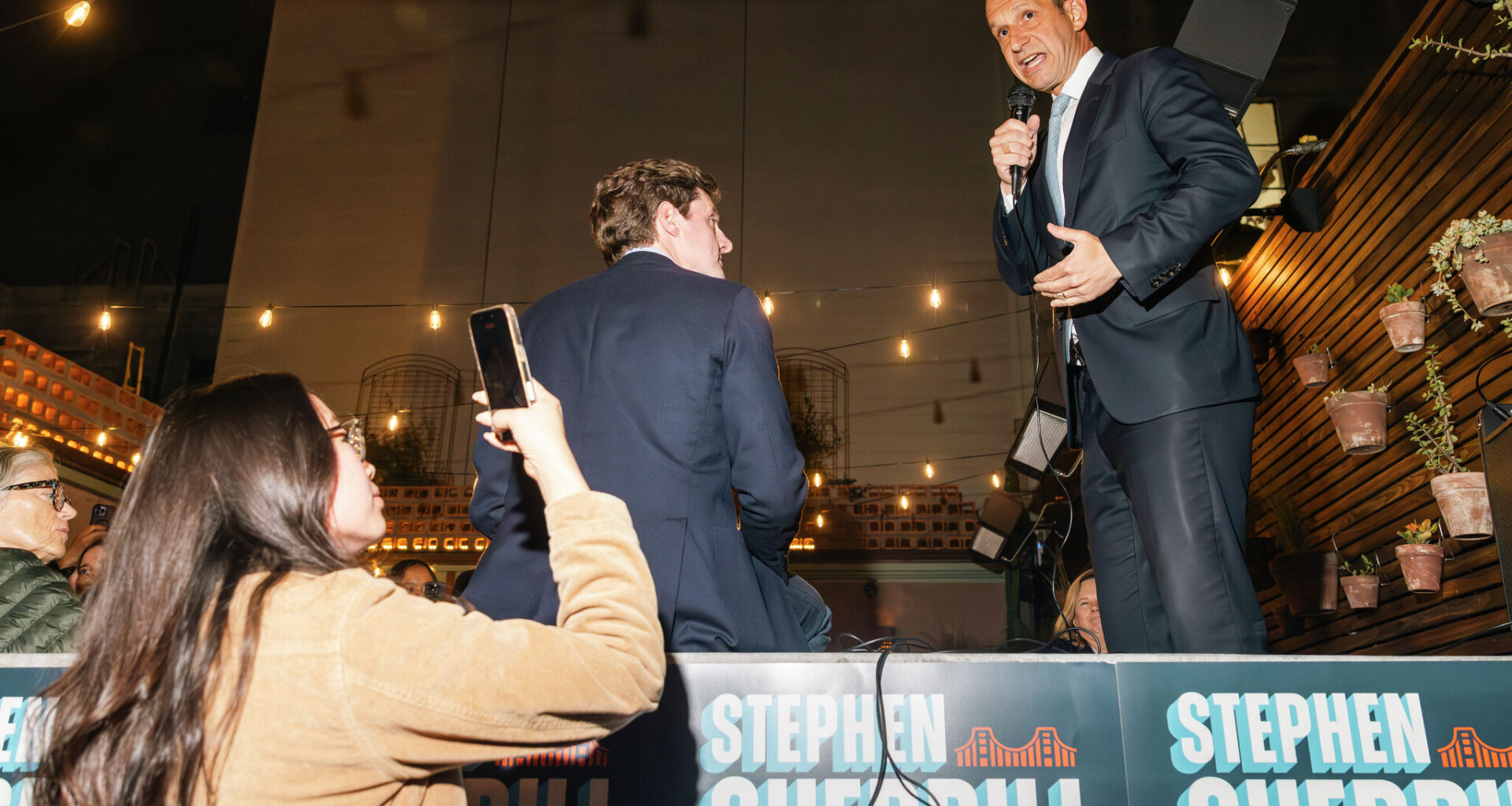
San Francisco Mayor Daniel Lurie speaks at District 2 Supervisor Stephen Sherrill’s election watch party on Tuesday. Sherrill’s win, along with Alan Wong’s victory in District 4, keeps allies of the mayor on the Board of Supervisors.
Lizzy Montana Myers/For the S.F. Chronicle
San Francisco voters delivered an important message on Tuesday — and it was a spirited shout of “Let’s Go San Francisco.”
The easy victories of Mayor Daniel Lurie’s preferred incumbent supervisors, Stephen Sherrill and Alan Wong (as well as the poor performance of Proposition D, the “overpaid CEO” tax, which Lurie campaigned against), delivered a resounding victory for the mayor and his agenda.
And, to craft a sentence I’m delighted to write, a rather stunning defeat for NIMBYism in San Francisco.
Article continues below this ad
Lurie came into office arguing that San Francisco must become a city that says “yes” more often — to housing, to growth, to investment and to the public infrastructure that makes growth work. Tuesday’s results suggest that voters understand the status quo is no longer acceptable.
Every election of late seems like a referendum on housing. But this one, which resulted in victories for two pro-housing supervisors (both strong allies) in decidedly anti-growth districts, feels different.
San Francisco Chronicle Logo
Make us a Preferred Source to get more of our news when you search.
Add Preferred Source
The political significance isn’t simply that Sherrill and Wong, who both support the mayor’s “family zoning” plan, won (and handily) — it’s where they won.
Both prevailed in districts that have historically been among the most resistant, hostile even, to new housing development, particularly market-rate housing, density and most especially, family zoning.
Article continues below this ad
That makes their victories notable for several reasons:
First, it weakens the idea that pro-housing politics are only viable in certain slivers of the city. San Francisco’s housing politics have long been framed geographically: pro-housing in dense eastern neighborhoods, anti-housing on the west side and in wealthy northern neighborhoods. If candidates perceived as more aligned with housing production can win in Districts 2 (the Marina) and 4 (Outer Sunset) — areas known for NIMBYism — it suggests voters may be reassessing old assumptions about growth and affordability.
These victories also signal that the housing crisis has become impossible to ignore, even for voters who have historically been wary of development.
The median home price for a single-family home in San Francisco is hovering around $1.6 million. The artificial intelligence industry boom has led not just to overbidding but to houses selling for double the asking price, resulting in an absurd “mansion shortage.” San Francisco keeps breaking its own record for one-bedroom apartment rents, which are now at a median price of $4,000 a month. Combined with declining school enrollment, struggling commercial corridors and concerns about the city’s economic future, housing is no longer an abstract policy discussion.
We may have an AI boom, but do we all want to live in a city that only employees of AI companies can afford to live in?
Article continues below this ad
Voters may not suddenly embrace every development proposal, but they increasingly recognize that maintaining the status quo is not a solution.
The election of Sherrill and Wong strengthens Mayor Lurie’s governing position. A loss in either district would have weakened his leverage with the Board of Supervisors; Lurie’s ability to count on the board’s support moving forward (at least until the next election in November) keeps the wind in his sails.
Whether or not this changes the calculus for other district candidates in the future remains to be seen. (We don’t have too long to wait and see; there’s another election in five months). But these victories show that candidates can win in historically NIMBY districts without running against housing — and as a result, future candidates may become less inclined to treat opposition to development as the safest political position.
For decades, much of San Francisco’s housing debate has operated on the assumption that homeowner-heavy neighborhoods would always punish politicians who supported substantial growth. Sherrill and Wong’s wins suggest that the electoral risks of supporting housing may be declining while the risks of defending scarcity are increasing.
That’s why these elections matter beyond the candidates. They may be the clearest evidence yet that even some of San Francisco’s most development-skeptical voters are becoming more open to the idea that the city cannot preserve affordability, economic diversity or long-term vitality without building.
Article continues below this ad
When the Chronicle’s editorial board, of which I am a member, interviewed the slate of District 2 and 4 supervisor candidates, one question that continuously came up was whether or not they could represent the interests not just of their constituents but of the city at large. The candidates who emerged as the winners demonstrated an understanding that the city works best when it works together. Those who lost really didn’t seem to believe that.
Neighborhoods shouldn’t be able to opt out of solving the challenges the city faces; I believe the supervisors we will have now have a good understanding of that.
A serious housing agenda requires more subsidized affordable housing, more market-rate housing, more family-sized apartments, more senior housing, more student housing, and more homes near jobs and transit — more housing at all unit sizes, locations and income levels.
Two supervisors can’t determine the city’s entire housing future. State law, market pressure and the simple arithmetic of scarcity will shape the city’s choices. San Francisco needs far more homes than it has, and a lone election can’t change that reality.
But there are things the board now can, and likely will do, including reducing inclusionary requirements that make projects infeasible, cutting development impact fees, reforming transfer taxes that discourage large multifamily projects and continuing to work on speeding approvals.
Article continues below this ad
Even if they succeed on those fronts, they’re still fighting high interest rates, reluctant lenders and construction costs that are among the highest in the nation.
California and San Francisco have enacted wave after wave of pro-housing legislation since 2022 — builder’s remedy reform, Senate Bill 423 streamlining, transit-oriented upzoning, fourplex legalization, family zoning, permit reforms — yet the city completed just 1,453 units in 2024, while tens of thousands of already-approved homes sit unbuilt.
Nevertheless, let’s savor this victory for a moment.
San Franciscans can and should celebrate a political and regulatory environment that has become dramatically more pro-housing.
Guest opinions in Open Forum and Insight are produced by writers with expertise, personal experience or original insights on a subject of interest to our readers. Their views do not necessarily reflect the opinion of The Chronicle editorial board, which is committed to providing a diversity of ideas to our readership.
Read more about our transparency and ethics policies
Few people were excited about this election, but lots of people are energized by Lurie. The mayor now has a mandate to build a durable coalition around housing production, economic vitality and civic renewal.
This is San Francisco, and there is zero chance that that coalition will agree on everything (looking at you, Marina Safeway project). But it can agree on the central challenge facing the city: It cannot become more affordable without dramatically increasing its housing supply.
Allison Arieff is a columnist and editorial writer for the Opinion section.