
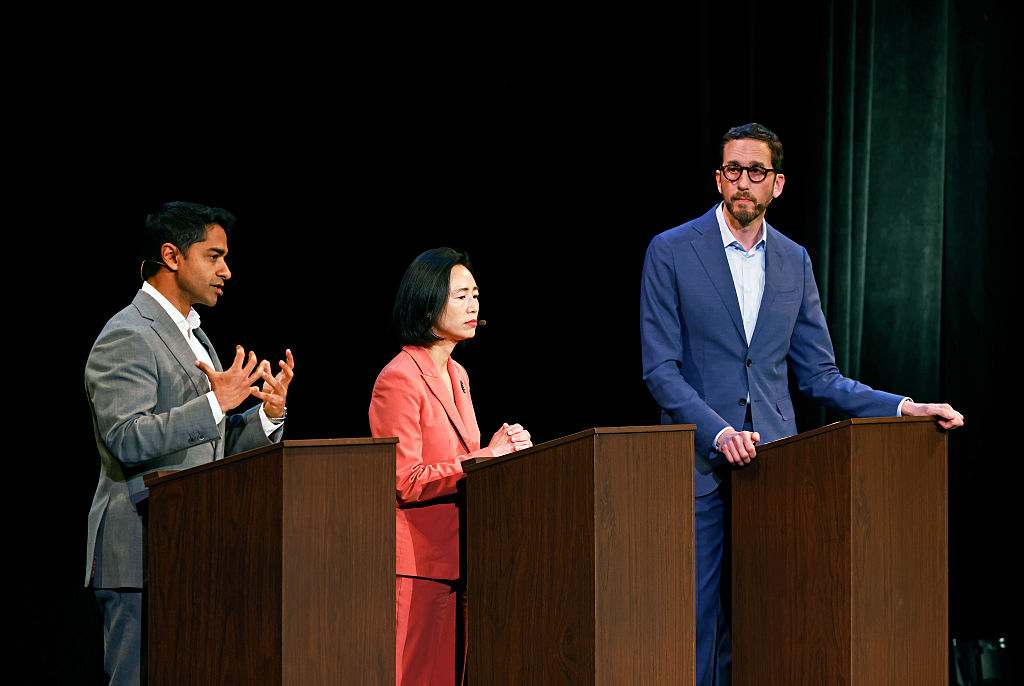
Whether Chakrabarti’s local political record particularly matters in a race for Congress may be debatable, but there is perhaps another reason why he has struggled to endear himself to a segment of the city’s progressive base: he is, like so many of the men responsible for financing the right-wing takeover of the city in recent years, a centimillionaire who attended Harvard, began his postgraduate life at the hedge fund Bridgewater Associates, moved to Silicon Valley, and made a fortune helping to found Stripe.
For some of those dismayed by San Francisco’s transformation into an increasingly exclusive, sanitized tech enclave, there is a disquieting quality about Chakrabarti’s biography. Likewise, there’s something unnerving about his transience, having vacated and returned to the city several times over recent years. It’s a vulnerability Wiener and his allies have repeatedly attempted to exploit in both mailers and the side of a van, and it’s likely why Chakrabarti has used one of his final advertisements to remind voters not of his position on Palestine or health care but of his San Francisco credentials. The spot features old photographs of Chakrabarti at the Golden Gate Bridge and on Baker Beach. I’m one of you, it seems to say.
Chan does not need to convince anyone of that. Born in Hong Kong and raised in Taiwan, she arrived in the city at thirteen and initially lived with her mother, brother, aunt, and uncle in a one-bedroom Chinatown apartment. Chan didn’t go to Harvard, but rather to the University of California, Davis, an hour and change away. She spent the first years of her career working not for a start-up in Silicon Valley but for the Community Youth Center of San Francisco.
None of that necessarily means that Chan would make a better representative than Chakrabarti, but it has given her campaign a certain symbolic weight for people concerned that the San Francisco they love is in danger of slipping away: a city where a child can arrive without English, attend public schools, make a career in public service, raise a family, and go to Congress. It fits the narrative all too neatly that Chakrabarti, who has given his campaign nearly $10 million of his own fortune, has outraised Chan by a margin of nearly twenty to one.
For some of those dismayed by San Francisco’s transformation into an increasingly exclusive, sanitized tech enclave, there is a disquieting quality about Chakrabarti’s biography.
More than that, perhaps, Chan is a known quantity. She has racked up endorsements from teachers, nurses, and firefighter unions, the San Francisco Labor Council, and a broad array of local progressive organizations. She has been backed by Preston, Peskin, and Chen, the candidates Chakrabarti overlooked two years ago, as well as by Sen. Adam Schiff and Pelosi herself. Chakrabarti, though his platform may go further than Chan’s, does not list a single union endorsement on his website. He has not been endorsed by a single active member of the Board of Supervisors or a single member of the California legislature. He does, however, boast the support of New York Councilman Chi Ossé.
Pelosi, whose animus for Chakrabarti seems to date at least to 2019, when he compared moderate House Democrats to segregationists over their support for a border aid package, has taken to publicly suggesting he’s a carpetbagger: “I don’t have any idea who he is,” she told KQED in a recent interview. “I’ve never seen him at a homeless shelter, or a food bank, or at an immigration center. I’ve never seen him in the community.”
San Francisco voters will have to decide how to weigh it all — whether an energetic candidate who cofounded Justice Democrats but has a questionable local record is worthy of left-wing votes, or whether a candidate backed by Schiff might well be the safest progressive bet. The American Israel Public Affairs Committee has routed hundreds of thousands of dollars to a Super PAC supporting Chan, though its motivations for doing so are not entirely clear, given that Chan is a vocal opponent of Israel’s assault on Gaza. AROC Action, the political organization of the Arab Resource and Organizing Center, issued a joint endorsement.
California Democratic Socialists of America (DSA) did not recommend a vote for either candidate, calling both “decent but flawed” choices, and DSA San Francisco likewise abstained. Aditya Bhumbla, cochair of DSA SF, told Jacobin that both candidates were “deeply imperfect,” calling Chakrabarti entrenched in tech circles and Chan entrenched in the machinery of the Democratic Party. Bhumbla characterized Chakrabarti as “spending tens of millions to blanket the airwaves in the absence of a long-term connection to local organizing” and criticized Chan for bad votes related to policing and homelessness. “The absence of a true socialist in the race is an indication that the Left has work to do if we’re going to be able to exert power in Congress,” Bhumbla said.
Polls suggest Chan and Chakrabarti are neck and neck, though Chan’s campaign has insisted that some surveys have missed her robust support among Chinese speakers. Whoever triumphs will likely face Wiener, who, in some respects, is an even better avatar of modern San Francisco than Chakrabarti is. Wiener, who was raised in southern New Jersey and came out as gay while attending Duke University, landed in San Francisco in the late 1990s. He has been a fixture of the city’s political life for the better part of two decades — first representing a district including the Castro on the Board of Supervisors before winning election to the state senate a decade ago.
Wiener has carved out a reputation in Sacramento as one of the legislature’s most productive members, and he has championed the kind of deregulatory, abundance-style YIMBYism that has gained rapid popularity in recent years. He also has close connections to major real estate interests and Silicon Valley players, including Larsen, who has donated $100,000 to a Super PAC supporting him. Perhaps not coincidentally, Wiener opposes both a San Francisco tax on CEOs who make more than one hundred times what their median employee makes and a onetime tax on California billionaires. Even Pelosi supports the latter measure, which will be on the ballot in the fall when Wiener faces either Chan or Chakrabarti.
That race, too, will be a referendum on San Francisco’s political direction. Whoever triumphs between Chakrabarti and Chan will need the other candidate’s validation and supporters. With San Francisco continually under threat from big money interests, the Left cannot afford to be divided — or pick the wrong candidate to elevate.