
About our live results
Keep in mind that, in tight races particularly, the winner may not be known for days or weeks after Election Day. That’s because early voting and mail-in ballots have fundamentally reshaped how votes are counted and when election results are known.
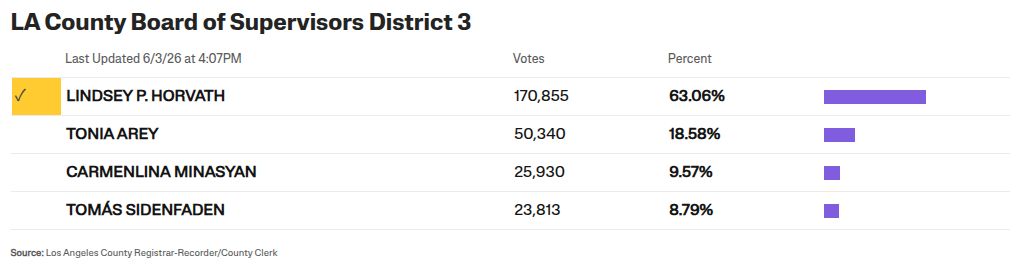
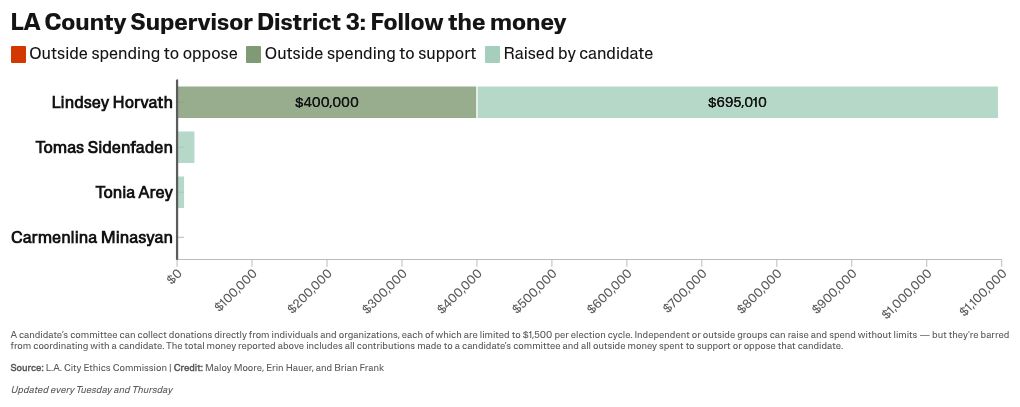
Incumbent Lindsey Horvath faced three challengers in the primary for her District 3 seat, and on Wednesday she saw her top challenger — in a distant second place — concede the race.
Follow the vote after polls close
Our limited-run newsletter Make It Make Sense unpacks the ballot count and results, then checks in regularly on officials voted into office and the measures voters pass.
“Los Angeles County, thank you,” Horvath said on Instagram. “I am grateful for every voter, volunteer, & supporter who made this victory possible.” And while votes are still being counted, challenger Tonia Arey conceded on Instagram that the gap was too great. “The voters of LA County District 3 made their decision. While this was not the outcome we hoped for, I respect the will of the people and the democratic process.”
What’s at stake in these races
The five county supervisors hold huge power in Los Angeles County and together represent more than 10 million people. That’s more residents than most U.S. states.
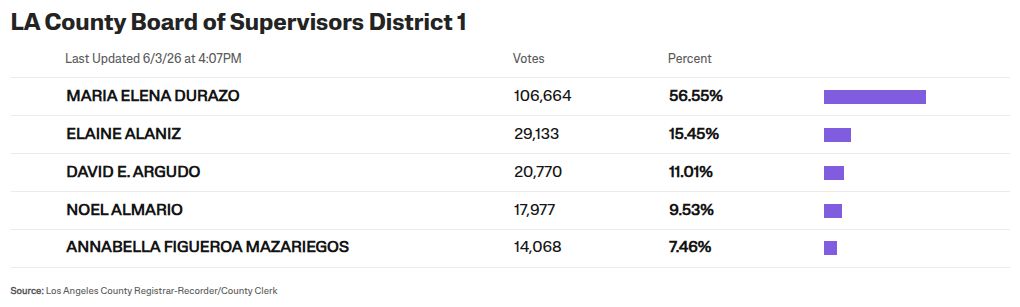
A second of those supervisorial seats is still being decided: Five candidates were in the running to be the L.A. County supervisor for District 1, seeking to fill the seat currently occupied by Hilda Solis, who is termed out this year.
Maria Elena Durazo appears poised for victory if the trend continues. Durazo is a longtime labor leader and major figure in L.A. Democratic politics. She has been a California state senator since 2018, representing the 26th District, which includes Hollywood and East Los Angeles.
What it takes to win
A candidate could win outright with more than 50% of votes cast. If no candidate crosses that threshold, the top two finishers will compete in a runoff in the November general election.
Why this race matters to everyone in L.A. County
The supervisors steer a nearly $50 billion annual budget and determine countywide policy for jails and juvenile halls, foster care and the Sheriff’s Department. The board plays a key role in regional homelessness planning and has at times come into conflict with the city of L.A.
Here’s a look at a few of the thorny issues on the agenda for the Board of Supervisors in the next term.
L.A. County faces bleak budget problems due to federal funding cuts, liabilities from systemic child sexual abuse, costs related to the Palisades and Eaton fires and more.Federal cuts are expected to slash $2.4 billion from county health programs over three years — so the Board of Supervisors put an initiative on the June ballot to temporarily raise sales taxes.The county will also head into the next fiscal year with a homelessness spending plan that includes nearly $200 million in reductions to programs and services.The board will continue to reckon with the ongoing immigration raids across the county. In January, the supervisors moved to designate county property as “ICE Free Zones.”The county will keep addressing its troubled jail and juvenile halls, which have been tasked with making major changes to address concerns over health and safety.
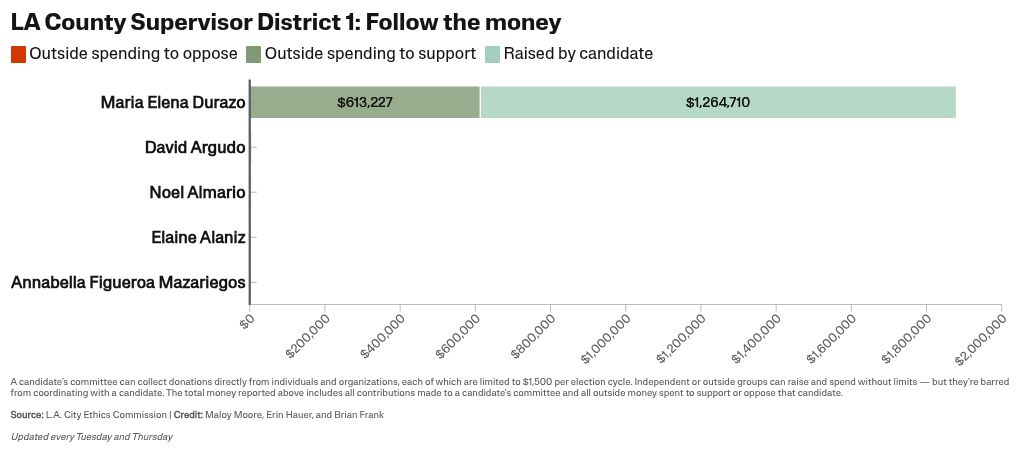
Campaign finance
Go deeper on the issues
About the vote count
For LAist’s charts showing vote counts, we get numbers directly from the L.A. County and Orange County registrars of voters for local races. Totals are updated on our site as soon as possible after the registrars provide new tallies. For statewide races, counts come from the California Secretary of State’s Office.
Keep in mind that, in tight races particularly, the winner may not be determined for days or weeks after election day. That’s because early voting and mail-in ballots have fundamentally reshaped how votes are counted and when election results are known. In L.A. County, for example, updates on the counting are expected to continue through June 26. After the polls close on election night, expect updates every 15 minutes or so through the early morning hours Wednesday. After that, expect updated counts around 5 p.m. on the following days: June 3, 4, 5, 8, 9, 10, 11, 12, 16, 18, 24 and 26. Final results must be certified by July 10.
Our priority during the vote count will be sharing outcomes and election calls only when they have been thoroughly checked and vetted by journalists. To that end, we will report when candidates concede and otherwise rely on NPR and the Associated Press for race calls (before official results). We will not report the calls or projections of other news outlets. You can find more about NPR’s and the AP’s process for counting votes and calling races here, here and here.
Tracking your ballot
You can track the status of your ballot through California’s BallotTrax website.
If your mail-in ballot has any problems (like a missing or mismatched signature), your county registrar must contact you to give you a chance to fix it.
Official results
The California Secretary of State’s Office is required to certify the final vote tallies by July 10, marking the official end of the 2026 primary election.
LAist’s Voter Game Plan will be back in the fall to help you prepare for the Nov. 3 general election.
What questions do you have about this election?
You ask, and we’ll answer: Whether it’s about who’s funding the campaigns or how to track your ballot, we’re here to help you understand the 2026 election
Ask a Question
LAist senior editor Rene Lynch contributed to this report.