
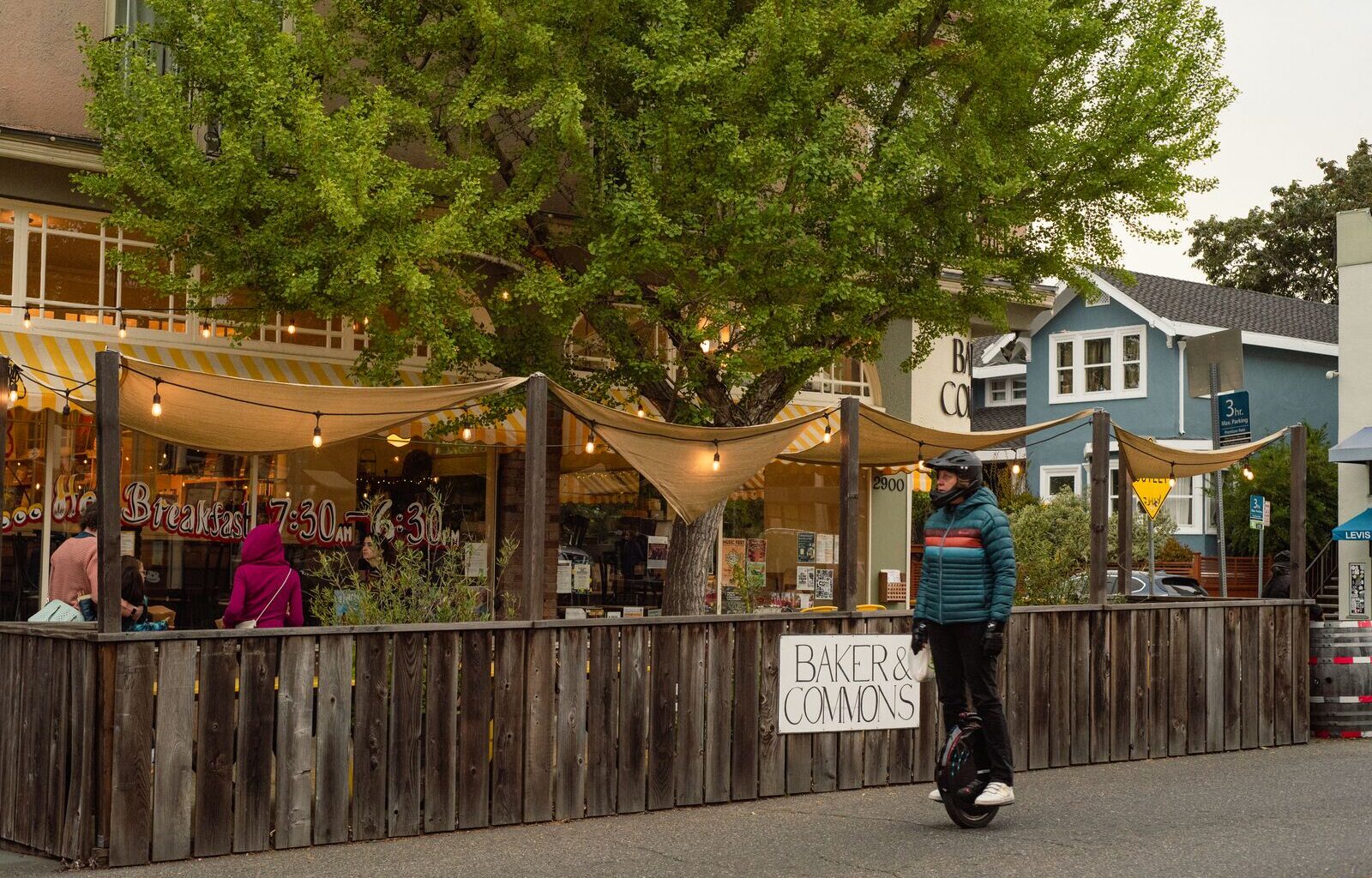
 The Landmarks Preservation Commission deadlocked on a proposal to declare the Elmwood neighborhood’s commercial strip a historic district. Credit: Ximena Natera for Berkeleyside
Update, June 4: The application to declare the Elmwood neighborhood’s commercial strip a “historic district” will go before the Landmarks Preservation Commission for a second time Thursday night. The commission meets at 6:30 p.m. at the North Berkeley Senior Center; you can also watch and participate in the meeting via Zoom.
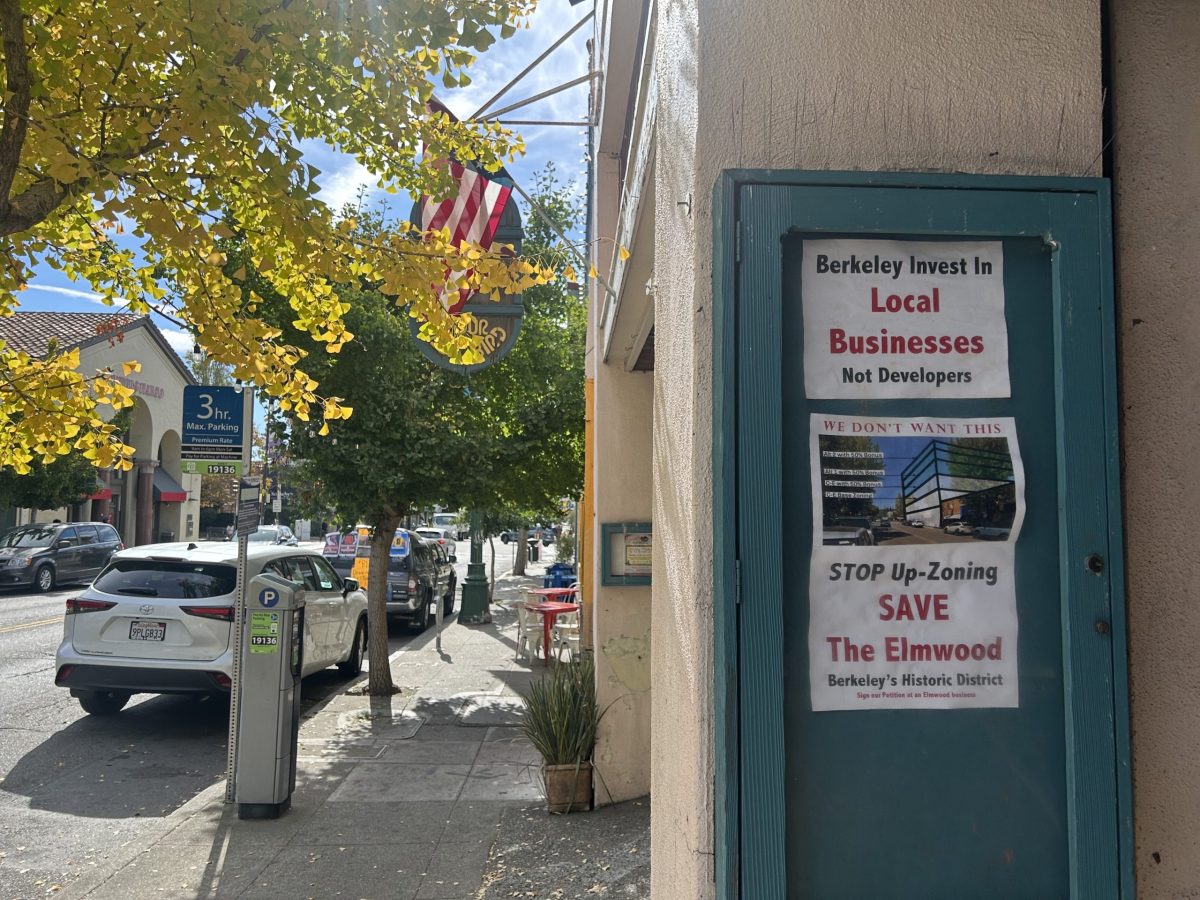
Original story, May, 13: The Elmwood neighborhood’s commercial strip could be declared a historic district if city officials approve a proposal backed by local preservationists and hundreds of residents. But to critics, the drive looks more like an attempt to thwart plans to build housing in the wealthy and exclusive neighborhood than a genuine effort to honor history.
Berkeley’s Landmarks Preservation Commission deadlocked on the historic district proposal at a meeting last week, where opponents of a separate plan to raise height limits in an effort to encourage new development along portions of College, Solano and northern Shattuck avenues turned out to advocate for the designation. The City Council is expected to take up the rezoning proposal this summer, after it was endorsed by the Planning Commission.
The historic district application described the Elmwood as “one of Berkeley’s most remarkable and best-preserved neighborhood shopping districts,” with buildings that “represent some of the best in commercial design of the 1920s.” It was written by Anthony Bruce, the executive director of the Berkeley Architectural Heritage Association. However, BAHA President Leila Moncharsh told Berkeleyside that Bruce did not prepare the application in his official capacity; the association did not take a position on the effort. Bruce wrote in the application that he was representing the Elmwood Property Owners Association.
Bruce proposed the city create a historic district that covers 34 properties along College and Ashby avenues, across portions of three blocks between Russell and Webster streets. More than 400 people, including 17 owners of commercial properties in the area, signed petitions supporting the application.
“Elmwood is more than a collection of buildings — it is a complete and living historic environment where architecture, history and community life still come together,” Claudia Hunka, the owner of Your Basic Bird pet supply store on College Avenue, told the landmarks commission as she introduced the proposal. “Approving this designation preserves one of Berkeley’s most authentic and enduring places.”
Are a parking lot and strip mall worthy of historic status?
The properties Bruce argued should be considered part of the historic district range from the Walter Ratcliff-designed Mercantile Trust Company Building, a city landmark built in 1925 that now houses a Wells Fargo branch, to the parking lot behind it, which opened in 1965.
City planning staff have identified the parking lot as one of a handful of properties where developers might build housing in the Elmwood — but Bruce argued each of those sites was worthy of distinction. The parking lot, he wrote, has landscaping that “creates a parklike effect” and a “lush entrance” to the neighborhood; the 7-Eleven property, built as a Safeway grocery store in the 1930s before it was heavily renovated in the 1970s, “has significance … for introducing the concept of the strip mall to the Elmwood.”
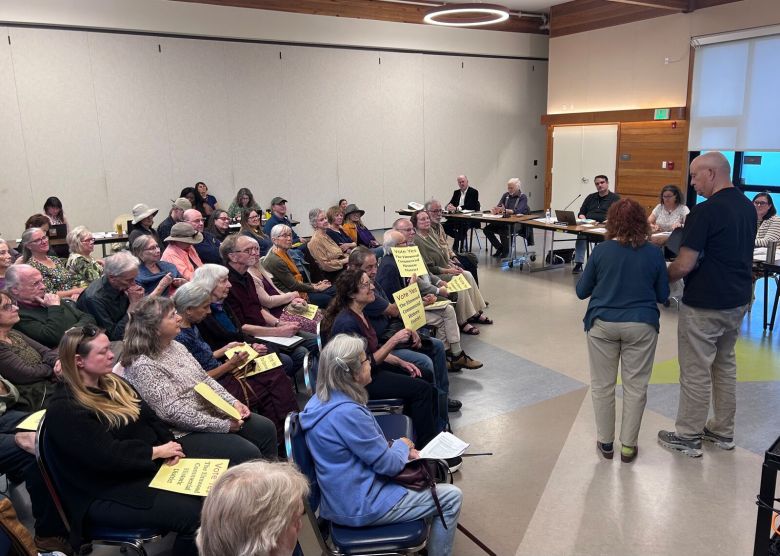 Dozens of people attend a meeting of Berkeley’s Landmarks Preservation Commission meeting to support a proposal that would declare the Elmwood neighborhood’s commercial strip a historic district. Credit: Nico Savidge/Berkeleyside
Housing advocate and Elmwood resident Theo Gordon called the application a “farce.”
If it is approved, anyone who wants to demolish or modify a building in the historic district would have to go before the landmarks commission for a discretionary review — a process that could last up to a year, according to city staff, and be subject to an appeal to the City Council that would take another four to six months. Other wealthy areas, such as San Francisco’s tony St. Francis Wood neighborhood and the Baywood enclave in San Mateo, have similarly sought historic district designations when they were eyed for new housing.
“I am asking you to reject the idea of locking our neighborhood in amber,” Gordon said at the landmarks commission meeting Thursday night. “It’s obviously a thinly veiled plot to block housing.”
Bruce’s application and comments from many of those in favor of the historic district also linked the designation with the push to build apartments in the neighborhood. Some described the Elmwood as a “fragile ecosystem,” and its locally owned businesses as “endangered species” that could be lost to new development. Bruce wrote that the city’s proposed zoning changes “would destroy the historic character” of the area.
Peter Montgomery, a member of Berkeley’s Civic Arts Commission, invoked Donald Trump’s demolition of the East Wing of the White House and repainting of the Lincoln Memorial Reflecting Pool to make his case for the application.
“We have elements in this society that are making decisions with disregard to history,” Montgomery said, his voice heavy with emotion. “They are only interested in money and power.”
Landmarks commission deadlocks on designation
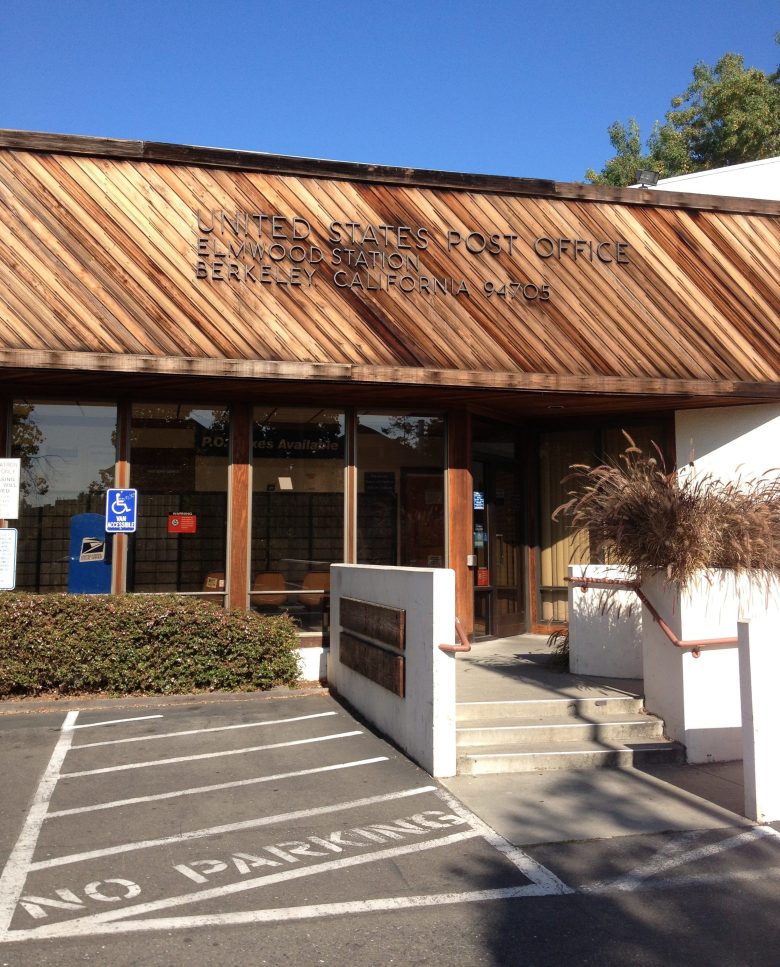 A file photo of the Elmwood neighborhood’s post office. Credit: Frances Dinkelspiel/Berkeleyside
A consultant contracted by Berkeley’s Planning Department recommended the commission approve the historic district designation, calling the Elmwood “an important example of neighborhood commercial development” because it was the first area zoned for that use in Berkeley’s landmark 1916 zoning ordinance.
But the firm, Rincon Consultants, recommended tightening the district’s boundaries to leave out six properties, including the bank parking lot, strip mall and a post office built in the mid-1970s that has also been identified as a potential site for new housing; Bruce’s application contended wooden elements on the post office’s facade evoke the iconic architecture of the Sea Ranch community. Those properties were all built outside what the firm defined as the area’s “period of significance,” the years from 1907 to 1928 when most of the commercial strip was built. Bruce argued that period stretched into the early 1980s.
Three landmarks commission members — Ellie Greene, Michael Montilla, and Molly Turner, a substitute commissioner who attended Thursday’s meeting in place of Chair Denise Hall Montgomery, who was absent — were cool on the proposal.
Each criticized the idea of celebrating the area’s ties to the 1916 zoning ordinance, which made the Elmwood’s residential blocks the first neighborhood in the country zoned exclusively for single-family homes. The ordinance has come under scrutiny in recent years because the single-family zoning category would go on to spread nationwide, with cities using their zoning codes as an ostensibly race-neutral way to segregate neighborhoods — an effect they also had in Berkeley.
“That was a part of a red-lining and a racist history in the city of Berkeley,” Greene said of the 1916 ordinance. “That is not a history that I have any particular desire to maintain or uphold.”
The other three commissioners at Thursday’s meeting — Susan Orbuch, Steven Finacom and Paul Schwartz — supported the proposed historic district. While not all of the properties are notable enough to merit landmarking, Orbuch said, the historic district designation is a fitting way to recognize the “place and its fabric.”
“When you look at them all together, they create something that is bigger than the sum of its parts,” Orbuch said.
A motion to reject the historic designation failed on a 3-3 vote; commissioners then voted to continue discussion of the proposal to their next meeting June 4.
Montilla appeared to be a potential swing vote in the debate, saying he is open to extending a distinction to some Elmwood properties that aren’t currently landmarked, but wasn’t sold on declaring the entire strip a historic district.
“It is a lovely commercial area that is deserving of some level of protection,” Montilla said. “But whether or not that protection is a historic landmarking is where I am drawing the line in my mind.”
Editor’s note: This article has been updated to clarify that, although the application for the Elmwood historic district was prepared by the executive director of the Berkeley Architectural Heritage Association, Anthony Bruce, he did so in his personal capacity and not as a representative of the association. The group did not take a position on the historic district application.
Related stories
November 7, 2025Nov. 7, 2025, 8:34 p.m.
Plans to rezone wealthy Berkeley neighborhoods for more housing are scaled back after uproar
May 6, 2026May 14, 2026, 9:22 a.m.
9-story housing next to Cheese Board? Berkeley could OK taller buildings on 3 popular streets
August 25, 2025Aug. 26, 2025, 9:15 a.m.
“*” indicates required fields