
As California’s June primary ballots continue to be counted, the governor’s race remains too close to call. Election data expert weighs in.
SACRAMENTO, Calif. — As California election officials continue counting ballots from the June primary, uncertainty remains over which two candidates will advance to the November runoff in the race for governor.
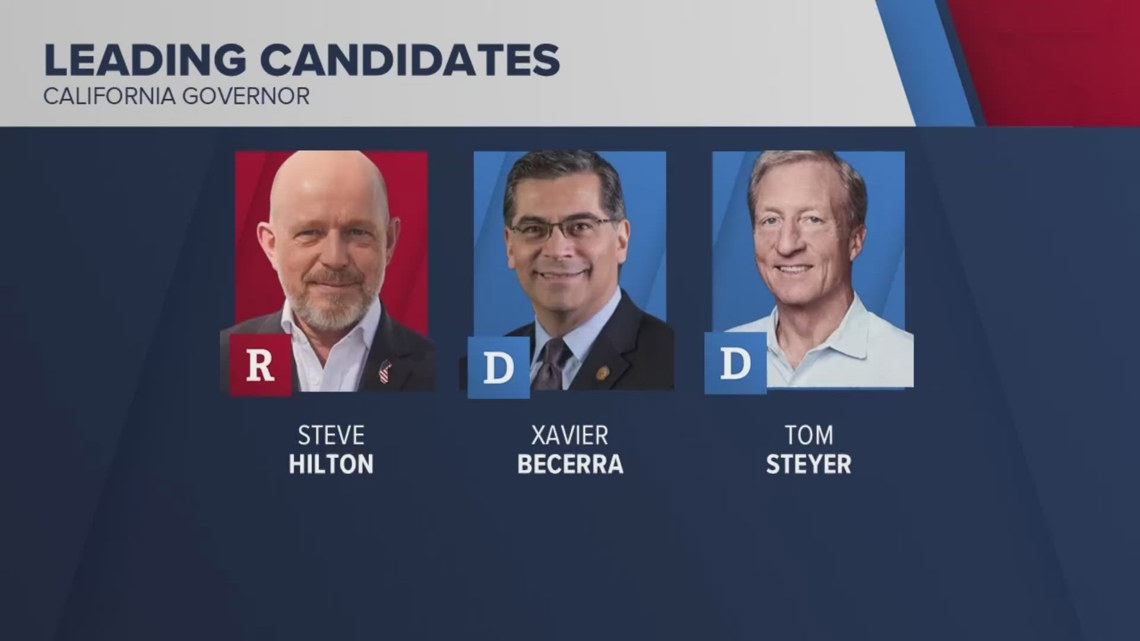
As of Thursday evening, with 59% of the estimated vote counted, The Associated Press shows Steve Hilton leading the gubernatorial field with 27.2% of the vote, followed by Xavier Becerra with 26% and Tom Steyer with 20.2%. The top two candidates will advance to the November general election.

This story continues below.
Election data expert Paul Mitchell said the order of finish among the leading candidates may not carry much significance because the candidates faced different levels of competition within their parties.
“I don’t think it has any meaning whether one finishes above the other in a primary like this,” Mitchell said. “This is a race where Steve Hilton really had one opponent – Chad Bianco. Whereas Xavier Becerra had five opponents, the major Democratic candidates in the race with him.”
The key question now is whether the November matchup will be Hilton and Becerra or Becerra and Steyer.
Mitchell said Steyer faces a steep challenge in moving from third place into the top two. Early results show a 6-point gap between Steyer and Becerra.
“He not only needs to make up that six-point gap, but he also needs an additional six points to make up for the ballots that have already been tabulated,” Mitchell said.
Mitchell said a clearer picture could emerge when the next batch of election results is released Friday evening. By then, more late-arriving ballots will have been counted, including ballots cast by Democrats who waited until the final days before turning them in.
“Many of these Democrats who traditionally vote early – older, Democrat, Democrats who vote in every election, that hadn’t turned in their ballots yet… they would say I don’t want to make a mistake in the governor’s race,” Mitchell said.
Mitchell said those late ballots could help determine the direction of the Democratic contest.
On Election Day, both the Becerra and Steyer campaigns acknowledged the uncertainty surrounding a crowded field.
“You never know what to expect in a campaign cycle. And don’t count anybody out,” said Jonathan Underland, a spokesperson for Becerra’s campaign.
Steyer said the race became easier for voters to understand as it progressed.
“I think this race has seemed really complicated. Everybody was really confused for a long time. There’s 60 people on the ballot for goodness sakes. But I think it’s become a very simple race,” Steyer said.
The primary also included Proposition 50, which would temporarily redraw California’s congressional districts to give Democrats a five-seat advantage as a counter to Texas’ mid-decade redistricting plan that gave Republicans a five-seat advantage.
Mitchell, who drew the maps, said the measure’s success remains uncertain.
“Voters have to vote. Campaigns have to campaign. And the map drawer doesn’t have anything beyond their one single vote in their one single congressional district anymore,” Mitchell said.
One development Mitchell said he did not anticipate involved Rep. Kevin Kiley, who switched his party affiliation from Republican to independent and is running for California’s redrawn 6th U.S. House District.
Early results showed Kiley and Republican candidate Michael Stansfield holding the top two spots in that race.
“Which would be a minus one from the redistricting plan passed by Prop. 50,” Mitchell said. “Kevin Kiley decided he didn’t like my maps. And so he is moving to a different district and is running.”
The outcome of the remaining vote count could also affect California’s role in the fight for control of Congress during the 2026 midterm elections.
Watch more: California’s late ballots could shake up the governor’s race
ABC10: Watch, Download, Read











1
/
12