
Oakland is in the middle of a sweeping transformation, with a new hospital tower and research space reshaping the neighborhood that has been Pitt’s home for more than a century. That growth took center stage June 2, when regional business and civic leaders gathered at the University of Pittsburgh for the Pittsburgh Business Times’ latest Corridors of Opportunity forum.
The event brought nearly 300 community members and leaders, including Pittsburgh Mayor Corey O’Connor, to Alumni Hall. Attendees heard firsthand about Pitt’s past, present and, most importantly, its future as an anchor institution in Oakland, including aspirational plans for the neighborhood’s next big opportunity for development: the Craig Street corridor.
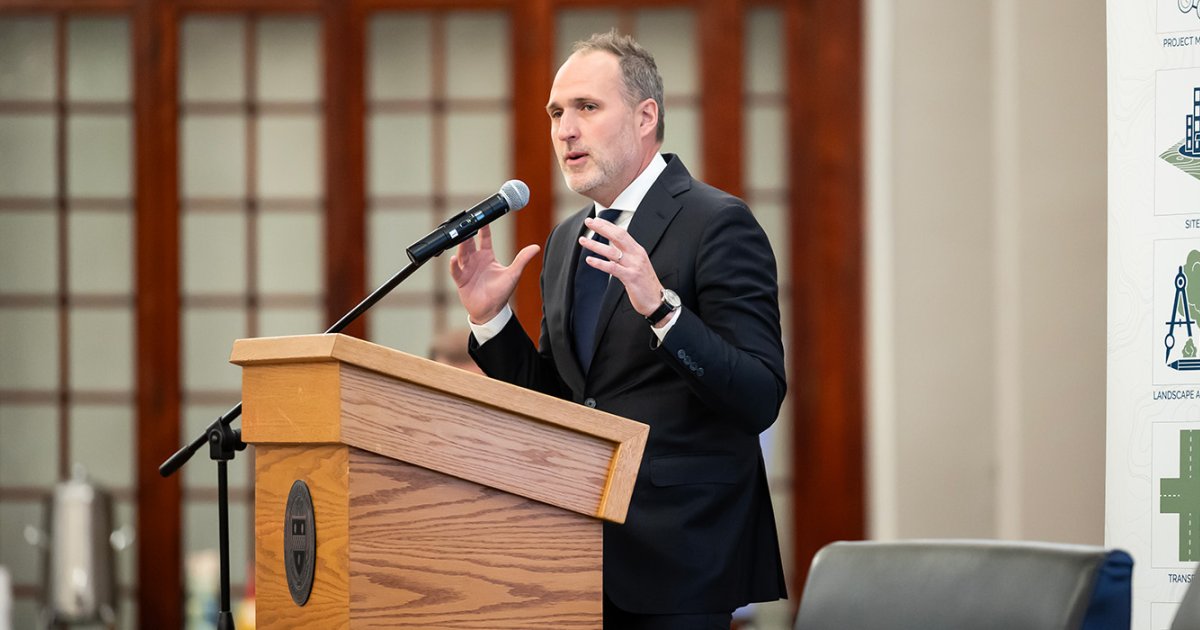
Senior Vice Chancellor for External Relations Kevin Washo opened the program, noting in his remarks that the futures of Oakland and of the University are inseparable.
“Oakland isn’t just a campus,” Washo said. “It’s a corridor of research, medicine, education and community.”
One corridor ripe with potential is Craig Street, where Washo said the University already owns assets and is reimagining “what local can look like” within Pitt’s footprint. He pointed to Fifth Avenue and Craig Street — together, a walkable gateway connecting key campus spaces like the Cathedral Lawn and Heinz Memorial Chapel to Carnegie Mellon and the Carnegie Museums — as Oakland’s next major area of growth.
To that end, Washo said Pitt recently completed an extensive Campus Master Plan under Chancellor Joan Gabel and has now engaged the international design firm Sasaki to study Craig Street and the University’s parcels there. He described Sasaki as a world-class partner for the kind of work the corridor demands.
“Oakland and Craig Street deserve world-class vision, strategy, design,” Washo said. “We see Craig Street as the next big opportunity in Oakland. We aim to make the most of the opportunity in a way that works for the good of residents, entrepreneurs, anchor institutions and the region at large.”
Washo added that Pitt and Oakland have been intertwined since the University made the neighborhood its home in 1908. Today, Washo said, the neighborhood is the third-largest economic center in Pennsylvania, blending technology, life sciences, health care and higher education with cultural anchors like the St. Paul Cathedral and a thriving mix of small businesses.
“You can feel the heartbeat of the region’s innovation here,” Washo said.
He also noted the University’s five-year, $5 million investment in the city’s neighborhood business corridors, public safety and parks, a commitment Forbes recently described as “a model for partnership and collaboration between governments and institutions.”
Washo credited partners including UPMC, Carnegie Mellon University, Innovate Pittsburgh and Wexford Science + Technology for the Oakland neighborhood’s growth and momentum. He singled out the University’s partnership with UPMC, which draws patients, scientists and entrepreneurs from around the world. Washo also praised the Oakland Alliance, a coalition of institutions and community partners — including Pitt — working to attract businesses and accelerating its economic development. Several small businesses received a shoutout, including the Irish Design Center on Craig Street and Merante Italian Grocery on Bates Street.
“These are small businesses that are trying to thrive, but more are coming in, and we need to cultivate that and curate that,” Washo said. “We need small businesses to bring that life out 24/7/365. It’s a neighborhood where people want to live, and they want to work, and we should all be proud of that.”
Following Washo’s remarks, a panel of regional partners took the stage to discuss Oakland’s growth, moderated by Pittsburgh Business Times publisher Evan Rosenberg. The panel featured John Grady, chief investment officer at Wexford Science + Technology; Ralph Horgan, associate vice president for campus design and facility development at Carnegie Mellon University; and Sandy Rader, president of UPMC Presbyterian Shadyside.