
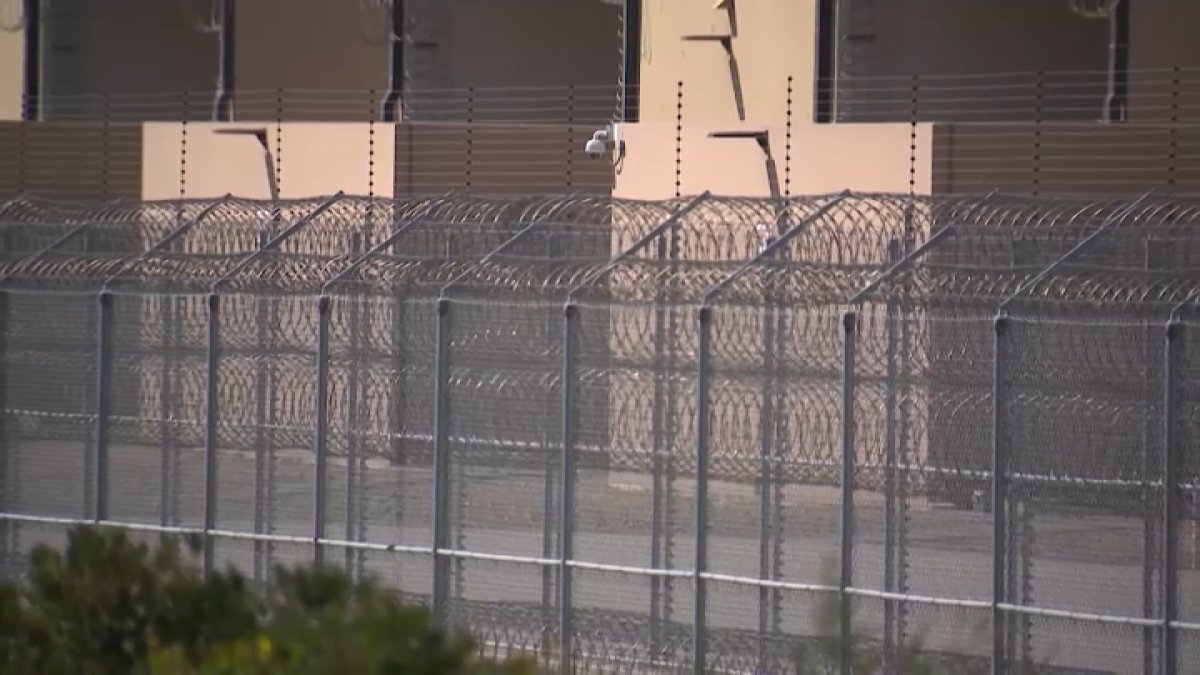
A federal judge on Wednesday ruled that ICE must allow San Diego County to conduct a health inspection of the Otay Mesa Detention Center by June 17.
The ruling came after months of complaints from people held at the facility about bad food, cold temperatures and harsh conditions, which prompted two county supervisors in February to initiate an inspection.
Supervisors Terra Lawson-Remer and Paloma Aguirre were turned away, showing emails indicating prior approval, while the county’s health officer was let in but not allowed to speak with detainees nor see things like medical records, which would be needed to conduct the full inspection.
The county filed a federal lawsuit, and on Wednesday, a judge granted its request for a preliminary injunction. The order requires the Department of Homeland Security, ICE and CoreCivic, the private prison company that runs the facility, to let a team of up to four subject-matter experts – but not the supervisors themselves – inside for a health and safety inspection up to the standards of state law.
The team must be allowed to talk to detainees who agree to speak with them, the order said.
“San Diego County has set the gold standard for the rest of the state with this win,” Lawson-Remer said in a statement on the ruling. “It’s an enormous victory for immigrant rights, and for the 1,400 detainees at Otay Mesa Detention Center and thousands of other detained immigrants throughout the state of California.”
The county has said the lawsuit was the first of its kind to be filed in relation to the statutory authority to conduct inspections of federal detention centers granted by state law.
“This ruling sends a powerful message to the Trump administration that accountability matters and that the health and well-being of detained immigrants cannot be ignored,” Lawson-Remer continued.
“We are glad that our county staff will still be able to conduct these inspections and exercise our legal right,” Aguirre added. “This has always been about fundamental accountability. We have a duty to oversee what happens within our borders and ensure that every individual is being treated humanely, safely and with dignity. We will continue to use every tool at our disposal to hold those in charge accountable. This is a win for California.”
“ICE complies with all court orders as soon as it receives sufficient notice to do so,” Acting Assistant DHS Secretary Lauren Bis said in a statement when asked about the ruling.
“All detainees are provided with proper meals, quality water, blankets, medical treatment and have opportunities to communicate with their family members and lawyers,” Bis continued. “ICE has higher detention standards than most U.S. prisons that hold actual U.S. citizens.”
CoreCivic has repeatedly said the “safety, health and well-being of the individuals entrusted to our care is our top priority” and that their facilities are regularly audited.
“The leadership and staff at OMDC welcome the oversight of the San Diego County Health and Human Services Agency,” CoreCivic added Thursday.
The ruling came just a few weeks after the California Department of Justice released its report on immigration detention centers across the state. The report is the DOJ’s fifth since 2019 and provided a preview of what the county might find.
Attorney General Rob Bonta said Thursday that the DOJ found that as the number of people in the facilities increased amid President Donald Trump’s mass deportations, the centers were not equipped to accommodate those surges.
“At Otay Mesa in particular, detainees didn’t have access to toilets as they are required to under the governing rules,” Bonta said. “There was a lack of cleanliness of the showers and the toilets. There was inadequate food at times. There were conditions that were substandard and, honestly, frankly, subhuman.”
The report said the site visit took place over two days in October 2025 and DOJ staff interviewed dozens of detainees. The vast majority (82.5%) of the 1,433 people held there at the time were classified as the lowest level of threat.
“Overcrowding is a big concern at the facility, where overflow detainees sleep on ‘boats’ placed on the floor due to the unavailability of beds,” the report reads, noting a report that one 89-year-old detainee was assigned to a “boat” on the floor and other detainees helped that individual get in and out of bed.
“Additionally, several detainees stated that the food portions were too small, one describing the portions as ‘just enough to survive’ but leaving them constantly hungry,” the report stated. “Many reported that food that is supposed to be hot is often cold, not thoroughly cooked or expired; describing bad-smelling or half-cooked chicken, raw meat, undercooked pasta and expired milk and tuna. One person also recalled finding pebbles in their food. Some stated that the food made them sick and led to stomach problems.”
“Bad food but you’ve got to eat,” said Joel Palacios, who spent seven months at the Otay Mesa Detention Center and said he lost 20 pounds.
Andrea Salas, whose son Oscar has been at the detention center for almost a month, said he’s told her the same.
“He looked emaciated,” Salas said in Spanish of her visit with him. “It broke my heart.”
“He’s told me he’s desperate, that the food is terrible,” Salas continued in Spanish. “He eats it because he has to eat, but it’s awful, he says.”
Salas and Palacio both said they were glad to hear the county will be allowed inside.
“Knowing authorities will inspect the facility makes me happy because we’ve heard of serious health problems there,” Salas said.
“That’s good because they can see what’s going on,” Palacio added. “Those guys have got to open the door to … go in and check it out and do a little better than what [they’re] doing, because there’s a lot of people inside.”
The DOJ report also stated that half of the detainees interviewed also flagged issues with access to water and described bugs coming from the sinks, mildew and mold on the faucets, as well as a bad taste and a foul smell to the water.
“They’re cruel, they are inhumane,” Bonta said of the conditions found, noting they had declined since the last report. “What were already substandard conditions are only getting worse. The conditions are deteriorating, eroding, worsening. And that’s completely unacceptable. And it needs to change.”
CoreCivic said in a statement that the company has “significant concerns about the accuracy of several findings in this report, which do not reflect the documented operational record at our California City and Otay Mesa facilities.”
“That record has been verified by independent auditors, federal oversight officials and elected officials who have toured these facilities firsthand,” CoreCivic said. “It’s worth noting that a substantial portion of the findings are based on secondhand reports rather than independently verified observations. CoreCivic has consistently rebutted these same claims with documented, verifiable evidence.”