
Market Match gives shoppers who use CalFresh (California’s name for the federal Supplemental Nutrition Assistance Program) a dollar-for-dollar match of up to $15 per visit to purchase fresh produce at farm-direct sites like certified farmers’ markets, mobile markets, and farmstands. The Fruit and Vegetable Program provides a dollar-for-dollar match of up to $60 per month, instantly rebated to a CalFresh shopper’s EBT card when they buy fresh produce at participating grocery stores.
As professionals who have worked to advance healthy, just, and resilient food and agriculture policies throughout our careers, we know first-hand the extensive economic and community benefits of state investments like these—not only to CalFresh participants but also to food retailers and small-scale farmers. Unlike traditional charitable feeding programs that often rely on food donations or offer inconsistent access to fresh, culturally relevant foods, Market Match and the Fruit and Vegetable Program provide supplemental benefits that work like cash. They give consumers the freedom to choose from California’s produce bounty while supporting the state’s food and farming economies.
Without new funding, however, these programs could disappear from our statewide nutrition safety net—precisely when federal support is also shrinking. With only days to go until the June 15 deadline for passing a state budget, the California legislature and Governor Newsom must prioritize funding that increases healthy food access for our state’s most vulnerable populations.
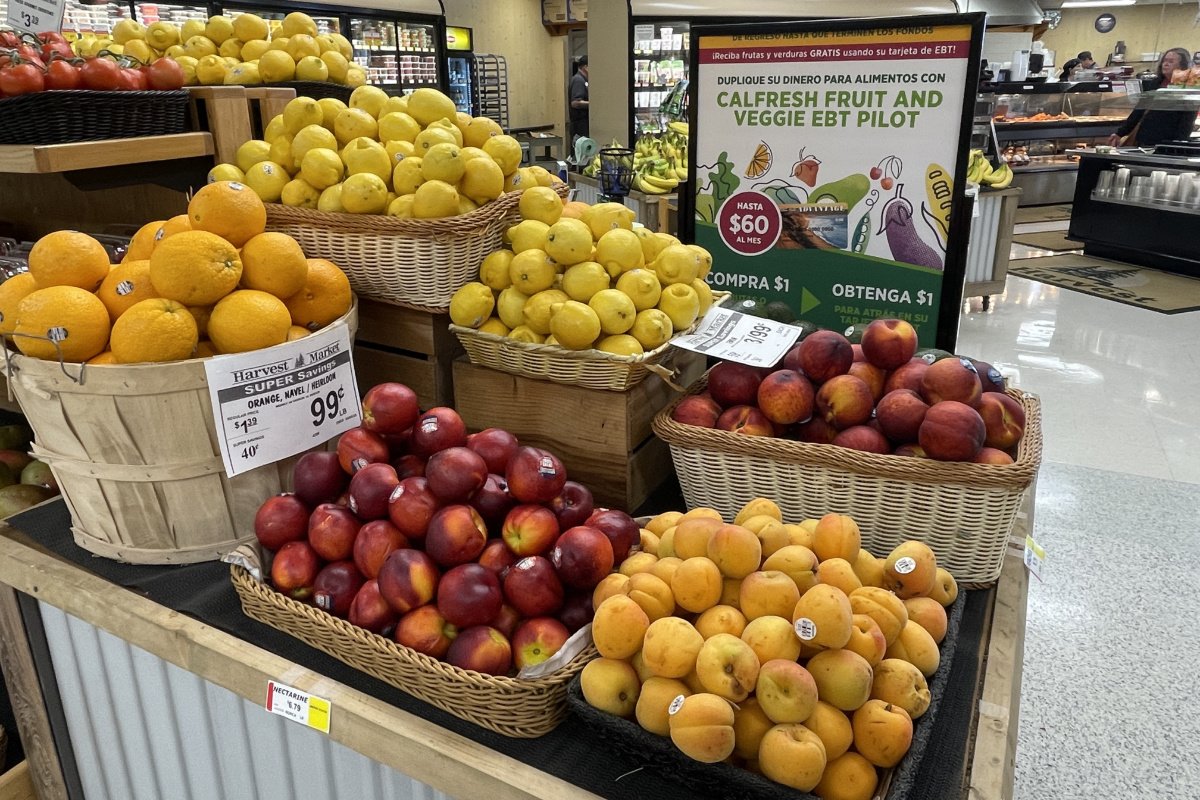
A promotion for the CalFresh Fruit and Vegetable EBT pilot program at a Harvest Market store in Fort Bragg, California. (Photo courtesy of Denisse Becerra / Fullwell)
Long before the steep cuts to food assistance mandated by last year’s federal budget bill began taking effect, low-income Californians were struggling to put healthy food on the table. In 2024, federal CalFresh benefits did not cover the cost of a moderately priced meal in all 58 California counties. For years, CalFresh benefit amounts have tended to fall short of families’ needs, with a significant number of participants running out of money before month’s end.
California’s supplemental CalFresh programs stepped in to fill the nutritional gap. The Fruit and Vegetable Program, championed by state Senator Scott Wiener (D-District 11) and Assemblymember Alex Lee (D-District 24), is a documented success at alleviating hunger and increasing access to healthy, minimally processed foods. Administered by the California Department of Social Services and first piloted in 2023, it is operating for a third year thanks to a $36 million allocation in the current budget. Yet without additional resources, it is expected to run out of funds and shut down by the end of June.
Participation in the program, which operates in 91 grocery stores, has grown every month since it relaunched in November 2025, demonstrating its immense value in people’s lives. In April 2026 alone, the program reached 92,000 households, providing nearly $4.85 million in fruit and vegetable supplemental benefits. Since its inception, it has served more than 325,000 unique California households. Senator Wiener and Assemblymember Lee are seeking $100 million in next year’s budget to support the year-round operation of the Fruit and Vegetable Program and allow for modest expansion into currently unserved communities.
Market Match, the nationally recognized initiative that inspired the Fruit and Vegetable Program, is the largest state grant funded by the California Nutrition Incentive Program (CNIP). Administered by the California Department of Food & Agriculture, Market Match helps recipients of CalFresh, Senior Farmers Market Nutrition Program, and Women, Infants and Children (WIC) purchase California-grown fresh fruits and vegetables. Although Market Match has a 15-year track record of improving nutrition and increasing agricultural sales, it too is at risk of being eliminated. Program funding will run out in early 2027 without additional resources.
In 2025 alone, Market Match supported more than 627,000 shoppers at nearly 300 farmers’ markets, delivered nearly 50 million servings of California-grown produce statewide, and kept food dollars in communities where they were spent. Every dollar spent with local family farmers generates $3 for the local economy. Market Match also draws down federal funding through the U.S. Department of Agriculture’s Gus Schumacher Nutrition Incentive Program.
Senator Josh Becker (D-District 13) and Assemblymember Damon Connolly (D-District 12) have championed a phased budget request for CNIP/Market Match funding, starting with $20 million in the 2026-27 budget cycle, increasing to $30 million in 2027-2028, and building to $50 million in 2028-2029. This would allow the program to expand to all farmers’ markets statewide and increase the match from $15 to $20 per visit.
Developing a budget plan that appropriately mitigates the H.R. 1 mandates has, understandably, been a priority for Governor Newsom and the Legislature this year. However, leaving Market Match and the Fruit and Vegetable Program unfunded—which may seem like savings now—will place a strain on future administrations and on our state’s welfare.