
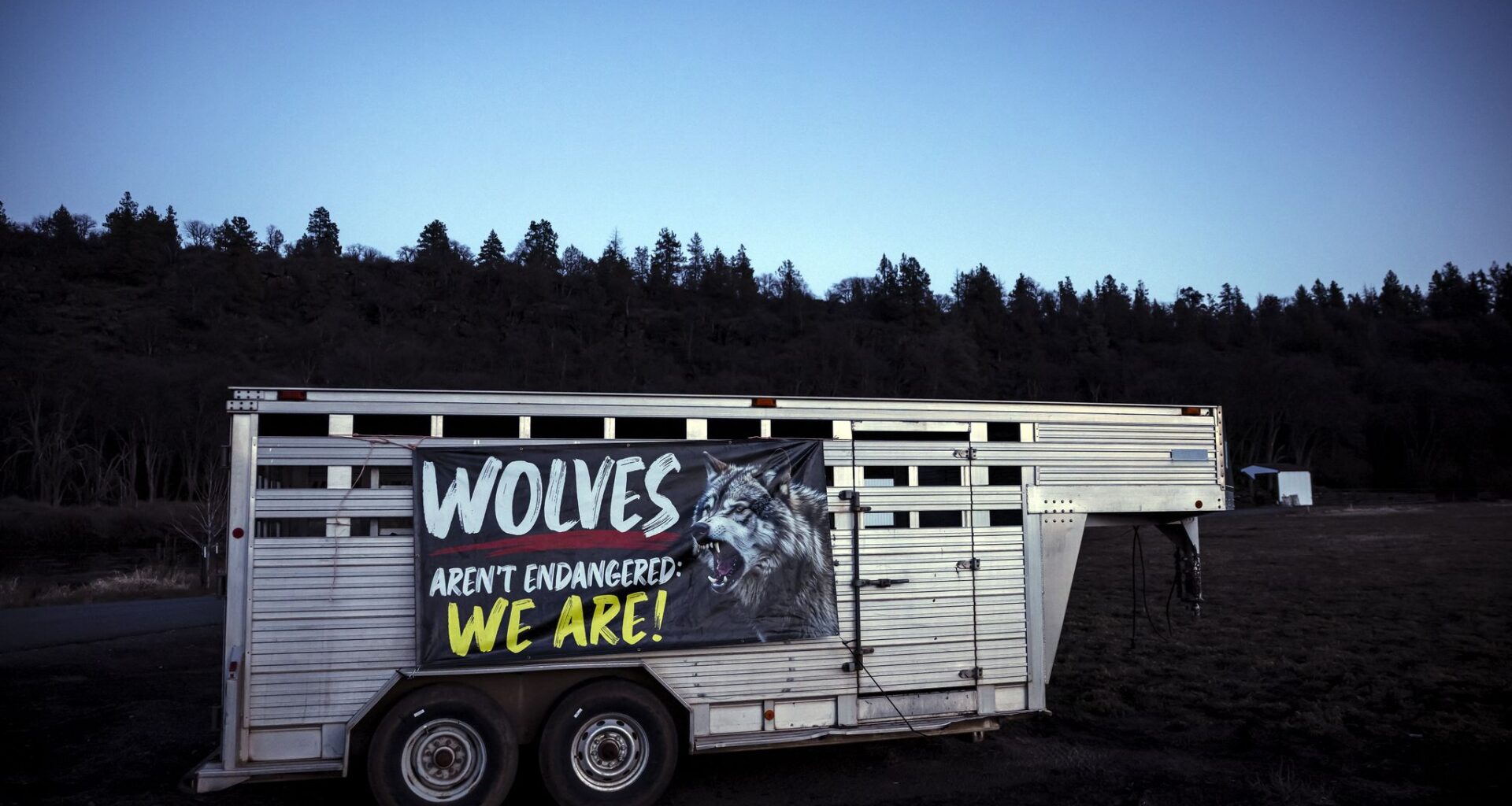
A rancher’s banner decries the growing wolf population near MacArthur, Calif., on Jan. 28, 2026.
Carlos Avila Gonzalez/S.F. Chronicle
The state budget proposed by Gov. Gavin Newsom, set for final consideration this month, includes little or no funding for programs central to managing California’s emerging wolf population — a shortfall that both friends and foes of wolves say could lead to problems.
Conservation groups supportive of the wolf’s return to the state, after its eradication a century ago, claim more money is needed to ensure the endangered animal makes it in California. Ranching communities wary of predation argue more money is needed to contain the wolves and offset their sometimes gruesome impacts.
The two sides have forged an unlikely alliance urging the governor and Legislature to comprehensively increase funding for wildlife management. Without sufficient outlays for two programs in particular — one that helps lessen human-wildlife conflicts and another that reimburses ranchers for wolf attacks on livestock — the allied groups say wolves and other top predators will struggle to thrive and co-exist with people in the modern age.
Article continues below this ad
“This is the only time you’ve seen the Center for Biological Diversity and the cattlemen’s association on the same letterhead,” said Kirk Wilbur, vice president of government affairs at the California Cattlemen’s Association. “Regardless of what side of the aisle you’re on, you want to see the (wildlife) programs adequately funded.”
Other organizations joining the campaign for greater investment in wildlife include the California Farm Bureau and Western United Dairies, which have viewed wolves largely as a threat to livestock and sought greater predator controls, and the Sierra Club, Defenders of Wildlife and National Wildlife Federation, which have championed wolf recovery and opposed aggressive restraints.
San Francisco Chronicle Logo
Make us a Preferred Source to get more of our news when you search.
Add Preferred Source
The re-establishment of wolves in California began last decade, when the storied canines began moving in from other states. Their comeback is widely seen as a conservation triumph but in some rural areas, where wolves have preyed on cattle, there’s been resistance. About 10 wolf packs currently roam parts of the state, mostly in the far north.
The Newsom administration didn’t comment on the funding for wolves and other wildlife when contacted by the Chronicle. While state budget revenues aren’t much different than they were in the last few years, the governor has made a point of trying to reduce spending and strengthen the state’s financial health before leaving office in January.
Article continues below this ad
His proposed 2026-2027 budget, taking effect July 1, offers no funding for the state’s Wolf-Livestock Compensation Program, which provides financial reimbursement to ranchers whose livestock is killed by wolves. The current budget included $2 million for the program.
The California Department of Fish and Wildlife, which oversees wolf management, has promoted the compensation program as a way to not only to make ranchers whole but increase buy-in for the recovery.
The program, launched in 2022 with a $3 million allocation, initially extended the reimbursement to wolf deterrence measures, like building fences, and it provided “pay for presence” funds to compensate ranchers for the stress wolves put on livestock. Payments for these purposes have since been dropped, though both ranching and conservation groups are pushing to restore them. They’d like to see millions more allocated for compensation.
Another program, the Human Wildlife Conflict Program, will receive a $1 million allocation under the proposed 2026-2027 budget, but the interest groups say this funding is also millions of dollars short of what it should be.
The program is aimed at boosting the state’s response to wildlife conflicts, not just with wolves but other animals in both rural and urban areas. The on-and-off-again funding for the program, which included $7 million in the 2021-22 fiscal year and $5 million in 2022-23, has helped pay for 20 short-term staff to handle and help prevent wildlife problems. The funding also went toward improvements to state wildlife tracking systems.
Article continues below this ad
“It’s a total misstep to not have continued funding for this,” said Pamela Flick, California program director for Defenders of Wildlife. “With the growing human population and increased effects of climate change, wildlife and humans are coming into more contact than ever before — not less. So we really need a robust program.”
The Legislature is required to approve the governor’s budget by June 15, and the governor is required to sign it into law by June 30. Lawmakers often pass a placeholder budget by June 15 to ensure they continue getting paid, and to give themselves more negotiating time before the new budget goes into effect on July 1, the start of the fiscal year.
Arthur Middleton, a professor of wildlife management at UC Berkeley who has been helping the state navigate the controversial return of wolves, worries that the state’s dearth of wildlife funding signals a broader shift away from responsibly stewarding wolves as well as bears, mountain lions, coyotes and other animals.
Middleton warns that a lack of proactive management could allow more situations to escalate like the conflict last year in Sierra Valley (Plumas and Sierra counties). There, a pack of wolves was infuriating ranchers after it became acclimated to eating cattle. State officials resorted to a $1.4 million hazing program, but that didn’t work, so they shot four wolves.
Article continues below this ad
“Given the urgency of the crisis and the breadth of the coalition working on solutions including the current funding request, it’s a gut punch,” he said. “California is rallying to have big predators in abundance — without wanting to pay for it.”