
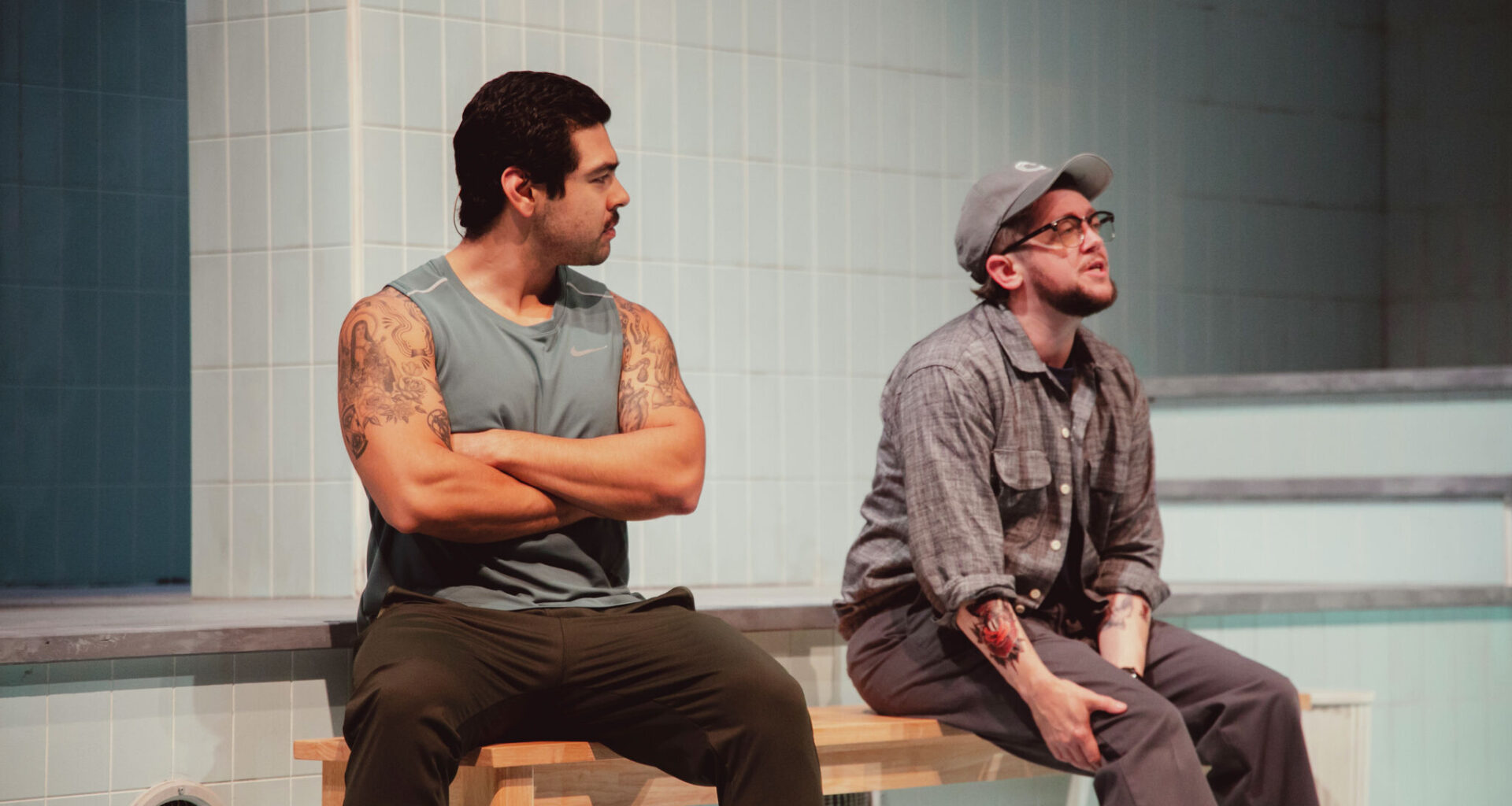
Laura Domingo, left, and Petey Gibson in “Becoming a Man” at Z Space.
Kayleigh McCollum/Z Space
In a way, Carl and Lynette are just like any other longtime couple. They know each other’s flaws as no one else does, and when they finally fling them at each other in a shouting match, it’s like rending skin. The marriage could be over.
But in the gem of a play “Becoming a Man,” Carl (Petey Gibson) and Lynette (Laura Domingo) are also like few other couples in history. Carl has just undergone a gender transition, and what was once a lesbian relationship now looks, to the outside world, like a straight one. Just as Carl is finally feeling comfortable in his own skin for the first time in his life, practically blazing with gender euphoria, Lynette is struggling to say his new name aloud — or even feel attracted to him.
P. Carl’s searingly, squirm-inducingly honest play, adapted from his memoir of the same name, flows back and forth in time to Polly (Shoana T. Hunt), Carl’s pre-transition self. In scenes set in the past, she curls in on herself, muffling and stilting her speech, unsure what’s wrong with her and why she keeps winding up in the psych ward. In the present, she’s like Carl’s older sister, stepping in to chide him when he overindulges in his newfound male privilege.
Article continues below this ad
Shoana T. Hunt, above, and Petey Gibson in “Becoming a Man.”
Kayleigh McCollum/Z Space
How easy it is for this expert in gender theory and Pride parade marcher to start bashing feminism and the wife once he’s surrounded by fellow he-men in the local bar.

“Becoming a Man”: Written by P. Carl. Directed by Lyam B. Gabel. Through June 14. 90 minutes. $35-$75. Z Space, 450 Florida St., S.F. 415-626-0453. www.zspace.org
Love is love, so we hear, and embracing true identities, in all their rainbow colors, is supposed to be the highest good, no questions asked. But the show, which I saw Thursday, June 4, at Z Space, creates space for breath, messiness and humanity underneath the slogans.
San Francisco Chronicle Logo
Make us a Preferred Source to get more of our news when you search.
Add Preferred Source
Carl admits he “kind of” likes being perceived as straight. Lynette confesses to Carl, of Polly, “I miss her.” If the play is called “Becoming a Man,” its mission might be to help the world become a place where people can sincerely say things like that without instantly getting written off as chauvinistic or transphobic.
Article continues below this ad
The show, directed by Lyam B. Gabel, spends a lot of time discussing mental health — which might be necessary to depict just how miserable Carl was in the gender he was assigned at birth, how his transition was “life or death.” But all the therapy-speak feels navel-gazey, like the product of someone who’s spent a lot of time paying professionals to listen to them.
Shoana T. Hunt, left, and Laura Domingo in “Becoming a Man.”
Kayleigh McCollum/Z Space
It might be true, as Carl’s mother (JoAnne Winter) tells Carl, that he was “valedictorian of your high school class. The first doctor on either side of the family. You’re our superstar.” But it’s still cringey to include a line like that in your own autobiographical play.
Gibson, with an endearing, low-key naturalism, mitigates those missteps. His eyes often downcast, a wry smile on his face as he shuffles along, it’s as if he’s got a movie projected around him that only he can see.
Sometimes, in moments of crisis, Sarah Phykitt’s video design and Joseph Amodei’s sound design let us in on what he’s experiencing. Wavy lines of light distort the swimming pool walls of Randy Wong-Westbrooke’s set. A movie reel whirs, but it sounds like it’s moving back and forth, eluding our grasp — or maybe it’s a clock ticking down to detonation.
Article continues below this ad
The set is a tile-lined pool because, as Carl explains, he only ever wanted to swim once he was in the correct body, in the right kind of swimsuit.
Eric Esquivel-Gutierrez, left, and Petey Gibson in “Becoming a Man.”
Kayleigh McCollum/Z Space
In one of the show’s most poetic moments, his trainer, Eddie (Eric Esquivel-Gutierrez), tells him, “Part of being a good swimmer is feeling the water against your skin. Sometimes when I watch you, I think your body is pushing the water away.”
So much of contemporary life is about denying, managing or repressing the body, and it’s a woo-woo cliche to urge us to listen to it instead. “Becoming a Man” makes the body’s calls refreshingly matter-of-fact.
Article continues below this ad
Dive in, it says. Isn’t your skin already tickling in anticipation?