
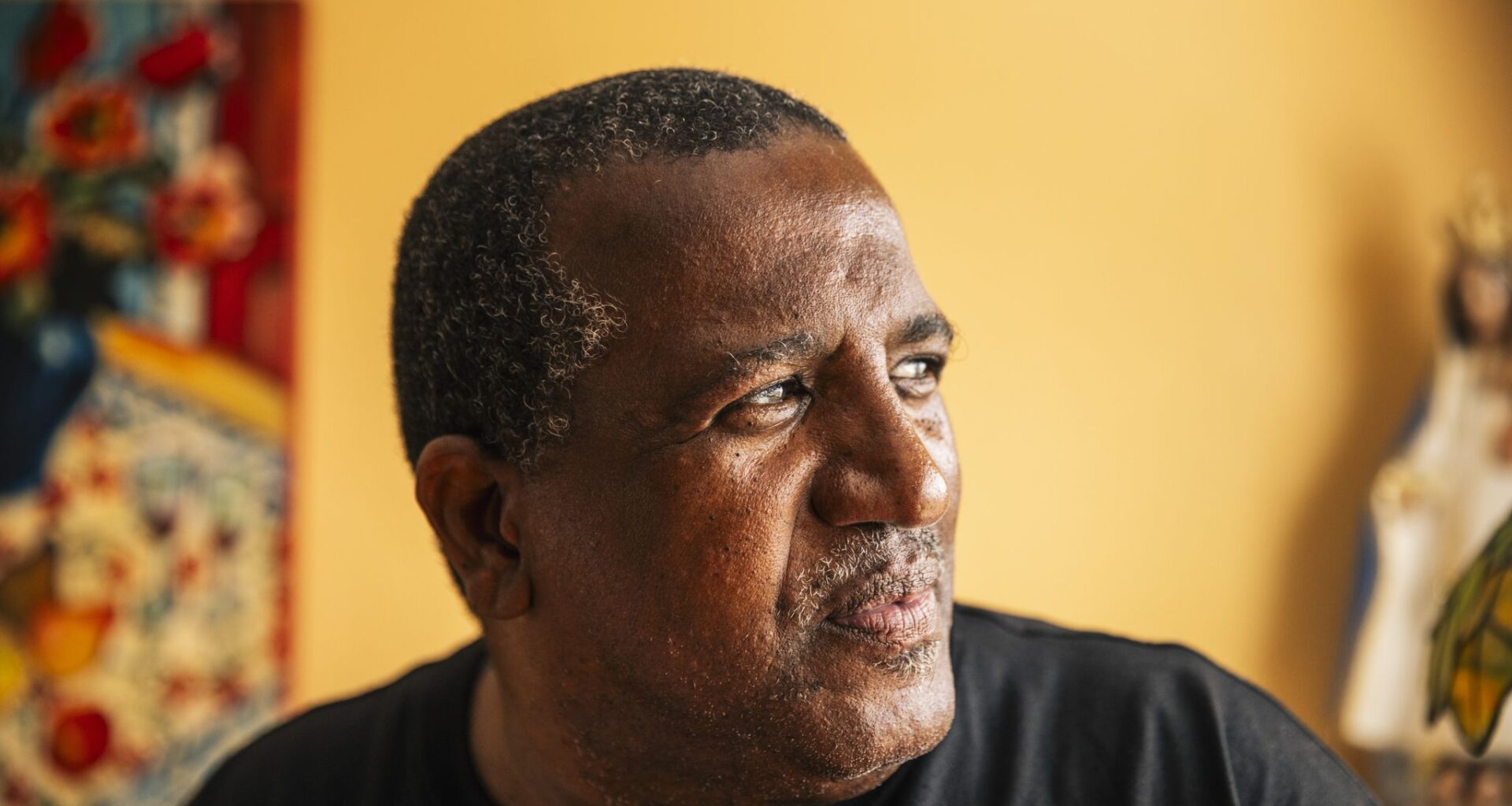
Joaquin Ciria, who was released from incarceration in 2022 after 32 years of wrongful imprisonment, stands for a portrait at his brother’s home in San Francisco in 2023.
Stephen Lam/The Chronicle
Joaquin Ciria, who was freed from prison with the support of then-District Attorney Chesa Boudin, has won a federal appeals court’s approval to sue San Francisco police after spending 32 years incarcerated for a murder he didn’t commit.
A ruling Friday by a divided panel of the 9th U.S. Circuit Court of Appeals puts a suit filed by Ciria against the city in 2022 a step closer to reality. The city could still ask the full appeals court for a new hearing before a larger panel, and later seek review in the Supreme Court.
Ciria, now 65, has maintained that he did not fatally shoot his best friend, Felix “Carlos” Bastarrica, 30, in an alley south of Market Street in 1990, in what prosecutors described as a drug-related murder. He was convicted in 1991.
Article continues below this ad
In 2019, a friend of Ciria’s from childhood in Cuba told Ciria’s mother that he had witnessed another man commit the murder but had failed to come forward because he feared being outed as a police informant. Later, the chief prosecution witness, George Varela, 18, who admitted driving the killer, said officers had threatened to charge him with murder unless he implicated Ciria.
Ciria was eligible for parole while in prison but was repeatedly denied release by the parole board after continuing to deny his guilt.
San Francisco Chronicle Logo
Make us a Preferred Source to get more of our news when you search.
Add Preferred Source
Boudin created a commission in 2020 to review claims of innocence by incarcerated people and it recommended Ciria receive a new trial. The commission’s work was echoed by attorney Ellen Eggers and the Northern California Innocence Project.
Ciria’s case was the first to be addressed by the commission. Boudin said police had “inappropriately pressed the star witness (Varela) to identify Ciria.”
Article continues below this ad
A Superior Court judge overturned Ciria’s conviction in 2022 and ordered him freed. He is now seeking damages for fabrication of evidence and malicious prosecution.
Joaquin Ciria becomes emotional with family friend Marina Flores as he walks out of the San Francisco Sheriff’s Department as a free man in 2022.
Brontë Wittpenn/The Chronicle
He is one of seven San Francisco defendants, all of them Black, whose convictions between 1974 and 2010 were later overturned, according to the National Registry of Exonerations.
Boudin was later recalled from office in a campaign led by tough-on-crime advocates, and his successor, Brooke Jenkins, has sided with prosecutors in the case.
In Friday’s 2-1 ruling, the appeals court said that, based on Varela’s statements and other evidence, “a jury could reasonably conclude that (police Inspectors Arthur Gerrans and James Crowley) used coercive or abusive tactics during Varela’s interrogation to fabricate evidence against Ciria.”
Article continues below this ad
Jurors could also find that the inspectors “knew or should have known Varela was not telling the truth but merely adopting the fabricated story they fed him,” Judge Richard Paez wrote in the majority opinion. “He was evidently going along with their version of events to avoid a murder charge; and there was minimal objective evidence that Ciria was the shooter at the time of the interrogation.”
Paez was joined by Judge Mary Schroeder. In dissent, Judge Eric Miller said that even if the officers violated Ciria’s constitutional rights, those rights were not “clearly established” at the time of the investigation in 1990.
The officers did not use or threaten to use force against Varela, they employed “standard interrogation methods,” and a reasonable officer could have concluded that Ciria, who had a criminal record and knew the victim, could have been the shooter, Miller said.
Paez was appointed by President Bill Clinton, Schroeder by President Jimmy Carter, and Miller by President Donald Trump.
“We are disappointed by the court’s ruling,” said Jen Kwart, spokesperson for City Attorney David Chiu, which represented the city in the case. “We are reviewing the decision and will determine any appropriate next steps.”
Article continues below this ad
Varela has refused to give further testimony about the killing.
According to the lawsuit, the Innocence Commission found that the Police Department secretly paid a witness $10,000 for her testimony incriminating Ciria.