
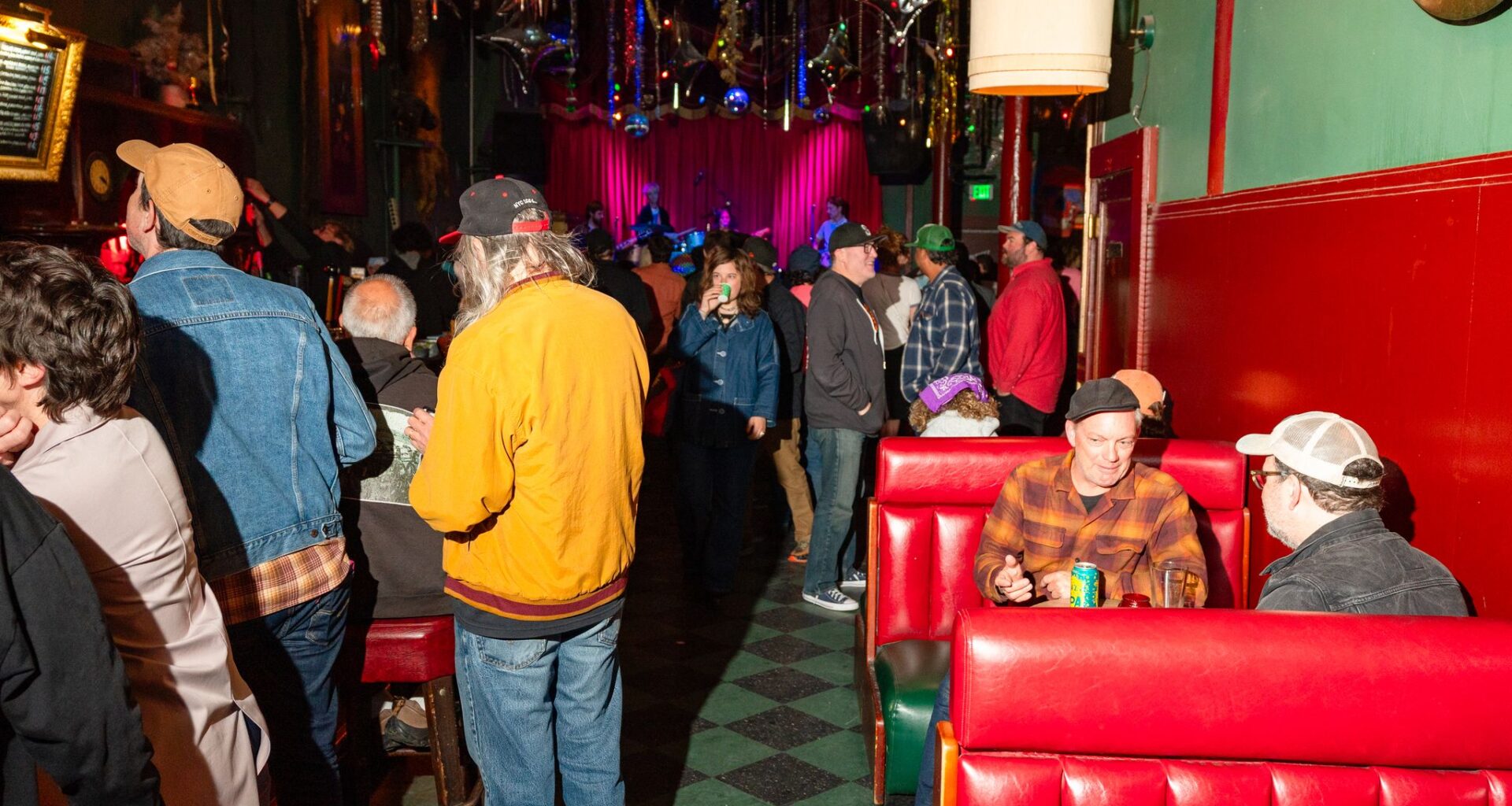
People gather at the Make-Out Room as opening band Rily performs before Kelley Stoltz in San Francisco in May. The bar in the Mission District is up for sale after 30 years.
Adam Pardee/For the S.F. Chronicle
It’s been a rough year for independent music venues in San Francisco.
January brought news that a pair of Potrero Hill punk rock clubs, Bottom of Hill and Thee Parkside, would both be closing. Bottom of The Hill will host its last show on New Year’s eve. Thee Parkside, which lost its lease after investors bought the property for $1.3 million, is going dark on July 5.
Black and red graffiti scrawled on the patio concrete walls at Thee Parkside states “this will be condos you can’t afford.”
Article continues below this ad
Now the community of musicians who keep the Mission District rocking is bracing for more change: Longtime owner Marty Rapalski is selling the Make-Out Room and the Latin American Club.
Marketing materials for both businesses tout “a rare opportunity to become the next owner of two of San Francisco’s coolest, sexiest bars.” The Make-Out Room, which pays $9,200 a month in rent, is being offered for $400,000. The Latin American, which pays $6,130, is listed at $300,000. Both bars are profitable, according to the sales deck.
The Make Out Room, on 22nd Street in the Mission District, has hosted bands for three decades.
Adam Pardee/For the S.F. Chronicle
“Become a neighborhood hero by keeping a couple of soulful joints alive in a community that cares about its landmarks,” the brochure states.
San Francisco Chronicle Logo
Make us a Preferred Source to get more of our news when you search.
Add Preferred Source
Rapalski says he is ready to retire from the nightlife business.
Article continues below this ad
“I tell people I am selling and they are like, ‘nooo’ – they are super bummed,” said Rapalski, who plans to move abroad. “But I have to retire eventually. I have been doing this for so long. I want to do something else. My heart is not in it any more like it was.”
For more than three decades the two Mission District establishments, located on the same block of 22nd Street, have nurtured an ecosystem of musicians and songwriters that have helped ensure that San Francisco holds on as a bastion of rock ’n’ roll innovation despite waves of tech wealth and displacement that have priced many artists out of the city.
The Make-Out Room, a dark narrow club with red naugahyde booths and silver streamers and disco balls hanging from the ceiling, has been a band incubator and dance hall, a rock ’n’ roll employment agency where the doorman and and beer server and swamper are likely to have as much musical chops as the players on stage.
Across the road, the Latin American Club is 22nd Street’s laid-back front parlor, a warm breezy room with big windows and modernist pinatas and 1950s formica dinette sets, a place to meet friends before a show and watch the neighborhood amble by.
Make-Out Room bartender Lance Kramer speaks to customers inside the Latin American Club in San Francisco. The bar is up for sale.
Adam Pardee/For the S.F. Chronicle
Rapalski opened the Latin American Club in 1993. At the time what is now the Make-Out Room was the Transfer Club, known for its six-piece salsa bands and staying open until 4 a.m. Rapalski was working in the Latin American when Walter Castillo, who owned Transfer Club, walked into the bar and asked him if he wanted to “buy a pinball machine.”
Article continues below this ad
“I said ‘No thanks, Walter, I don’t really have the room for it — too much real estate,’” said Rapalski. “The next day he came back over and said, ‘Do you want to buy a bar?’ I was like ‘OK, maybe.’ We went down and took a look.”
From the beginning the Make-Out Room, with a capacity of 150, punched above its weight in terms of music, supplementing a diet of indie rock with everything from weddings to free jazz, poetry readings to pulsating dance nights.
Make Out Room owner Marty Rapalski is selling the bar, and the nearby Latin American Club. He said the bars, which are for sale, have attracted offers from people who want to preserve what their status as live music venues.
Adam Pardee/For the S.F. Chronicle
Cake has played there. As has Norah Jones, Death Cab For Cutie, Tracy Chapman, the Decemberists and Calexico. Jonathan Richmond does a residency every summer and San Francisco-based acclaimed rockers Kelley Stoltz and Chuck Prophet and Mark Eitzel return to the stage year after year despite playing much larger clubs and theaters across Europe and the United States.
Stoltz, who played a record release party in late May for his 19th album, recalled the first time Rapalski called him.
Article continues below this ad
“In those days you would call and press star and listen to your messages, and my God it was Martin Rapolski calling and offering me a gig at the Make Out Room,” Stoltz said. “It may well have been Radio City Music Hall calling.”
Like dozens of other musicians who played the Make Out Room, Stoltz also worked as a barback there. Other musicians who have been employed at the Make Out and Latin American include songwriter Tom Hayman, who continues to work the door on weekends, as well as members of the Osees, Hiss Golden Messenger, Court and Spark.
Kelley Stoltz performs at the Make Out Room in San Francisco in May.
Adam Pardee/For the S.F. Chronicle
Even Rapolski’s attorney, Ragi Dindial, is a drummer who has played hundreds of sets at the Make-Out and Guy Carson, the real estate broker who has the listing for the two bars, is a founding member of the influential art rock band the Potato Eaters.
Stoltz said he and fellow musicians “have kicked around the idea of making a double LP of every group that has had a member who has worked here because he employed the whole Mission scene.”
Article continues below this ad
Amy Morris Gibbs, who has managed both the Make-Out and Latin American for 18 years, estimates that 80% of the staff of both places has been made up of musicians.
“We are a safe place, very accepting,” Gibbs said. “It’s friends and musicians and neighborhood folks. There is no specific kind of person that comes to either bar and that’s lovely. That’s the city.”
Make Out Room manager Amy Gibbs and her husband, Make-Out Room promoter Parker Gibbs, pose for a photo inside the Latin American Club. Amy said most of the people who have worked at the club have been musicians.
Adam Pardee/For the S.F. Chronicle
Marc Capelle, a Mission District musician who leads Marc & the Casuals and the Red Room Orchestra, said the Make-Out Room’s sound is distinctive because of a hollow two-tiered stage “that makes not a lot of sense.” Capelle, who plays trumpet, piano and sings, said his goal from the beginning was to “score a hat trick” by playing in three of four bands playing on a given night.
It’s something he has done too many times to count.
“I was in, immediately, when I sniffed fun, love and music,” he said. “You showed up there and everyone was so happy and musical. We stand for an analog communication that has been diminished but fortunately there is still a hankering for.”
Matthew Edwards, whose multiple bands including the Music Lovers, have performed at the Make-Out over the decades, got married there.
“It’s my favorite place to play in the world. There are a couple of places I play in Paris, I play a place in London, I play a place in Birmingham. But the Make Out Room is, in my estimation, unsurpassed. I don’t know what I would have done as an artist in San Francisco without him.”
San Francisco Entertainment Commission President Ben Bleiman said he thinks the Make-Out Room would be attractive to an operator willing to capitalize on what the club has and expand it with more diverse offerings.
“There is a market right now for live music and dancing and authenticity,” Bleiman said. “What I am seeing post-COVID is the Gen Zers are going out more, they are learning how to socialize. Their habits are becoming more like other generations’ habits.”
Customers talk and enjoy their drinks inside the Latin American Club.
Adam Pardee/For the S.F. Chronicle
He pointed to Killowatt on 16th Street in the Mission, which has a robust music programming after having no live acts for two decades.
“They brought back Killowatt but in a very modern way,” he said. “It may feel like the punk rock club is back open, but they are putting an incredible amount of thought into how to bring people in there in modern times. They are meeting the market where it is.”
Meanwhile, 2027 may prove to be a more hopeful year. Rapalski said the two bars have attracted multiple offers from buyers who seem committed to preserving them. Bottom of The Hill co-owner Lynn Schwartz said that the club has also been focused on “finding someone who can make sure the venue honors our legacy but also makes it their own.”
“We have had so many exciting conversations — we are really really really hopeful we are going to find the right person,” she said. “To operate any venue successfully is an enormous labor of love. It takes so much patience. It’s like banging your head against a wall. It can be so difficult to see bands you love and treasure and go all out every time to be under-attended. If we give our name to someone we are going to make sure it stays awesome and I’m sure Marty feels the same way.”
Gibbs, the manager, said she would help ease a transition to new ownership but is also ready for a change. Stoltz said he is optimistic about the Make-Out Room’s future but understands that it will be different without Rapalski. He pointed to all the storied rock clubs of the past that didn’t survive like CBGB, The Mudd Club, The Matrix and Winterland.
“We hope that whoever takes over gets the mission of the place but we don’t know. They may say, ‘This is going to be a fantastic yoga studio.’ I have no idea — I hope they employ many young yogis who go on to great success as spiritual healers,” he said. “We all honed our craft here. We learned how to entertain and put on a show. We have sent a lot of San Francisco vibes out into the world and this has been the launch pad for a lot of that.”