
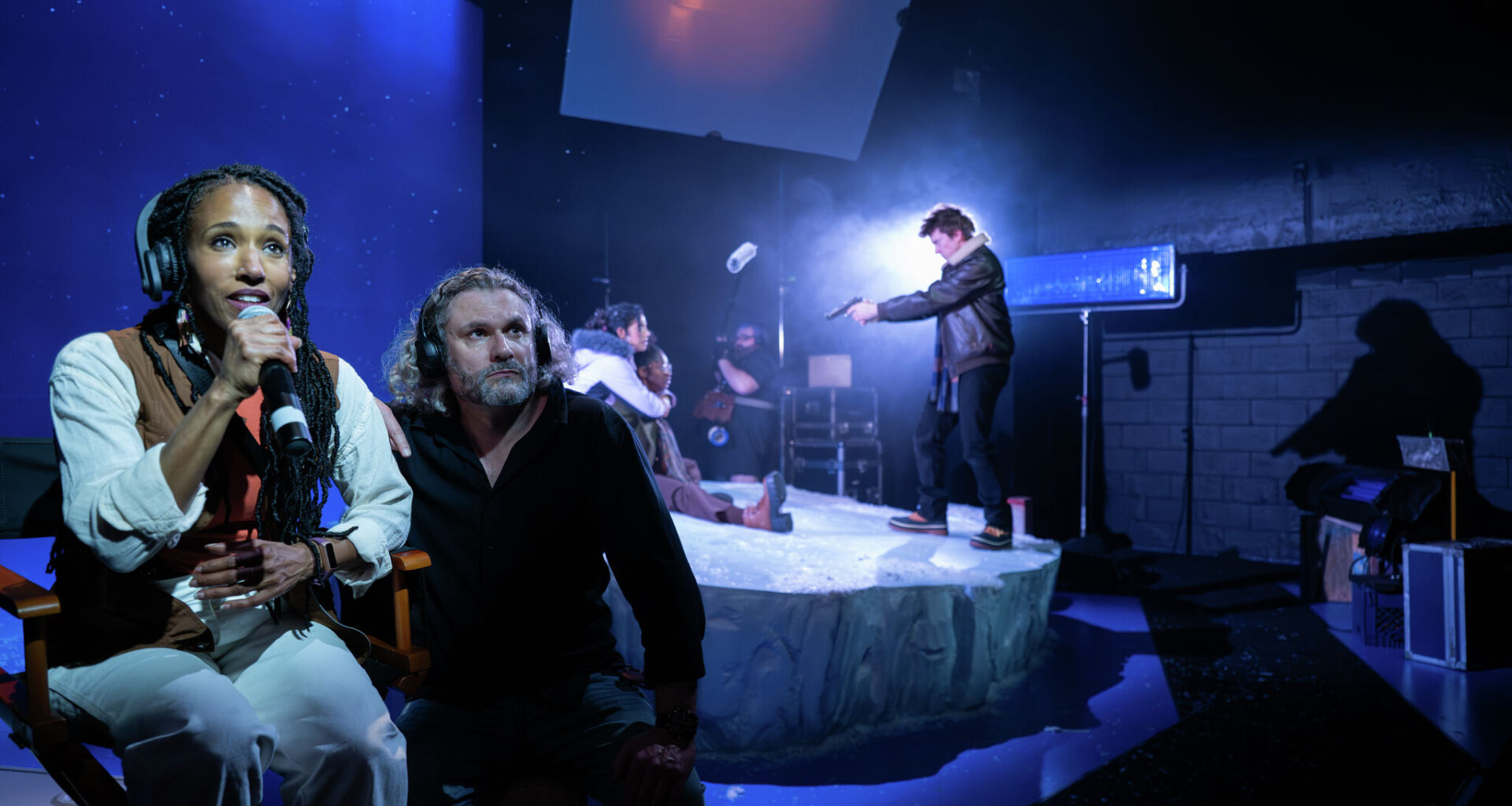
The cast of Shotgun Players’ “Continuity.”
Ben Krantz/Shotgun Players
Toward the end of “Continuity,” a scientist named Larry wonders what the point of making art about climate change is. When audiences partake of it, he says, “They unfortunately get the impression they’ve done something to help, when in fact they haven’t done anything at all.”
“Statistically speaking,” he adds, “the people who watch the most, help the least.”
By including such a metatheatrical line in her script, playwright Bess Wohl makes a big gamble. Succeed with her play set amid the filming of a Hollywood climate-change disaster flick, and she looks more clever than all those sincere, ecologically minded artists. Fail, and she’s written her show’s own coroner’s report.
Article continues below this ad
Shotgun Players’ production, which I saw Friday, June 5, at the Ashby Stage, falls mostly into the latter category.
Benoît Monin in “Continuity.”
Ben Krantz/Shotgun Players
The concept has satirical promise, though. Maria (Rezan Asfaw) is a director filming a scene set on melting ice, but the shoot location is in the New Mexico desert. The ice is made of Styrofoam, the actors are sweltering in their snowsuits and everyone’s thoughtlessly downing plastic bottles of water. The science in the screenplay by David (Benoît Monin) doesn’t really make sense, and the studio overlords are demanding a villain in the form of an ecoterrorist (Nicholas René Rodriguez) as well as a hopeful ending underscored by string orchestrations.
San Francisco Chronicle Logo
Make us a Preferred Source to get more of our news when you search.
Add Preferred Source
Hollywood tropes abound.
Article continues below this ad
Nicole (Regina Morones) is the coke-addled diva, David the cynical philanderer, Maria the tokenized woman of color heading her first big-budget film. A put-upon assistant director (Adam Mendez Jr.) and production assistant (Matt Standley) scramble about cleaning up messes and catering to imperious whims. Larry (Malcolm Rogers) is the nattering climatologist, representing the whole reason the movie’s supposedly getting made, who gets ignored or batted away.
Rezan Asfaw, left foreground, and Benoît Monin in “Continuity.”
Ben Krantz/Shotgun Players
Wohl might argue she’s puncturing, rather than perpetuating, all these stereotypes, but the utter lack of surprise in scene upon scene wearies. Plot points wheeze in, exhausted by their own inevitability.

“Continuity”: Written by Bess Wohl. Directed by Emilie Whelan. Through June 27. 90 minutes. $40-$80. Ashby Stage, 1901 Ashby Ave., Berkeley. 510-841-6500. https://shotgunplayers.org
Just as problematic is an uncertain tone. Director Emilie Whelan goes for neither larger-than-life zaniness, which would give us more permission to laugh, nor lived-in realism.
Article continues below this ad
Instead, her actors shadowbox in some liminal state. When major life revelations drop, everyone keeps chugging along, barely mustering a reaction. In the great game of hot potato that is comic dialogue, the tuber is frozen, and everyone lets it kersplat to the ground.
Still, a few moments break through. As a bit player whose part keeps getting cut down, Ije Success creates the layered expression of someone who sees much more than she lets on — and is perfectly comfortable not sharing any of that with the world. In one moment of filming, when Morones’ Nicole is especially unhinged, Success’ bewildered, “Do something!” expression as she turns toward the director makes her a delectably satisfying stand-in for the audience.
Nicholas René Rodriguez, left, Ije Success and Regina Morones in “Continuity.”
Ben Krantz/Shotgun Players
As himbo actor Jake, Nicholas René Rodriguez utters inanities like he’s deeply moved by his own profundity, and Standley’s PA is a riot in walks alone. His default stride is the stiff staccato of a broken man trying not to burn himself on hot lava, but then when the bigwigs push him past his limit, it morphs into a swaggering saunter that says, “I see you. Just try me.”
“Continuity” wants to honor what scientists are actually saying, and it wants to be realistic about art’s role in the fight to save our planet. But simply pointing out how other storytellers fail doesn’t make for a very satisfying artistic experience.
Article continues below this ad
It’s not just that Wohl doesn’t opt for false hope; she’s right to skewer that. It’s that she’s chosen something equally easy — satirizing low-hanging fruit — and she’s punted the real problem to future generations of artists and environmentalists to solve.