
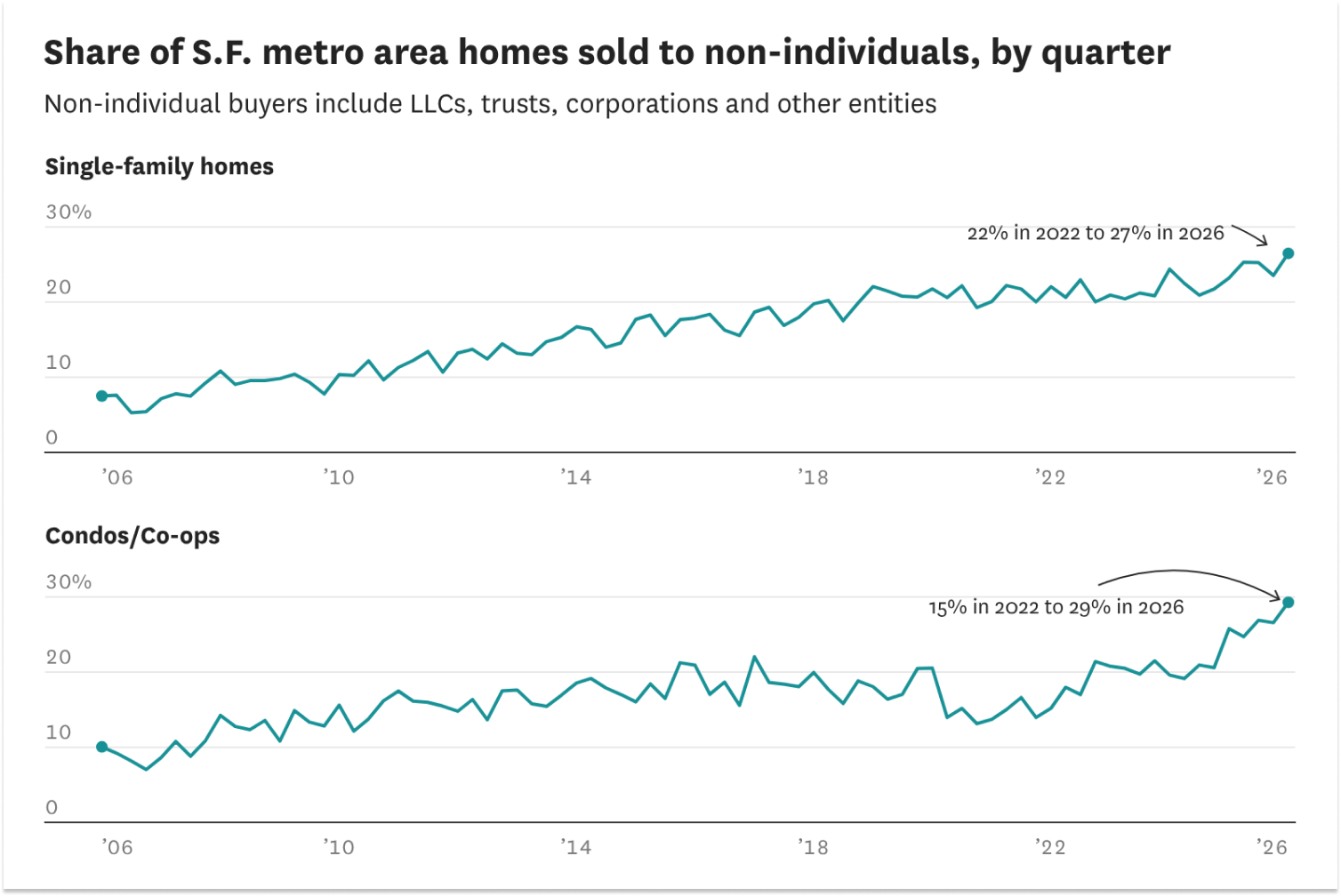
About 28% of homes sold in the San Francisco metropolitan area from January to March went not to individuals but to LLCs, corporations and trusts, according to an analysis of property records by Redfin. That was the highest share since 2000, the furthest back the real estate brokerage’s data goes, and a more than 3 percentage-point increase from the same period in 2025.
Redfin, which defines these buyers as investors, noted a recent report that the rise is striking considering investor purchases of homes in the U.S. overall have fallen to their lowest level since 2020. The company said a nationwide cooling of both home prices and rents caused investors to retreat from the market, potentially loosening competition for individual buyers. The fact that investors are becoming more active in the San Francisco metro area — which Redfin defines as San Francisco and San Mateo counties — is a sign of the market’s resurgence.
These entities have especially expanded their market share in the condominium market, doubling their share of condos and co-ops purchased in the San Francisco metro area from 15% in 2022 to 29% in 2026.
But some real estate agents argue that Redfin’s data doesn’t mean institutional investors are snatching up properties in the Bay Area. Other data indicates that these investors own a relatively small share of residences in the Bay Area, especially compared to the Sun Belt — where, ironically, Redfin’s data suggests they’ve pulled back the most from sales. Instead, said Compass real estate agent Amanda Jones, Redfin is picking up on a buyer trend toward privacy.
Property record data, which Redfin uses for its analysis and is generally available to the public, lists the owner’s name. Between that and online access to property listing images, Jones added, “it feels like living in a home with no shades and all the lights on.”
Jones explained that buying a home through a legal entity — often with generic names like “123 Main Street LLC” — allows owners more discretion than if they’d put their own name on the deed.
That’s been a common practice for decades in the Bay Area, especially in the region’s wealthiest enclaves. But it’s grown even more prevalent in San Francisco since the artificial intelligence boom began, causing newly wealthy buyers to think twice about making their $2 million asset public information.
“If someone … paid a crazy price for their house (which in this market, they are) they likely don’t want all their friends and colleagues to know about it!” Compass real estate agent Vanessa Kitchen said in an email. Trusts and LLCs also continue to be popular vehicles for estate planning, she added.
Still, some real estate agents said that at least some of the rise of non-individual buyers is due to people looking to make money off property. Daniel Foley, an investment real estate broker with Compass, said that San Francisco’s surging rents have started to draw venture capital back to the city’s housing market.
But most agents agreed that the LLCs buying properties in the city are run by people with only a few properties, not the corporate landlords that usually buy entire buildings. Karen Mendelsohn Gould, a Compass agent, said her high-rise condo listings have attracted small-scale investors hoping to rent them out — though, she added, they often plan to eventually move themselves or a family member into the unit.
A bump to San Francisco’s rental inventory via condominium conversion could alleviate some of the competition for apartments, though researchers say it has the opposite effect on home prices.