
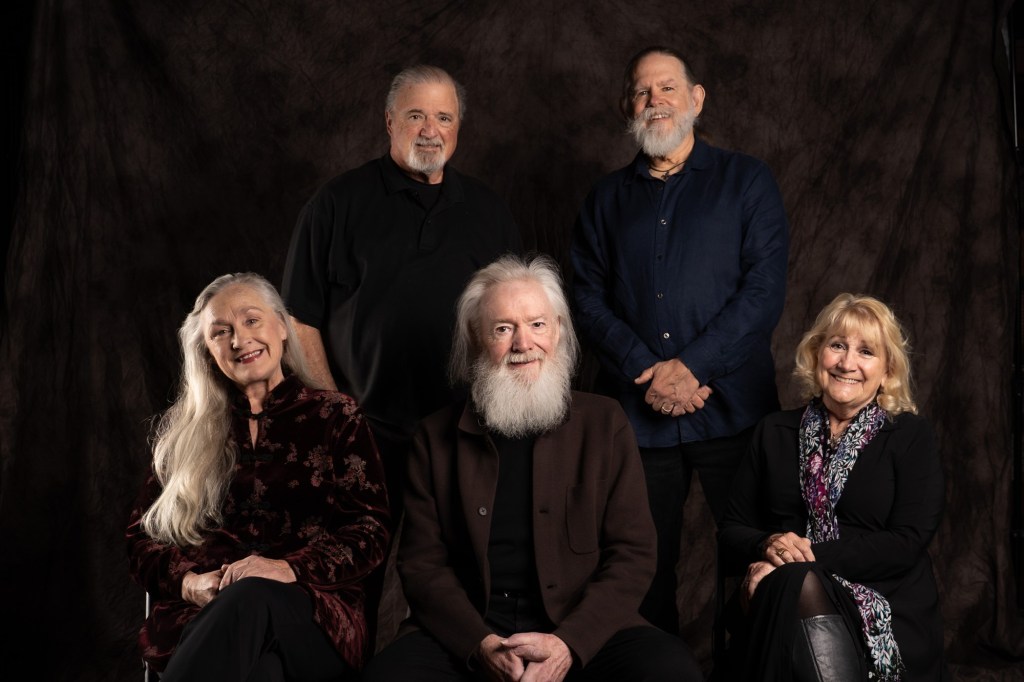
After more than 40 years working together, the five-member artist-led Lamb’s Players Theatre leadership team is making way for its successors in Coronado.
Producing Artistic Director Robert Smyth, Associate Artistic Director Deborah Gilmour Smyth, Associate Artistic Director Kerry Meads, Production Team Director Nathan Peirson and Art Director Christian Turner are all retiring from the company at the end of the year.
“When you create together, it’s a special bond,” said Meads, who joined Lamb’s Players in 1976 as a street theater performer. “It’s more than a job. It’s about working alongside and collaborating with people I love and respect as artists and who are my dearest friends on so many levels.”
The new leadership team at Lamb’s begins work on Jan. 1, 2027. Colleen Kollar Smith will join the Lamb’s Board of Trustees to serve as artistic director. Mike Bradford will serve as chief financial and operations officer. And Jennier Bradford will serve as chief philanthropy and administration officer.
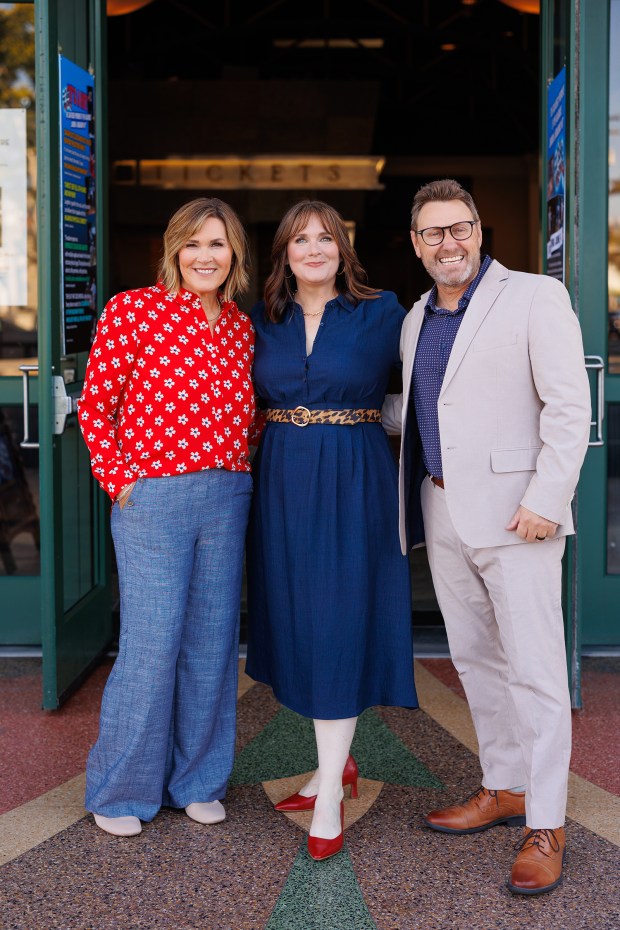 The new leadership team for Lamb’s Players Theatre beginning Jan. 1, 2027, are, left to right, Chief Philanthropy and Administration Officer Jennifer Bradford, left, Artistic Director Colleen Kollar Smith and Chief Financial and Operations Officer Mike Bradford. (Michael Pearce)
The new team’s first production will be of the musical “Godspell,” beginning Jan. 6.
“That was the first show we did that sold out at Lamb’s, back in ’82,” recalled Smyth, who will direct the production even though he will have left his leadership role by then.
Smyth and the current Lamb’s team has overseen nearly 400 productions, including 57 world premieres.
“I always knew there needed to be an end time, and I thought it would work out best if we could plan ahead and have some say in it,” he said. “I got to seriously thinking about that during early COVID and I started to talk to the rest of my leadership team about it, because I had to get them to also envision why it would be important that the five of us would leave at the same time.”
Turner, who’s been with Lamb’s since 1972, acknowledged “I never could imagine myself retiring, but talking to Robert about new people coming in, I agreed. It was hard at first, but then it became a natural thing to do.”
Gilmour Smyth recalled being “a little more hard-pressed to figure out how this would work. We all do a lot of odd combinations of things. Somebody has to take on those areas of responsibility.”
“What finally came to me was the need for a team to have cohesion and a real sense of their own vision. That’s who we’ve been. We’ve very much created this from our own experience,” she said.
Though she plans to continue her career as an actor and theater artist, Gilmour Smyth — who starred most recently at Lamb’s in “A Trip to Bountiful” — said this transition in her life will be challenging. She joined the Lamb’s acting company in 1980 and has been married to Smyth since 1985.
“Because Bob and I have only worked together as a couple,” she said, “my question’s going to be ‘How do we not work together?’ I’m not one of those who’s eager to stop working, but I recognize that the most important thing to me in my life is my husband.”
For Peirson, who joined Lamb’s in 1982, the advances in production technology in his particular craft have made his stepping aside “only logical.”
“It’s getting tougher when you’re in your 70s to run around catwalks. The technology that’s coming out, with everything – lighting, scenic, automation – is happening at such a fast rate that it’s hard for me to keep up. Younger people are raised on it. My brain is not that way anymore. It’s practical for me for retirement.”
All five of the current Lamb’s leadership members will have “emeritus status,” Smyth said. “Any of us can walk into that theater anytime we want, see a show, sit down in the empty seats and just meditate, and a lot of other things. We see ourselves as continuing to be ambassadors for this company.”
Like Gilmour Smyth, Meads, who’s the writer and director of Lamb’s’ annual Festival of Christmas productions, is reluctant to call this a retirement.
“I can’t use the word ‘retire’ personally,” she said. “I feel like I’m able to say ‘What does the next part of my life look like?’ I have no idea in some ways. It’s partly grandchildren. I am hopeful for the future of the company and I know that the timing is right. I have full confidence in that.”
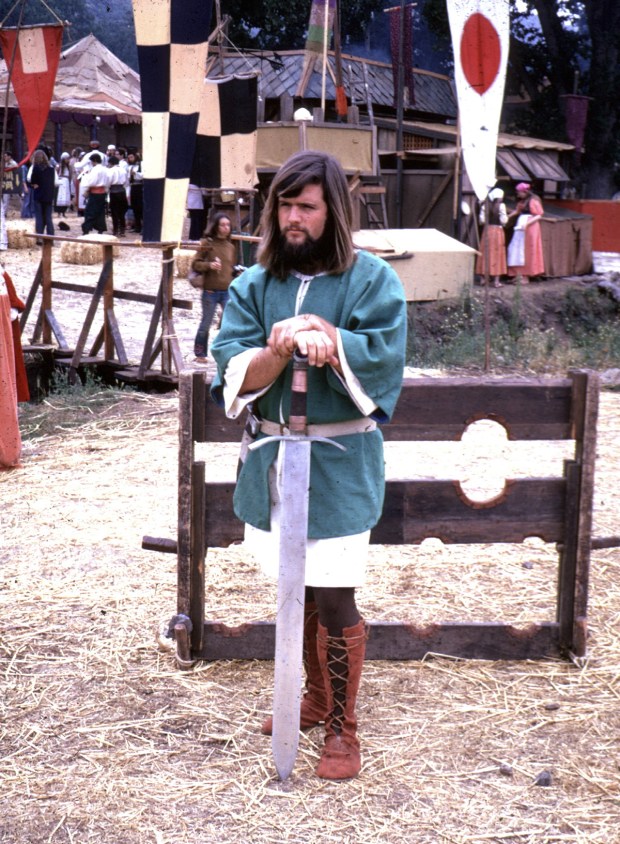 Christian “Chris” Turner on a street theater tour at a Renaissance fair in 1973. (Lamb’s Players Theatre)
A Lamb’s Legacy
Lamb’s Players, which was incorporated as a nonprofit organization in Minnesota in 1971, emerged out of a drama class at Bethel College in St. Paul taught by Steve Terrell. The street theater company’s seven members moved to San Diego a year later. Robert Smyth, then 27 years old, joined Lamb’s in 1976, championing the establishment of a resident theater company modeled after those he’d seen in England while attending the American School in London.
“He (Terrell) turned to me over coffee and said ‘Do you have any kind of a vision for theater?’” recalled Smyth. “I said I’d always believed that it would be fabulous to have a resident company of people who operated with the same kind of commitment and vision to bring a conversation to an audience over an extended period of years. He said ‘Come and do that with us.’
“I was young and luckily at a point in my life when I could be crazy. That resident ensemble that we had from ’78 until 2013 when we finally had to say we couldn’t do it anymore financially, all those people are dear to our hearts and our memories.” (Smyth took the helm from the retiring Terrell and became artistic director of Lamb’s Players Theatre in 1981.)
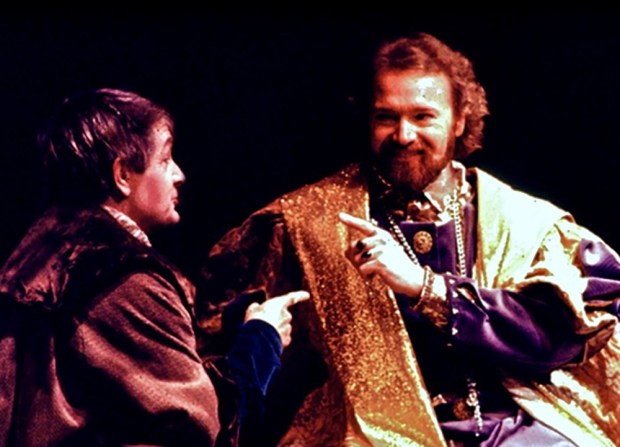 Michael Harvey, left, and Robert Smith in Lamb’s Players Theatre’s 1987 production of “A Man for All Seasons,” directed by Deborah Gilmour Smyth in her directorial debut. (Lamb’s Players Theatre)
Gilmour Smyth was the first performer hired for the resident acting company.
“What happened to me when I first came here in my early 20s was learning the strength of ensemble teamwork and letting the story come forward first,” she said. “That’s what I feel like honestly in the end will be our legacy. Theater is so ephemeral. It’s something that we share together in that moment. It’s an acquired love to sit in a dark room and watch these things together.
“As theater artists I hope that what we have experienced will continue to live in our hearts and transfer to the youth going forward,” she said.
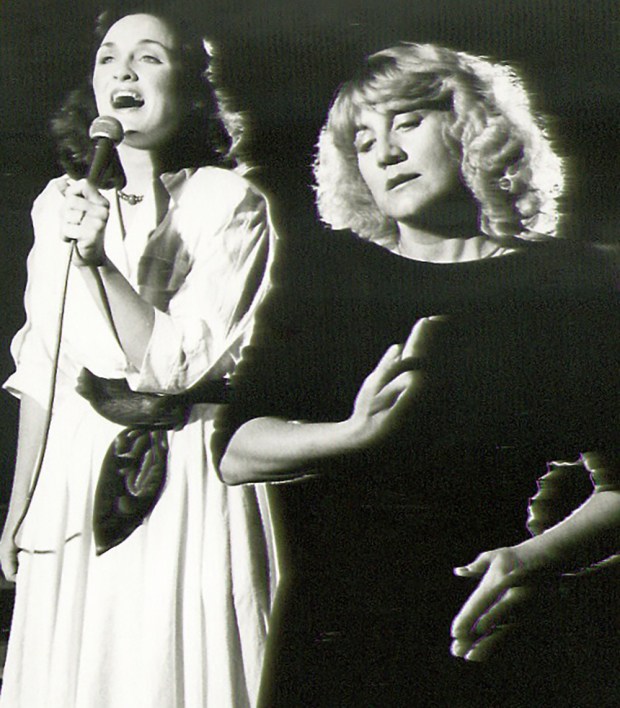 Deborah Gilmour Smyth, left, and Kerry Meads performing during Lamb’s Players Theatre’s Amsterdam tour in 1983. (Lamb’s Players Theatre)
Both Meads and Turner believe the strong relationship between all five leadership team members has resonated with audiences over the years, from the early days in Lamb’s’ National City space through the converted Spreckels Building on Orange Avenue in Coronado that it has occupied since 1994.
“I love when an audience member goes ‘Those people love working together, you can tell,” said Meads.
Added Turner: “I’ve talked to people who came to our theater in National City in 1980 or whatever and they want to come back because they really like us as staff and they like our stories as well. Doing original work. Doing work other people would be afraid to do.”
The team takes pride in not just the quality of the work they’ve done over 40-some years but doing it with fewer resources.
“We’ve told some remarkable pieces on our ‘poor stage,’” Peirson said. “The crazy amount of good, quality visual work on a budget that would probably shock most major theaters. I’ve always been proud that we can do so much with so little.”
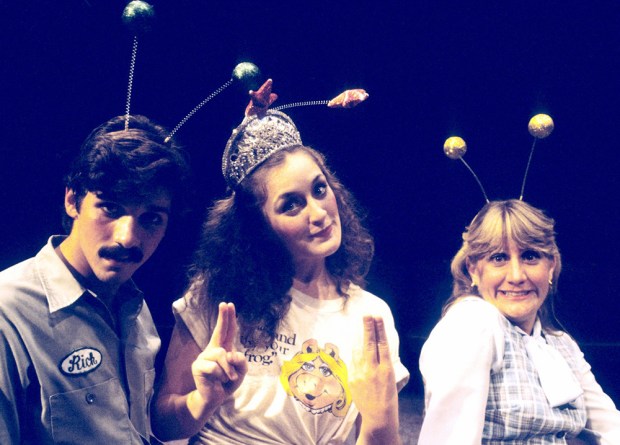 Ruck Rutti, left, Deborah Gilmour Smyth and Kerry Meads in Lamb’s Players Theatre’s 1982 production of “Godspell.” (Lamb’s Players Theatre)
Smyth said the nonprofit theater has been emboldened by its status as artist-led.
“These five people are all artists first,” he said. “It’s that sensibility and that commitment to the art first. The other stuff has gotten us into trouble sometimes, like ‘How did we budget that wrong?’ But we’re still here.
“I’m proud of two things that Lamb’s has done: one, it has caused other theater companies to suddenly go ‘What? That guy or that woman?’ Listen to that!’ Second, paying them. Nobody gets paid what they’re worth, but they get paid a living wage. We changed the rhythm and gave support to people who can make a living as a performer in San Diego.”
 A cast photo from Lamb’s Players Theatre’s 2011 production of the jukebox musical revue “Mixtape.” Pictured front and center in the red blouse is then-Lamb’s ensemble member Colleen Kollar Smith, who will take over as Lamb’s artistic director on Jan. 1, 2027. (Lamb’s Players Theatre)
Success secrets
The list of business teams, including artistic ones, that have stayed together for more than 40 years is undoubtedly a short one. Part of Lamb’s’ endurance has been cooperating and avoiding ego problems.
“The five of us have evolved as a group of people who know each other’s faults but are willing to serve each other and not try to make a kingdom out of our roles,” Turner said. “That’s a very powerful tool in any working community.”
(Former Lamb’s Managing Director) David McFadzean would talk about the ‘servant actor,’” Meads said. “I love ensemble, and when everybody does their role it serves the story and they serve one another. It’s a beautiful thing.”
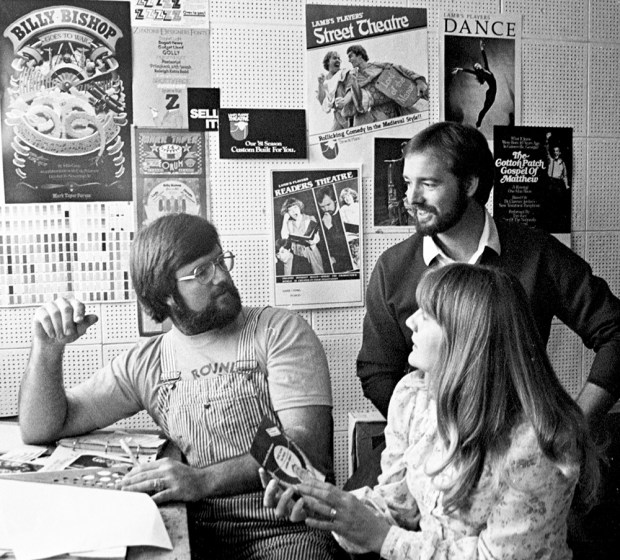 Christian “Chris” Turner, left, Robert Smyth and Kerry Meads in the Lamb’s Players Theatre offices in 1981, just after Smyth was promoted to artistic director. (Lamb’s Players Theatre)
Meads and Peirson emphasize the importance of a shared faith in maintaining the leadership team’s cohesiveness. “For me,” Meads said, “my faith in Jesus has bound all of us together. What allows us to give grace to another is priceless to me.”
Peirson started at the nonprofit theater as an intern in 1982 and values “the trust that’s been built over the years. Along with that, the grace and forgiveness and sense of family. We know how each other thinks. I’m not sure how prevalent that is in other theater communities.”
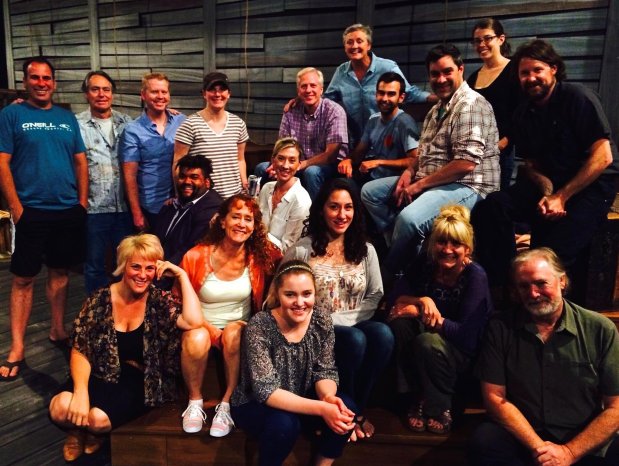 Veteran actors and musicians of Lamb’s Players Theatre pose for a photo in preparation for the company’s marathon “100 Hours of Stories” presentation in May 2014. (Kim Miller)
Reflecting back and ahead
Gilmour Smyth is calling her current status an “it takes a village moment. I want to keep acting, but the idea of doing this kind of work, of running a theater and doing it without these people is hard to imagine. It will be a different kind of stepping into the world of theater when I leave it.”
Admitting that he’s “kind of an introvert,” Smyth reflected that “all my life I found that the only way I can get anything done is with a group of people. The only way I can see things that work well is in a community. This was putting together a group of people that fit, that had respect, that had a common vision, that had a giftedness.
“We weren’t all alike by any means, but those differences complemented each other. I would put this group of people up in any grudge match out there. They’re really committed and talented workers,” Smyth said.
As for next year and the next leadership team at Lamb’s: “As I told Colleen (Kollar Smith),” Smyth said, “once year the starts I will never walk into this building and tell anyone what they need to do or what they’re doing wrong. I’m excited for them and what they’ll bring to this company and what the future will hold for the next part of Lamb’s’ history.”
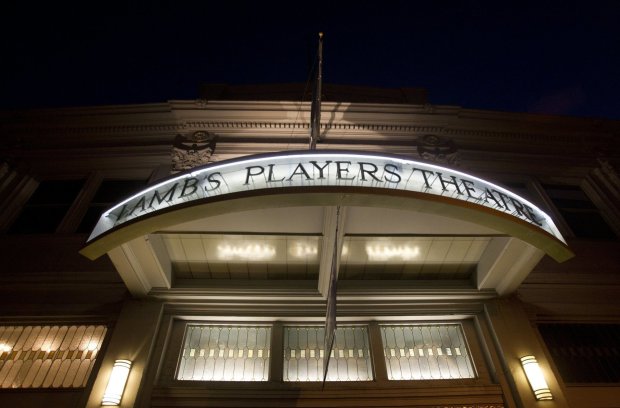 The marquee for Lamb’s Players Theatre, headquartered since 1994 in the historic Spreckels Building at 1142 Orange Ave. in Coronado. Before that, the company was based in National City. (Lamb’s Players Theatre)