
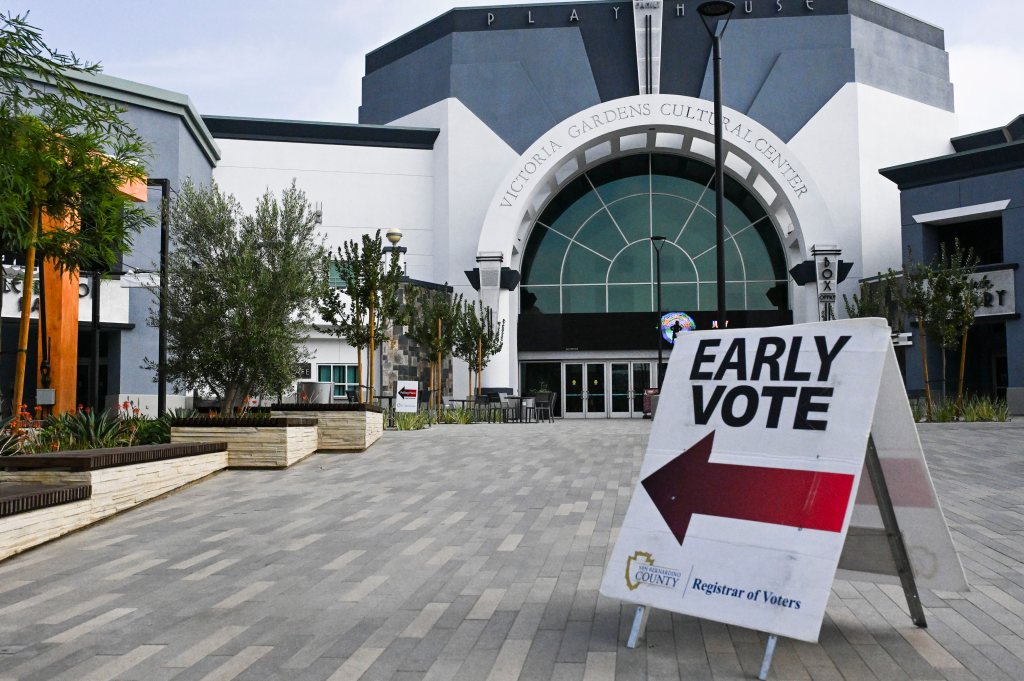
The chameleon might be the spirit animal of Inland Empire politics.
In a hyper-partisan landscape painted red and blue, the 2 million-plus voters in Riverside, San Bernardino and eastern Los Angeles counties defy broad-brush strokes.
The Inland Empire voted for President Donald Trump in 2024 only to approve Democrat-friendly congressional maps through Proposition 50 a year later.
In California’s primary election, which wrapped up Tuesday, June 2, “the IE went firmly back to being a swing county,” Marcia Godwin, a professor of public administration at the University of La Verne, said via email.
“It was almost like the Proposition 50 special election never happened.”
Votes are still being counted and outcomes could change, but patterns are emerging.
Here’s a look at some of them.
Bianco’s backyard boost
Republican and Riverside County Sheriff Chad Bianco came up short in his bid to be California’s next governor. He’s currently in fourth behind Republican Steve Hilton and Democrats Xavier Becerra and Tom Steyer in statewide results as of Friday, June 5.
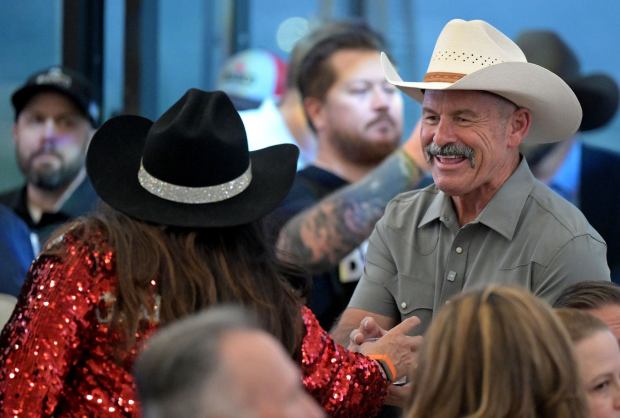 Republican gubernatorial candidate and Riverside County Sheriff Chad Bianco greets supporters Tuesday, June 2, 2026, at an election night event in Eastvale. (File photo by Will Lester, Inland Valley Daily Bulletin/SCNG)
But the outspoken sheriff, who promised to shake up Sacramento, is having a better showing among Inland voters. Going into Friday, he led the field with 27.5% of the vote in Riverside County and 21.87% of the vote in San Bernardino County — enough to finish third behind Hilton and Becerra.
Bianco also is outperforming his statewide margin — 11.2% of the vote as of Friday morning — in the Inland Empire.
Calvert survives — again
Legend has it Grigori Rasputin survived cyanide and beatings in frustrating repeated attempts to kill him.
Rep. Ken Calvert, R-Corona, has nothing in common with the 20th century Russian mystic. But the Inland Empire’s longest-serving congressmember shows an exceptional ability to withstand whatever Democrats throw at him.
Early decade redistricting forced Calvert, who’s been in Congress for three decades, to run in a purple district that included deep-blue and LGBTQ-friendly Palm Springs. Calvert, who once opposed same-sex marriage, withstood two well-funded challenges from Democrat Will Rollins, who preached a moderate message to win swing voters.
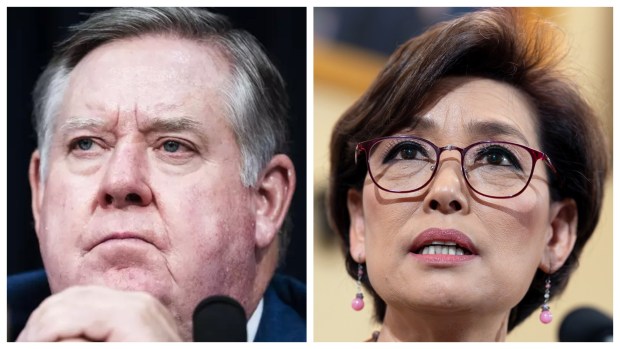 Reps. Ken Calvert, R-Corona and Young Kim, R-Anaheim Hills are on track to face each other in the November general election for California’s 40th Congressional District (Calvert file photo by Tom Williams, Getty Images; Kim file photo by J. Scott Applewhite, The Associated Press)
Proposition 50 obliterated Calvert’s district, forcing him to wage a bitter fight with fellow GOP incumbent Young Kim for a red seat spanning Riverside and Orange counties.
Results so far have Calvert well ahead and on track to make the November general election.
What’s more, Democrats appear to be locked out of the 40th Congressional District, with Kim in second and Democrat Esther Kim-Varet in third.
Shaw highlights conservative wins
In a deep-blue state, the Inland Empire is an oasis of sorts for right-of-center Californians. Just ask Sonja Shaw.
The conservative president of the Chino Valley school board is one step closer to becoming state superintendent of public instruction. She leads a 10-candidate field in a primary that included a former Assembly speaker, a current assembly member and an ex-state senator.
Shaw will likely face San Diego school board President Richard Barrera in November. With labor unions and Democrats rallying around Becerra, she has her work cut out for her in trying to become the first Republican since 2006 to win statewide office in California.
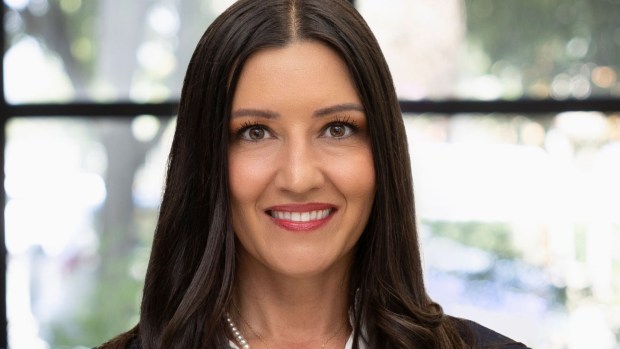 Chino Valley Unified School District board President Sonja Shaw is set to face San Diego school board President Richard Barrera in the November 2026 general election for state superintendent of public instruction. (Courtesy of Shaw campaign)
Inland Republicans had other reasons to celebrate beyond Shaw.
Michelle Paradise, a Riverside County official and former prosecutor who was endorsed by Bianco and other local Republicans, is winning a competitive race for Riverside Superior Court judge.
Julie Vandegrift, a member of the Murrieta school board’s previous conservative majority, is ahead in her bid to win back her seat. And Assemblymember Leticia Castillo, R-Corona, is slightly ahead of Democrat Clarissa Cervantes in a blue-leaning Inland district where while both candidates are guaranteed to advance.
“We are very pleased with the performance of Republican candidates throughout the Inland Empire in this primary election,” San Bernardino County Republican Party Chairman Phil Cothran said via email.
“These results demonstrate that Inland Empire voters continue to respond to a message focused on public safety, affordability, government accountability and economic opportunity.”
Sales tax measures rejected
Pitches to raise sales tax rates in several Inland cities didn’t add up for voters.
In Riverside, Measure Z, which would raise the city’s sales tax from 1 cent to 1.25 cents to raise $21 million for public safety and other services, was losing with 59% of voters opposed.
Loma Linda’s Measure X, which would boost the city’s sales tax by 1%, also trailed in the latest results. It wasn’t a sales tax increase, but Measure A, a $256 million bond to upgrade and repair schools in the Bonita Unified School District covering La Verne, San Dimas and parts of Glendora, is losing.
However, Perris’ Measure B, which sought a 1% sales-tax increase, is winning with 60% of the vote. The city declared a fiscal emergency in December.
Mixed results for incumbents
When it comes to holding elected office, it’s better to be in county government — at least in this Inland primary.
Sitting supervisors in Riverside and San Bernardino counties, along with San Bernardino County Sheriff Shannon Dicus, Riverside County Assessor/County Clerk/Recorder Peter Aldana and other county-level incumbents level easily won reelection.
The exception? San Bernardino County Auditor-Controller/Treasurer/Tax Collector Ensen Mason, who trails challenger Ryan Hutchison.
It’s been a rockier road for Inland Empire city council members.
While current San Bernardino Mayor Helen Tran will likely be reelected, San Bernardino City Councilmembers Theodore Sanchez, Sandra Ibarra and Fred Shorett were all trailing as of Friday, although Shorett will likely be the only incumbent to make a November runoff.
In Loma Linda, Councilmember Ron Dailey trailed Amy Jones. Riverside Councilmember Chuck Conder led going into Thursday but was just short of the margin needed to avoid a November runoff.
Supervisors get what they want
The San Bernardino County Board of Supervisors won the primary in more ways than one.
Besides Jesse Armendarez and Curt Hagman winning four more years on the board, Mason is losing.
In February, the board opened an investigation into Mason at the request of several members of the public. Mason denied wrongdoing, and the investigation report was not released before the election, effectively letting questions about him linger as voters cast ballots.
It’s not the first time in recent years that an election worked out for supervisors.
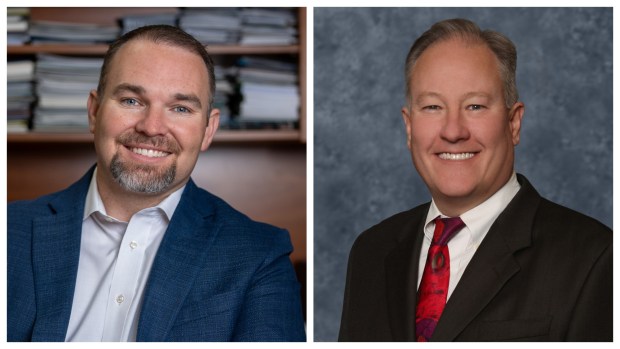 Rancho Cucamonga Councilmember Ryan Hutchison, left, is beating incumbent Ensen Mason in the race for San Bernardino County auditor-controller/treasurer/tax collector. (Courtesy of Ryan Hutchison, San Bernardino County)
In 2022, they put a provocative question on the November ballot — should San Bernardino County potentially secede from California?
Measure EE argued that the county might not be getting its “fair share” from Sacramento and Washington. It was the sort of measure that appealed to skeptics of big government, who found another ballot measure waiting for them that year in Measure D.
That measure’s wording made it seem like it would lower the term limits cap on supervisors along with imposing a more rigorous salary cap. In fact, it increased the amount of time they could spend in office and paid them more.
Measure D passed with more than 58% of the vote.
As for Measure EE, it took seven months after the election for the county to officially study secession. The final report said there was no cause to do so.
Staff Writers Israel J. Carreón Jr. and Beau Yarbrough contributed to this report.