
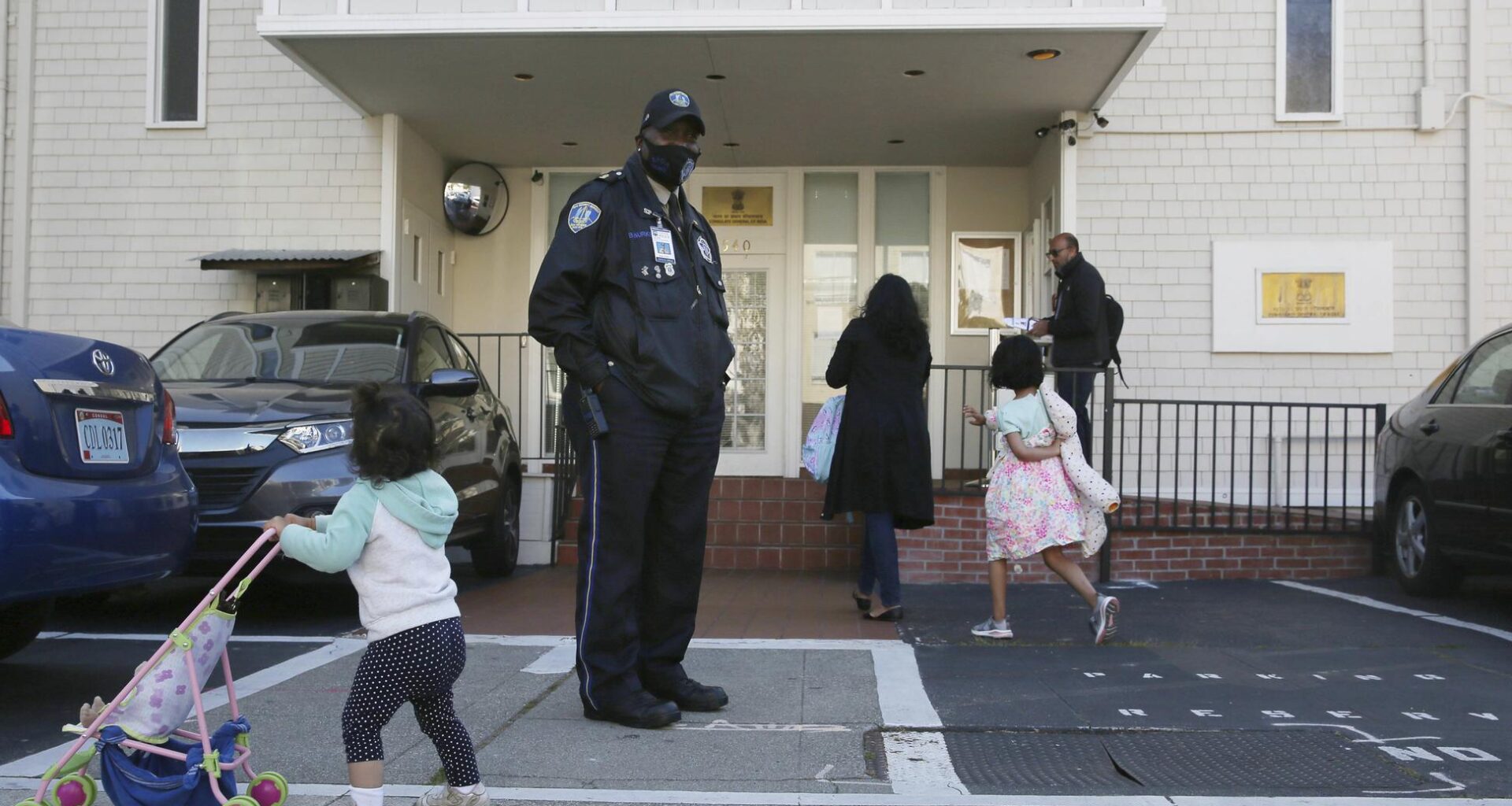
A security guard works outside the Consulate General of India in San Francisco in 2021. Scammers are calling Indian residents in the Bay Area, impersonating consulate staff.
Lea Suzuki / The Chronicle
My phone rang last week just as I was getting my kids out the door. It was a San Francisco area code — 415. I sent it to voicemail. Whoever was calling didn’t leave a message.
A half an hour later, as I sat down at my computer, it rang again. Same number. This time I picked up.
The man on the other line introduced himself as Kunal and said he was with the Consulate General of India. He said they had a document I needed to come pick up in person.
Article continues below this ad
I know there’s a Consulate General of India in San Francisco, but I’ve never been there, or to India. (Roy is a somewhat common last name in India, though the ancestors who passed it down to me were French-Canadian.) I figured it was a scam and hung up the phone. I immediately got another call from a San Francisco number, this time with a 628 area code. I declined the call.
But I was curious. I searched online and came across multiple posts about this exact scam on Reddit, particularly on forums related to Indian immigration issues, like r/returntoindia and r/NRI (an acronym for Non-Resident Indian). “PSA – Scam callers claiming to be from Consul General of India.” “Phone calls claiming to be from ‘Consulate General of India – San Francisco’ office.” “SCAM ALERT: Highly Sophisticated ‘Digital Arrest’ Scam targeting OCI Applicants.”
San Francisco Chronicle Logo
Make us a Preferred Source to get more of our news when you search.
Add Preferred Source
• The Indian Bay: Their meteoric rise reshaped the Bay Area and powered Silicon Valley. Is it at an end?
• Related: Indian engineers spent years chasing Silicon Valley. Now some say, ‘I would not come to the U.S.’
Article continues below this ad
Evidently, if I’d stayed on the line, Kunal would have told me that my phone number was associated with some sort of criminal activity in India, and we’d need to get the Delhi police involved and prove my identity to clear my name.
I wondered if the actual Consulate General of India in San Francisco was aware of this. It’s safe to say the answer is yes: A warning about these scam calls from April 2025 is pinned to the top of their X profile. The same warning appears on their Instagram page, and when you navigate to the consulate’s website, you get a popup message titled “Advisory on Fraud Calls.”
Raju Sharma, the head of chancery for the consulate, said people can reach out to the consulate using the email or phone numbers listed on the website if they have a question about a call they’ve received.
He referred back to the information in the online advisory: Scammers are “spoofing” the consulate’s phone number, making it look like the calls are coming from official numbers when they aren’t. The consulate does not make personal inquiries by phone; official requests will come from an email address with an @mea.gov.in domain.
“The Consulate hereby advises members of the public not to entertain any suspicious telephone calls made in the name of Embassy of India/Consulate,” the Consulate’s online advisory reads. “They are also advised not to reveal any personal information or transfer any money in response to such calls.”
Article continues below this ad
Eva Velasquez, the president and CEO of the Identity Theft Resource Center, said that she isn’t familiar with this specific scam, but that scams using demographic information like your last name to make threats seem more realistic are nothing new. I was likely targeted for my last name, even though in my case it was a misfire. Velasquez said the same thing happens to her: It’s her married last name, not maiden, but because of it, she regularly receives scam calls and texts in Spanish.
That Indian immigration is making headlines right now amid concerns over H1-B visas gives scammers another angle of attack, she said.
• Read more: These wealthy Bay Area suburbs have become a microcosm of India
• Related: Could this critical iPhone security feature make you a scam target? Here’s how to protect yourself
“Another very common tactic that the bad guys use is to look at external events going on and then capitalize on fear and uncertainty around those events,” she said. “It doesn’t surprise me at all that in this case, the bad guys are taking advantage of a lot of the rhetoric around immigration in this country right now and going to try to leverage that to scare immigrants, legal or not legal, into thinking that something’s wrong.”
Article continues below this ad
Phone number spoofing has existed for some time, and artificial intelligence has made it trivial to create scripts and even automatically generate the voice you’re hearing on the phone.
People on Reddit pondered how the scammers had gotten their information, speculating whether someone was leaking it from the government. Velasquez said typically, scammers are targeting as many people as possible, knowing only a small percentage of those attempts will succeed. With a large Indian population in the Bay Area, it stands to reason scammers will try to take advantage.
“I think we have this notion, when the target works, we feel like ‘Oh my God, they were targeting me specifically, how did they know?” she said. “They didn’t. This is being sent out en masse.”
If you get one of these calls, follow the consulate’s instructions and hang up.
Article continues below this ad