
A Message Crossing Ideological Lines
San Francisco Mayor Daniel Lurie won big in the June elections. Every candidate and ballot measure he campaigned for won. And the mayor did better than just win. His appointed D2 Supervisor Alan Wong won in a landslide. So did D2 Supervisor Stephen Sherrill, appointed by Mayor Breed but a strong Lurie ally.
Sherrill’s victory was expected. But the huge margin was not. Even more surprising was Wong’s big win. I don’t know anyone who foresaw a sweeping victory for Wong. Everyone I talked to either shared my prediction that Natalie Gee would win or thought Wong would take a close race.
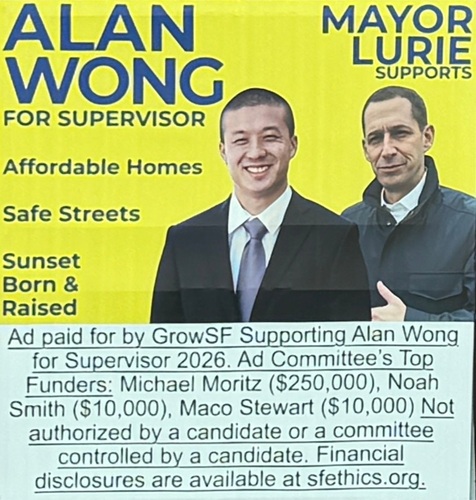
The chief explanation for Wong’s landslide victory is the billboards, mailers and other political messages linking Lurie to Wong. Lurie’s coattails in D4 were as strong as in D2, which few expected.
Lurie also focused on defeating Prop D. The labor-backed tax measure narrowly lost.
SF Politics Has Changed
Last week was not the first time Lurie outperformed election expectations. It followed his surprisingly large margin of victory in the November 2024 election. Lurie’s success with the electorate mirrors his over 70% support levels in recent polls.
Why is Lurie so popular? I attribute it to his single-minded message: the San Francisco Comeback. Lurie is relentlessly and unwaveringly focused on promoting San Francisco’s economic revival after years where future prosperity seemed in doubt.
The political strength of Lurie’s message is that it crosses ideological lines. It also crosses income lines, as lower-income voters see the city’s return to prosperity as good for them. Lurie has overwhelming support among the wealthy tech crowd driving up the real estate market. This affluent group really wants the city to thrive.
Unifying vs. Divisive Issues
From the late 1970’s through the second tech boom of 2011-2019, San Francisco politics was divided around strengthening rent control and restricting office and housing development. Downtown vs Neighborhoods was a major theme.
These issues no longer drive city politics. It’s become all about getting the city’s downtown and overall economy back on track—and that’s an issue made for Daniel Lurie.
Here’s how Daniel Lurie has tremendously benefited from this shift in focus.
In the 1980’s rent control on vacant apartments was a defining political issue. Mayor Feinstein’s veto of vacancy control alienated tenant voters. In the 1990’s and beyond I worked with the late Ted Gullicksen of the SF Tenants Union on several measures to restrict owner-move in evictions. This issue forced mayors Jordan, Brown and Newsom to take a side.
When mayors Dianne Feinstein, Frank Jordan and Gavin Newsom almost consistently sided with landlords, it limited their coattails. A supervisor candidate seen with them on an endorsement risked losing tenant votes.
Mayor Lurie has not had to take a stand on a divisive tenant protection measure. His message of economic recovery transcends the city’s traditional politics. So when he backs a candidate like Alan Wong, there is no downside to the supervisor.
Some believe Lurie’s support for Family Zoning risked alienating voters. I don’t agree. I never felt voters cared much about the issue Its passage did not risk alienating tenant voters, many of whom see upzoning as benefiting them. Those who strongly opposed it were never in the Lurie camp.
My belief was proved correct last week. The D2 and D4 winners backed the Family Zoning plan.
Everyone Supports Downtown Revitalization
San Francisco is decades past the days when activists criticized the “Manhattinization” of San Francisco. Office towers were blamed for damaging neighborhoods and the city’s affordability. Today, everyone wants downtown retail to revive and highrise office buildings to be filled.
So unlike Mayor Feinstein, Lurie loses no votes by promoting downtown revitalization.
Voters also like the idea that the mayor, by creating the San Francisco Downtown Development Corporation, has helped raise $60 million in private donations to revive downtown. Even those questioning the privatization of plans for downtown don’t complain about the mayor seeking private dollars.
Lurie Backs Messaging With Big Money
It takes money for Mayor Lurie to use his popularity to help his endorsed candidates and ballot measures. Lurie-backed candidates in D2 and D4, and his No on D campaign, vastly outspent their opponents.
But most voters don’t seem to care about this funding imbalance. They see Big Money as backing the San Francisco Comeback, the achievement of which has become the top voter priority.
Big Money has long been a feature of San Francisco politics. But Lurie, with his privately funded public relations operation, his push for private donations for downtown, and the dollars spent in the June election have taken Big Money in San Francisco to a new level.
If voters thought that billionaires were directly working against their interest, they would reject Lurie’s strategy. But they agree with the mayor’s goals.
And that’s why the mayor has a 70% popularity rating. Voters see him making progress on the Comeback, the issue that now defines San Francisco politics.

Randy Shaw is the Editor of Beyond Chron and the Director of San Francisco’s Tenderloin Housing Clinic, which publishes Beyond Chron. Shaw’s new book is the revised and updated, The Tenderloin: Sex, Crime and Resistance in the Heart of San Francisco. His prior books include Generation Priced Out: Who Gets to Live in the New Urban America. The Activist’s Handbook: Winning Social Change in the 21st Century, and Beyond the Fields: Cesar Chavez, the UFW and the Struggle for Justice in the 21st Century.