
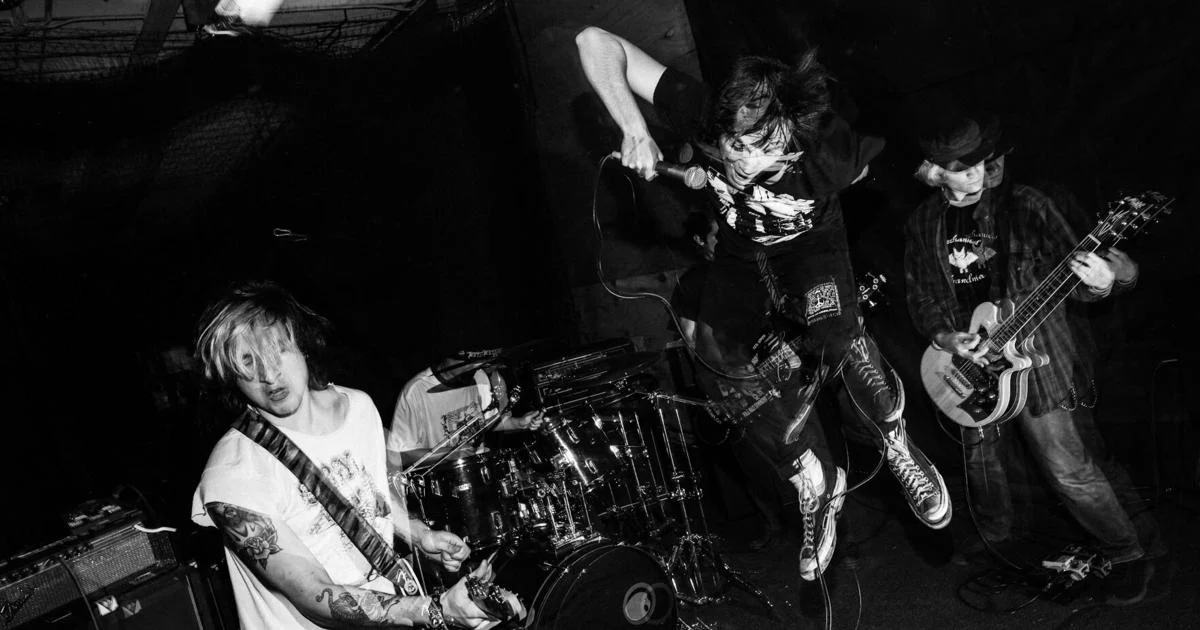
On a recent Friday evening, between what remains of the Vaillancourt Fountain and a brand-new pickleball court on the Embarcadero, a crowd of young people were patiently waiting for a do-it-yourself punk show to start.
The flyer for the event, dubbed “Sh-tshow at the Fountain” indicated that it was spurred by The City’s decision to tear down the longstanding landmark. More broadly, the show was a protest against what event organizers consider the erasure of art in a city known for flourishing underground scenes and globally recognized countercultures.
Cody Azumi, the event’s 25-year-old organizer — and the singer/bassist in the band Surprise Privilege — was fully engaged with the park police, doing his best to convince a patrolling officer to let the show commence.
A week earlier, at I Hate Records, the music shop he co-owns with Pretty Sims, of the prominent San Francisco punk band False Flag, Azumi reflected on why he’s given so much of his time and energy to The City’s punk scene.
“Because it’s awesome,” Azumi said, in the graffiti-clad store in the Lower Haight. “F—ed-up sh-t is happening here, people can’t afford it, the spirit of The City is dying. I’m talking about the spirit of the ’60s and ’70s, [when] all the arts and culture were really booming. I think it’d be, like, a damn shame for that to just disappear.”

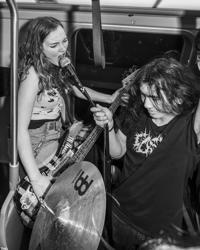
Pretty Sims performs with the punk band False Flag, with Cody Azumi acting as a microphone stand, on a BART train on Friday, Jan. 6, 2023.
Courtesy of Rob Coons
Over the past six years, Surprise Privilege has become one of the most exciting young punk bands in San Francisco, garnering headlines for its off-the-grid guerrilla shows. They staged a disruptive protest performance at a Turning Point USA event with the late Charlie Kirk at San Francisco State University last May, for instance, and an infamous show on a BART train alongside False Flag in 2023.
Even as The City has become more expensive, making it increasingly difficult for arts culture to thrive, these young musicians are finding ways to develop a growing scene, showing what is still possible out of love for the music, a bit of grit, a do-it-yourself attitude and a touch of foolhardiness. These bands, notably, are homegrown. Arising from and in response to the changing nature of The City itself, they are making quintessentially San Francisco music.
The City’s punk scene dates back to the 1970s, when bands like Dead Kennedys, Flipper, the Avengers and Crime established themselves in legendary North Beach venues, including The Mabuhay Gardens and On Broadway. They created an internationally recognized scene that became a key touring stop for the emerging punk, hardcore and thrash-metal scenes of the 1980s.
Prominent bands have continued to call San Francisco home in more recent decades. But after the nonprofit, all-ages music venue 924 Gilman Street opened in Berkeley in 1986, the Bay Area’s center of punk gravity shifted noticeably to the East Bay.
Pull Quote
“F–ed up sh-t is happening here, people can’t afford it, the spirit of The City is dying. I’m talking about the spirit of the ‘60s and ‘70s, [when] all the arts and culture were really booming. I think it’d be, like, a damn shame for that to just disappear.”
Fred Schrunk, who has owned and operated Thrillhouse Records in the Mission since 2004, agreed that The City’s affordability issues have made it difficult for new artistic life to enter, as he once did. Schrunk moved to San Francisco in 2002 with a few hundred dollars in his pocket, and opened Thrillhouse after another punk record store and venue, Mission Records, closed.
As a way to support bands that need spaces to play, he decided to say yes to everyone who asked him to book a show at his store, and it has been a node of all-ages music in The City ever since. He believes that most of the energy and excitement in San Francisco’s current punk scene comes from this younger generation of punks.
“The way that our world works now, you can’t save up $700 then move to another town, like you used to before,” he said. “San Francisco used to have just, like, tons of people moving into The City, joining the punk scene that was already happening, giving it energy, and now you don’t have that. A lot of the punk scene 1780949351 is based around the kids that grew up here.”
Not unlike Shrunk before them, Azumi and Sims opened I Hate Records last June, as a gathering place for punks in The City to meet, form bands, perform and sell their music.
Azumi said that, for him, it was important not just to give bands an opportunity to play, but to make punk exciting, especially in reaction to the current wave of tech companies taking over The City.
“There’s a bunch of people moving here, tech companies are back … I think punk as a counterculture has to react to that,” Azumi said.
Azumi moved to San Francisco from London during his junior year of high school, and worked with his father at a music store his family purchased in North Berkeley. A love of Green Day and a desire to play music brought Azumi to his first show at 924 Gilman.
After that, he was hooked, and, alongside members Joey Silberman and Alan Hernandez, Azumi formed Surprise Privilege. They played their first show at the legendary community-run venue at the beginning of 2020.
“When we were on stage and we played our first show, I was like, damn, dude, this is what I want to do for the rest of my life,” Azumi said.
Starting in July of 2020, while the vast majority of live music was shut down, Azumi started throwing generator shows — small concerts powered by a gas generator in an off-the-grid location. His shows were in Golden Gate Park, mostly for the band’s own amusement or for the few friends who decided to venture out of their homes.
The following summer, once quarantine had been lifted and the vaccines were rolling out, Azumi started throwing shows in the park once a week. Much to his surprise, hundreds of kids started showing up.
“There were like … kids I’ve never seen before, they were even younger than we were coming to these shows … turns out there’s hella f—ing people my age or younger that are making bands and throwing shows just by themselves. I thought it was f—ing awesome,” Azumi said.
A former Sears parking lot is now 97% occupied and home to 145 studio apartments for certain residents ages 55 and up
Pride month responds to the current political climate — without sacrificing celebration

A new school opening this academic year will provide students in the fifth through 12th grades with assistance and accommodations
One of the kids in attendance was Pretty Sims, whose parents had introduced her to older punk bands like X and Flipper. Sims and her sister, Strong, spent the pandemic writing and playing songs together in their parents’ flat in the Tenderloin.
Sims would also wander around San Francisco, scouting The City for locations where she could imagine throwing DIY shows in the future, even though she didn’t have a band of her own yet.
“I couldn’t find people who actually wanted to play music, you know, that was my problem,” Sims said.
It was at one of Azumi’s shows in Golden Gate Park where she saw people her age playing music for the first time. She noticed how radically the scene had changed since the pandemic, becoming much younger.
“It felt so freeing to see so many people my age at the same place, just having fun together, ” Sims said.
She decided it was time to start a band. She formed False Flag with her sister, and started throwing her own generator shows, eventually organizing them in tandem with Azumi. That led to their collective project on the BART train.
After the show, “Cody and I were sitting in [his] car together and we were really f—ing happy that it actually worked out and that nothing too bad, like, went wrong and, just looking at the videos, like, that was really f—ing fun,” Sims said. “I feel like that was a good example of how electric the DIY scene [is] in the Bay Area … after that, the DIY shows that we were doing had a really large attendance.”
Rob Coons, a well-known photographer who has been attending punk shows around the Bay Area for the past 33 years, noted that the explosion of young bands post-pandemic has been unlike anything he’s ever seen.
Due to the lack of venues for up-and-coming punk bands, Coons said, people have always had to be creative and find alternative ways of staging shows. However, he’s been really excited to see the way these bands have attempted to push the limits.
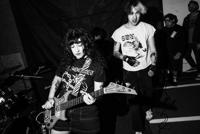
The punk band Panic performs in San Francisco on May 2, 2026, with Frankie Cerrato on bass and Donovan Society on vocals.
Courtesy of Matthew Kadi
The shows also had a deep effect on 19-year-old Roman Pepa. After catching False Flag by chance at the Haight Ashbury Street Fair in 2022, playing music felt achievable, and a local underground scene suddenly opened to him.
“It made me want to do more research on this type of scene that was around San Francisco that I had no idea that that was a thing,” Pepa said. “It was like a whole new world for me to explore.”
Like Sims, Pepa was turned on to punk early — his father, Dennis Pepa, is the former bassist and founding member of the well known 1980s Bay Area metal band Death Angel. Now, even when Pepa is not playing with his bands (P.O.S., Different Method, Panic and others), he’s attending shows all over the Bay Area. Inspired by his peers, he has also started to host his own events.
Lately, Azumi and Sims have decided to pull back some from the all-consuming work of putting on shows, focusing instead on their record store and their own bands. Azumi noted the whole new wave of even younger bands coming up, some of which he is still discovering. He’s been encouraged by how much the scene is continuing to grow.
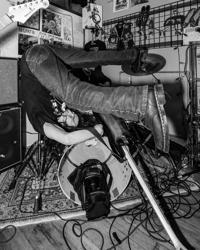
Cody Azumi, mid-flip, during a Surprise Privilege show at I Hate Records on April 4, 2026.
Courtesy of Rob Coons
“I want the 2020s to be remembered not just like, oh, they did punk again for a little bit, [but] damn, dude, punk is f—ing back, like they’re doing crazy f—ing sh-t … San Francisco punk is back alive and this is where the most exciting things are happening,” Azumi said.
Back at the site of the former Vaillancourt Fountain, the show continued to stall. Hillbomb, one of the bands set to play, huddled up next to a fence with a few of their friends, excited just to be there. The group included Phoenix Seevers, the band’s 19-year-old bassist and singer.
Hillbomb had been playing shows at a relentless pace since forming just over a year ago, mostly outside The City, where they found fewer regularly occurring shows. The band believes in the “magic” of San Francisco’s scene, however, despite the lack of available venues.
Seevers said he had seen videos of Azumi’s and Sims’ past shows — and that getting to play with Surprise Privilege was a dream come true.
“I think, really, the heart of San Francisco’s punk scene is in the DIY,” he said. “Not to disrespect any venues or anything because there’s awesome sh-t that happens everywhere, but I think the people who are gonna come out and do this sh-t in the cold outside on the street, facing adversity — that’s where the magic is happening.”
Ultimately, the park police prevented the show from occurring at the Vaillancourt Fountain site. The bands, undeterred, wandered into the financial district, just a few blocks away, to set up. The crowd followed.
As Hillbomb’s set started, the audience roared into a frenzy, with kids running in a circle, fists pumping, and others climbing on top of bus shelters to get a clearer view. Perhaps, within this group, friends were being made, new bands were forming and the scene was, organically, continuing to grow.
It was inspiring and the energy was contagious. Without a doubt, it was “f—ing awesome.”