
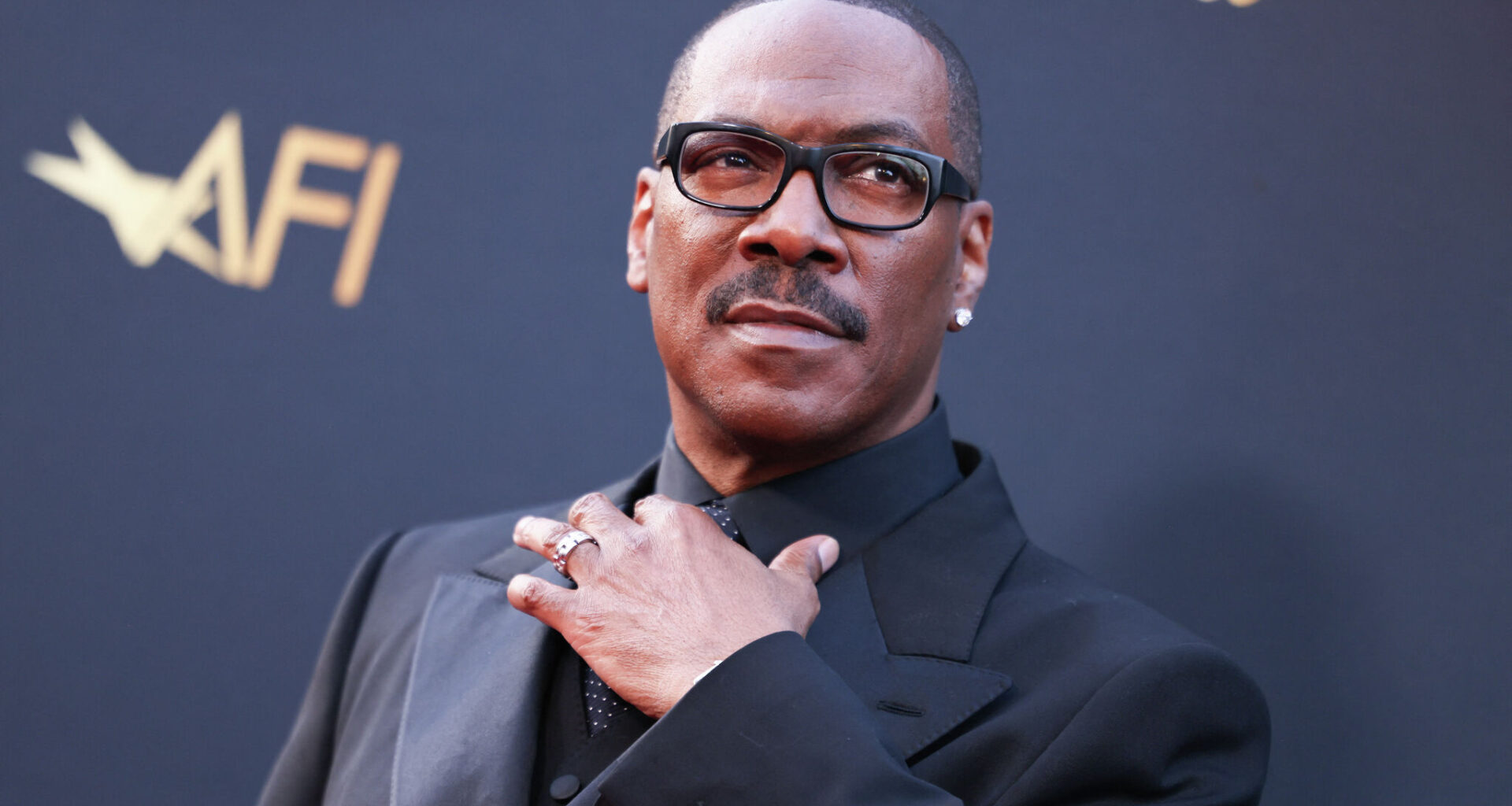
Eddie Murphy attends American Film Institute’s Life Achievement Award event at the Dolby Theatre in Hollywood on April 18.
Etienne Laurent/AFP via Getty Images
Dear Mr. Mick: Was there ever an actor that you looked forward to interviewing that turned out to be a real dud, for whatever reason?
Robert Freud Bastin, Petaluma
Dear Mr. Bastin: If you mean in connection with my Chronicle work, the answer has to be no, if only because I never once looked forward to interviewing any actor. Just about every interview I ever did was under compulsion. So if my interviews were dull, the fault was mine, because I didn’t want to be there.
Article continues below this ad
But I can tell you who, in retrospect, was my most puzzling interview: Eddie Murphy.
In person, he was kind of small and thin. He was earnest, seemed eager to please and wasn’t remotely funny. He was also unusually nice. The guy I know from television is outrageous, hilarious and taller.
San Francisco Chronicle Logo
Make us a Preferred Source to get more of our news when you search.
Add Preferred Source
That’s one interview I’d love to go back and reexperience, just to see if my memory is playing tricks. Because, in my head, there is absolutely no connection between those two Eddie Murphys. I remember them as completely different people.
Dear Mr. LaSalle: With the death of Rex Reed, any thoughts on his career? Did he serve a purpose writing critiques or was he just an angry man more interested in being famous?
Article continues below this ad
Film critic and journalist Rex Reed sits in a wicker chair at a beach in Malibu, circa 1973.
Ellen Graham/Getty Images
Dear Mr. Oertel: Rex Reed was the first nationally famous film critic. Before him, there were prominent critics, like James Agee, but Reed was the first critic that everybody knew, even if they’d never read a word he’d written.
I knew him from seeing him on talk shows when I was a kid. I always thought he was fun. I still think he was fun. He was also, with the possible exception of my former Chronicle colleague Edward Guthmann, the best-looking film critic in America.
He probably held on too long and became a bit of a crank in his later years, but he was Rex Reed. Would you volunteer to be the one to tell him to stop?
Article continues below this ad
Hello, Mick LaSalle: You were discussing the 1950s, and you said at that time that it was a grim period for American movies. But take a moment to consider “The Asphalt Jungle,” “All About Eve,” “Anatomy of a Murder,” “In a Lonely Place,” “Ace in the Hole,” “The Sweet Smell of Success,” “Paths of Glory,” “On the Waterfront,” “The Bad and the Beautiful.”
James Stewart carries Kim Novak at Fort Point, under the Golden Gate Bridge, in Alfred Hitchcock’s “Vertigo” (1958).
Paramount Pictures/Getty Images
Hello, Stan Campbell: And don’t forget “A Face in the Crowd” and “A Streetcar Named Desire,” plus the Hitchcock movies, “Vertigo,” “Rear Window” and “North by Northwest.”
The 1950s weren’t a wasteland. In fact, it’s possible that I’m just wrong, and it was a good era for movies. However, you can pretty much do that with every decade: find 15 or 20 unquestionably great films — because, after all, that’s still only two a year.
Article continues below this ad
Perhaps the better way to measure a decade’s output is to count how many good movies were made, or to judge the routine releases. This is harder, because it requires seeing almost everything in every decade, just to be able to make an honest comparison, and no one has seen that many movies.
My impression of the 1950s is that they don’t have the star power of movies of the 1930s and 1940s, and they lack the freedom of the 1960s and 1970s. They’re hampered by censorship, and their presentation of sex and relationships lands in a creepy zone mixing puritanism with prurience. If you were an actress, it was a particularly bad time. Look at Marilyn Monroe, a singular talent who spent almost her entire career playing morons.
Still, grand pronouncements are an unfortunate tendency of critics, and I might have given in to temptation in assessing that decade.
Have a question? Ask Mick LaSalle at askmicklasalle@gmail.com. Include your name and city for publication, and a phone number for verification. Letters may be edited for clarity and length.