

Officials in a handful of Orange County cities are moving forward with increasing street cameras and license plate readers to help beef up their surveillance and keep an eye on crime despite privacy concerns and fear of the footage being used by ICE.
“I’m deeply concerned about the future of our city and of our country. I don’t want to live in a world where my movements, going to visit friends, volunteering in my community, or going to the grocery store are being tracked by cameras and recorded in a database,” said Jana Anderson, a resident, at the Orange’s May 26 city council meeting.
“I don’t want my patterns of everyday life being analyzed by artificial intelligence or unauthorized users.”
City of Orange officials that night voted 6-1 to renew an over $375,000 contract for automated license plate readers known as Flock cameras at the end of May amid concerns it would invade the privacy of residents after an ex-police officer in Costa Mesa used it to stalk his wife.
Orange City Councilman Denis Bilodeau said while he values privacy, the cameras have been successful and powerful tools to solve crimes in other parts of the region.
“I don’t want the government tracking my movements and I don’t want them tracking yours either, but I’ve looked over the protocols that they use and I know this data is secure and very few people have access to it,” Bilodeau said.
“This is not being used to my knowledge for any kind of immigration enforcement, and I think this – these types of cameras are actually a game changer in terms of crime solving.”
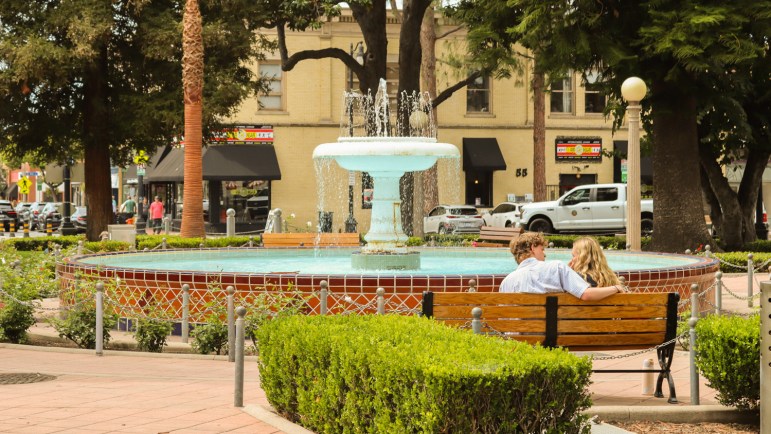 A couple sits on a bench at the Orange circle in Orange, Calif., on April 16, 2026. Credit: Nora Grube, VOICE OF OC
Councilwoman Arianna Barrios, the only one to vote against the contract, unsuccessfully pushed to postpone the vote on the contract, echoed privacy concerns of residents and publicly worried how the city would punish officers who misuse the data collected.
“That is something of such vital importance,” she said. “That there are some serious, serious repercussions if anyone steps out of those bounds because we are talking about people’s privacy.”
Orange Police Chief Adam Jevec said they are simply a tool for detectives to help them solve crimes and there are laws to prevent the misuse of the data.
“Flock is a tool that points us in a direction, and when you talk about privacy and you talk about access to this – policy and state law prevents officers from going and breaking the law, and when they break the law, they get held accountable,” he said.
Meanwhile, Anaheim officials approved buying over 70 more automated license plate readers and in Brea, intersection cameras are being installed, adding more cameras to the city’s proposed Integrated Crime Center.
At the same time, Santa Ana officials are expected to debate a resolution calling on state legislators to add them to a California speed camera pilot program to cite speeding drivers on local streets amid concerns about the implementation cost.
It comes as cities across the region in recent years have been increasing their stock of automated license plate readers in effort to deter and prevent crime and amid new concerns that the footage collected may be shared with federal immigration enforcement agencies.
Santa Ana Officials to Ask to Join Speed Camera Program
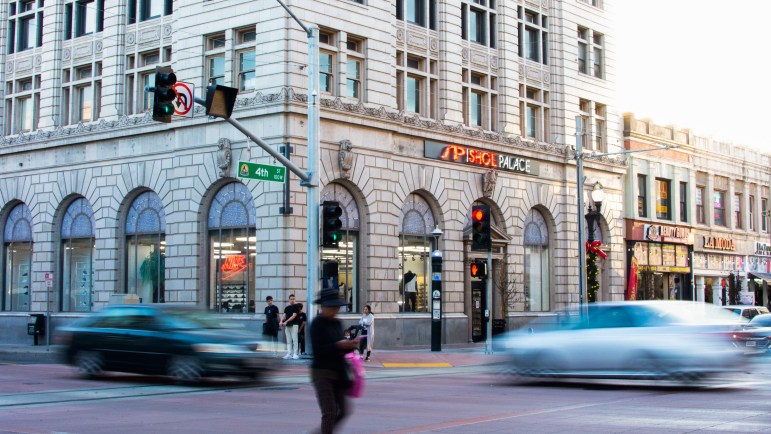 Downtown Santa Ana. Credit: QUINCY CARTMELL, Voice of OC
In April, Santa Ana City Councilman Phil Bacerra successfully called for staff to bring back a resolution asking state legislators to add the city to the California Speed Camera Pilot Program to try out cameras that photograph speeding cars’ license plates and generate citations.
The pilot program was approved as part of a state law in 2023 and implemented for the cities Los Angeles, Long Beach, San Francisco, Oakland, Glendale and San Jose.
Bacerra said joining the program would help keep residents safer and deter speeding, pointing to two fatal car accidents on and near Segerstrom Avenue last year.
Under state laws, he said city leaders would have to keep the data collected by the cameras confidential and safe from “certain agencies.”
“I don’t believe anybody on this dais wants this type of data shared with ICE,” Bacerra said at the April 21 meeting.
Councilwoman Thai Viet Phan questioned how much the cameras will cost as they face a multi-million dollar budget deficit heading into the next fiscal year.
“Of all the list of issues and items that we have on our (Capital Improvement Projects) as well as budget priorities. I don’t think this is the way to go. I would like to see what other options we have on safety on Segerstrom,” she said at the April 21 meeting.
Mayor Valerie Amezcua said protecting lives should be something officials prioritize when it comes to funding.
“We’d rather have parties than save lives,” she said. “We should be very passionate about losing the lives of our children and our families on that street or throughout this city, because I know I am and I’ve been this way since day one. I’m not doing it because it’s political season.”
Phan pushed back saying they don’t know how effective the program would be and should explore other options.
“All of us up here care about when someone dies from speeding. I live off Segerstrom, so I had a house there. I drove by it every day,” she said.
“We don’t know if it’s effective, we don’t have the money to implement it and we don’t know if it’s going to do anything because paying $50 for a fine is not necessarily going to slow people down, especially if they’re already not obeying stated speeding signs.”
It is unclear when the resolution will return to the city council.
Costa Mesa Residents Call on Officials to Cancel the City’s Contract with Flock
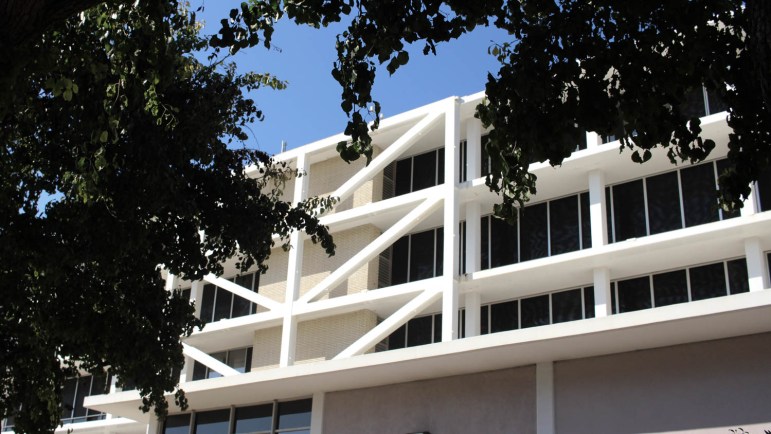 Costa Mesa City Hall. Credit: ERIKA TAYLOR, Voice of OC
Residents in Costa Mesa asked the city council for another audit of the Flock camera system set up around the city and to cancel the city’s contract with the company after an ex-police officer Robert Jay Josett allegedly used the system to track his wife, mistress and others.
Josett pleaded guilty in April to three misdemeanors, including unauthorized computer access and fraud related to illegally accessing the police department’s license plate reader system.
A month prior officials announced the results of a network audit that found no users have unauthorized access to Costa Mesa’s data and that none of the users were conducting unauthorized searches.
“He (IT Manager Michael Steinke) confirmed that we have not had any network security breaches at the time we have had Flock,” Councilmember Loren Gameros said during the March 3 council meeting. “The IT manager and his team constantly monitor the network and ensure that the data is safe.”
Despite the audit saying that there had been no confirmed security breaches during the time the city has had the system, Josett allegedly used the database to gather information not related to his job in 2023.
He also allegedly used the cameras to find his mistress’s new boyfriend in June 2024, despite being put on leave in December 2023, according to the OC District Attorney’s office.
“We’re not asking you to solve all the world’s problems,” said one public commentator during the April 21 meeting. “We’re asking you not to use our taxpayer dollars to subscribe to an ecosystem of mass surveillance of innocent residents through a company with a documented record of deception built by investors with a stated political agenda that is anti-democracy.”
The speaker was one of three to comment on the misuse of the city’s Flock camera system.
Anaheim Buys More License Plate Readers
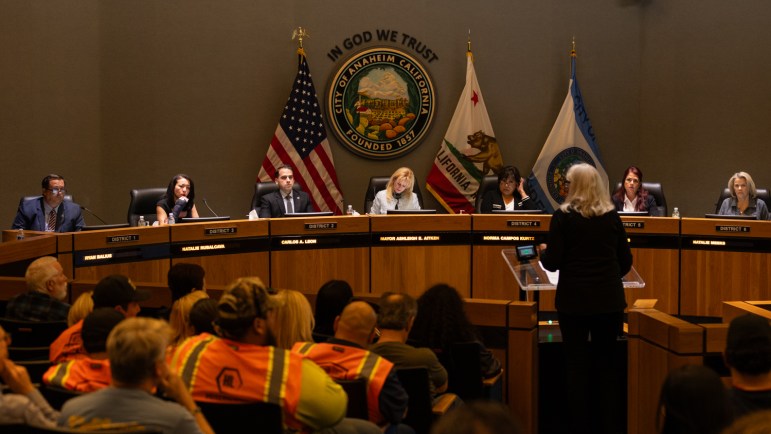 The dais at the Anaheim City Council meeting on Jan. 13, 2025. Credit: ERIKA TAYLOR, Voice of OC
Anaheim City Council members in April voted unanimously to pay $736,000 to buy 72 more automated license plate readers.
Twenty of the cameras will be placed throughout the city based on crime trends and 11 will be allocated to the resort area. The remaining 41 cameras will be placed through the Orange County operational area, according to Anaheim Police Lieutenant Jimmy Rodriguez.
The data taken from the readers will be housed in a cloud by Motorola Solutions, a third party company, and will be stored in the system for one year.
Anaheim City Councilwoman Natalie Rubalcava expressed concern over third party companies and what type of data outside entities may be able to obtain.
Councilman Carlos Leon also expressed concern over immigrant communities and questioned if the technology could be used to track undocumented immigrants.
“People are afraid. Families are afraid. That fear is real, it’s legitimate, we’ve said it before,” Leon said in the April 21 council meeting. “We’re living through a period of federal enforcement that has separated families, disrupted schools, shaken the sense of safety in our community and the sense of safety every person deserves to feel.”
Anaheim Police Chief Manny Cid explained to council members that the cameras are for public safety purposes only, and that the data taken from the readers will only be shared with state agencies and local law enforcement.
“The data, it belongs to us. We have total rights over who we share it with, who we don’t share it with,” Cid said in the April 21 council meeting.
The purchase in Anaheim faced pushback from residents and local activists like Gustavo Castillo, communications director for OC Communities Organized for Responsible Development, worried the data collected by the cameras could end up in the hands of federal immigration agents.
“This is not about safety, this is about expanding surveillance infrastructure,” Castillo said at the city council meeting.
“Once these systems are in place, the data can be shared, accessed, and misused across jurisdictions. If the data is used by agencies like ICE, the harm is immediate and irreversible. You cannot take back surveillance once it has been deployed.”
Castillo said the expansion of surveillance in the city will erode trust in local government.
“Residents should not feel like they’re being watched every time they leave their homes,” he said.
Brea Installs One of Three Camera Systems Around the City
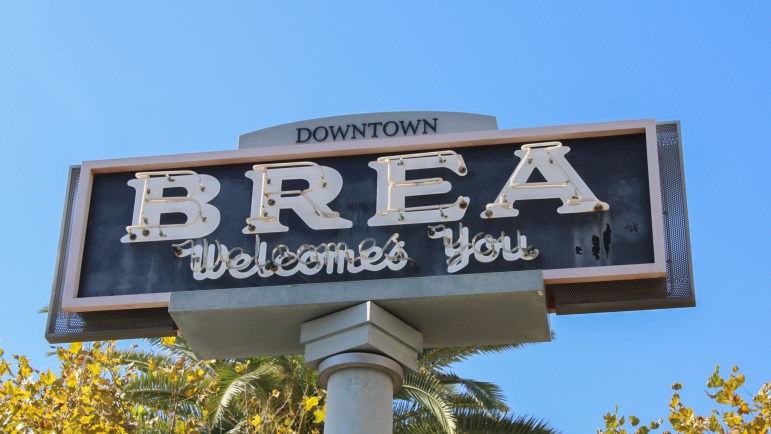 The iconic “Welcome to Downtown Brea” sign stands welcoming visitors on Tuesday, Nov. 12, 2024. CREDIT: LILAH GREGG, Voice of OC
Brea is gearing up to add traffic signal cameras to their growing surveillance across the city.
The cameras will be installed in the public areas of Brea, such as Brea Boulevard and Central Avenue, offering a live stream in these zones to help aid in expediting police and emergency services to the city’s intersections when crimes are actively happening.
The cameras will have four lenses that are multi censored, able to pick up a 360 degree view of the intersection it is posted on.
They will also be able to be manipulated by an analyst in the Brea Police Department’s proposed Integrated Crime Center, tilting and zooming in on any ongoing crime.
“The idea of the integration of it would be, like, say a robbery occurred at Brea Boulevard and Central,” said Brea Police Lieutenant Tony Barbosa in an interview with the Voice of OC. “We would be able to pull up Brea Boulevard and Central as the call was coming in, and we would be able to see what was happening in that intersection and potentially be able to zoom in on a car or a person that was committing that crime.”
Barbosa also explained that the cameras might have the possibility to get a close enough picture with the pan-tilt zoom cameras to recognize faces, but that it would be utilized in a live operation for specific criminal activity.
“We currently do not have a facial recognition (software) to upload any of this into. The zoom feature would be basically from the pan-tilt zoom camera, which would be operated in live feed conjunction with some kind of criminal activity,” Barbosa said.
According to Barbosa, who is also the project manager for the system, the installation of the cameras around the city are a part of a grant project adopted by the Brea City Council on Dec. 19, 2023.
The grant funds the implementation of not only the traffic signal cameras, but the installation of licence plate readers and drone software from Motorola Solutions, the same company Anaheim is purchasing their readers from, for the purpose of constructing this integrated crime center.
The construction for the camera and fiber network was approved Aug. 19, 2025.
Related