
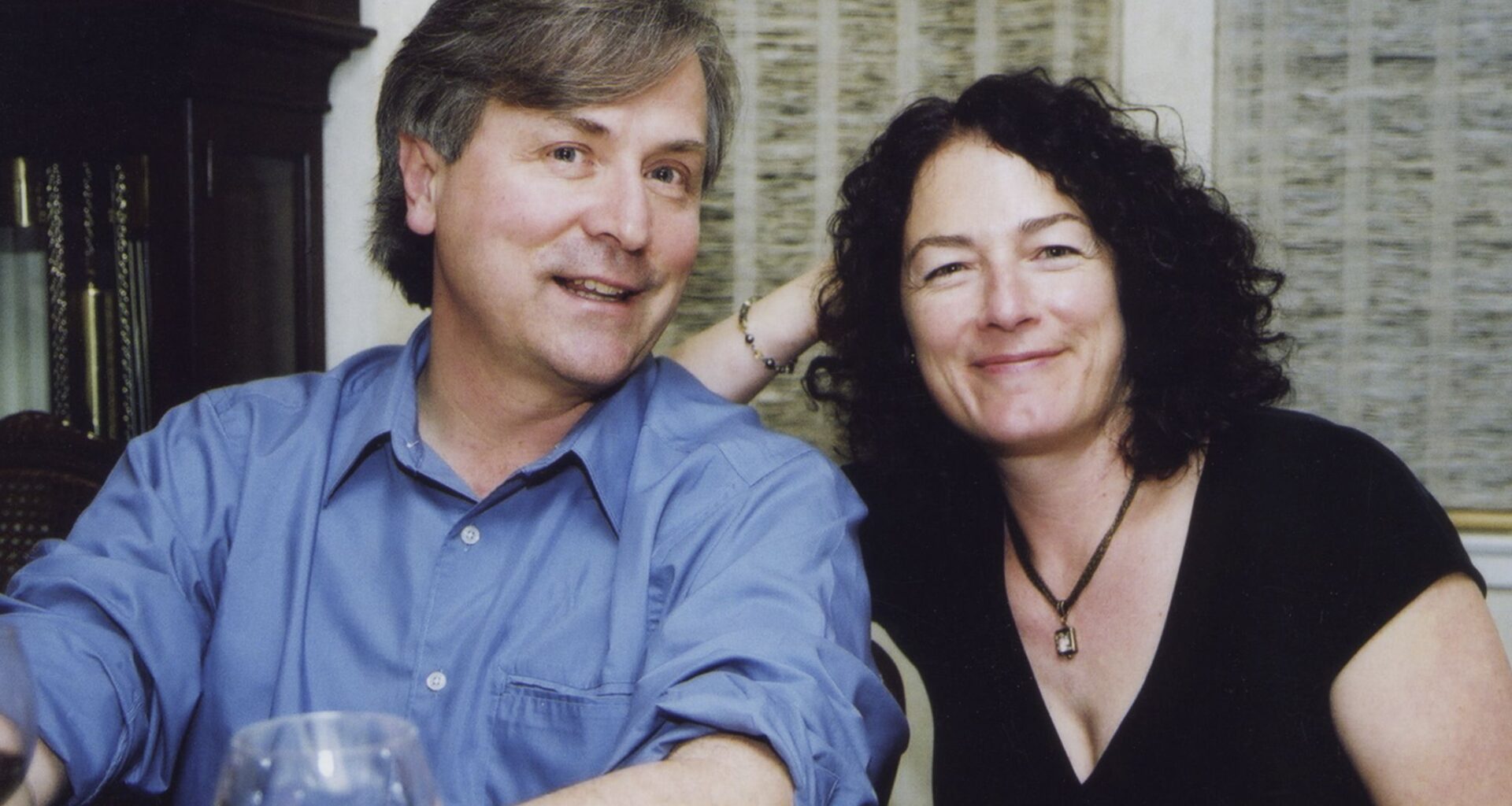
David Talbot and Camille Peri at her parents’ home in Belmont, Christmas 2000.
Courtesy of Sue Peri
Camille Peri, right, and Kate Moses at a book signing event for their book “Mothers Who Think” at the Avid Reader in Davis in 1999.
Courtesy of Sue Peri
Camille Peri on her motorcycle in San Francisco in the 1970s.
Courtesy of Sue Peri
Camille Peri (feeding bird) in a family modeling spread that appeared in a Life magazine advertisement in the 1950s.
Courtesy of Sue Peri/The Davis Enterprise
In the constant flow of literary output from her family’s funky hillside home in San Francisco, Camille Peri did her part by coming up with the name “Salon” for a pioneering culture website, and a daily feature for it called “Mothers Who Think” that became so popular it launched two book spinoffs.
But her most ambitious project was a biography of Fanny Van de Grift, the Victorian-era San Franciscan who endured a turbulent marriage to the Scottish adventure novelist Robert Louis Stevenson. That project took her 10 years to research and write, during which time Peri was weakened by chemotherapy and radiation for a recurrence of breast cancer — while she was also tending to her husband, David Talbot, the Salon co-founder and author of “Season of the Witch,” who’d suffered a stroke in 2017, and an incapacitating second stroke in June 2024.
Obstacles and distractions and financial concerns confronted Peri every morning before she could get to her writing station, but she stuck with it through the publication of “A Wilder Shore: the Romantic Odyssey of Fanny and Robert Louis Stevenson” in the summer of 2024. The book release party was triumphant, even as Peri hid the news that her cancer was terminal.
Article continues below this ad
She died at home May 16, at age 71, said her son Joe Talbot, a filmmaker who directed and produced “The Last Black Man in San Francisco” while living at home with his parents and younger brother Nat.
Camille Peri joining a martini toast at her San Francisco home, Christmas 2024.
Courtesy of sue Peri
“My mom had an infectious goodness that has left a giant hole in all of our hearts,” said Joe Talbot, 36. “She was funny and clever and eternally curious, always interested in talking about what was going on in the world. She had a journalistic appetite that made life itself so fun, even when it was hard on her.”
San Francisco Chronicle Logo
Make us a Preferred Source to get more of our news when you search.
Add Preferred Source
Her creativity went beyond the written word. She and Talbot attempted to turn a plain and shabby 1920s house into an 1890s Victorian by adding gingerbread detail and trim. The magic of pouring her heart into an old house and hanging onto it, despite the seismic demographic shift in the city, was a direct influence on her son’s vision for “The Last Black Man in San Francisco,” released in 2019.
Article continues below this ad
In total, seven books, five short films, one online magazine and a number of freelance articles came out of the three-bedroom home, which became a creative magnet for guests. Among them was Jimmie Fails, who stayed eight years and later co-wrote and starred in “The Last Black Man in San Francisco,” which was inspired by Fails’ experience growing up in the city and his family’s connection to a Victorian home in the Fillmore.
Also staying there were Ozer, a San Francisco rapper; author and poet Olivia Gatwood; and Peri’s older brother Don, who has written four books about Walt Disney and his entertainment empire. Then there was Talbot’s older brother Stephen, a documentary filmmaker and former childhood actor who’d played Gilbert Bates on “Leave it to Beaver,” and his little sister Margaret, a 20-year staff member of the New Yorker, based in Washington, D.C.
“Camille and David had the best breakfast table banter of any couple I’ve ever known,” said Margaret, noting that their marriage was similar to that of Fanny and Robert Louis Stevenson, the latter of whom once described it as “one long conversation.”
“They really identified with that,” Margaret said. “Camille was somebody with a zest for life and a gift for happiness that was at the center of this household where people really were coming and going — rappers, poets, activists and writers of all kinds. It was a circus in the best possible way.”
Camille Marie Peri was born Jan. 10, 1954, at Mt. Zion Hospital in San Francisco, where her family went back three generations. Two of her grandparents lived through the earthquake of 1906; her grandmother Lorraine watched the fire burn from the top of a hill at age 6. Her father, Joe Peri, was a lithographer, and her mother, Alice Hill Peri, stayed at home with her children Bob, Don and Camille.
Article continues below this ad
A montage of Camille Peri’s childhood modeling pictures for newspapers and magazines.
Courtesy of Sue Peri
All three worked as child models, Camille starting at age 3 for Macy’s ads that ran in the Chronicle and Examiner, along with national publications like Life and the Saturday Evening Post, often photographed by the great Fred Lyon. The entire family appeared together in a gatefold spread that was photographed on the coast of Oregon.
In the late 1950s the Peri family moved to the Peninsula — first San Bruno and then Belmont, where Camille attended Cipriani Elementary School and Ralston Middle School. Her interest in writing dates back to a scholastic magazine contest she entered and won during middle school, said Don.
At Carlmont High School she was both a frosh-soph cheerleader and a varsity cheerleader for the Scots, and graduated in 1972. After one year at College of San Mateo, she transferred to UC Berkeley, where she graduated Phi Beta Kappa in American studies in 1976. Her senior thesis was on gangster films of the 1930s. In addition to receiving an A, her professor told her, “Not only is this the best thing I’ve ever read by an undergraduate, it’s the best thing I’ve read by anybody on this subject,” said her brother.
This emboldened her to move to San Francisco and pursue life as a freelancer, still a viable career in the 1970s when magazines like Mother Jones and San Francisco Focus were fat with ads and in need of content. She got an apartment on Taylor Street, a few blocks from Steve McQueen’s apartment in “Bullitt,” and got around town on a Honda 350 motorcycle. She paid her bills by waiting tables at the Crown Room in the Fairmont Hotel, and at Beach Blanket Babylon. She filled her time by volunteering at Legal Services for Children.
Article continues below this ad
Camille Peri on her motorcycle in San Francisco in the 1970s
Courtesy of Sue Peri
As a freelancer she was fearless. For one article she tracked down an Argentine war criminal hiding out in Northern California, and for another she tracked down Joe Montana to discuss his Christmas memories. Her brother, Don, happened to be at her place when the 49ers star returned her call.
“She was going somewhere and trying to wrap up the conversation but he wanted to keep talking about Christmas,” he said. “We couldn’t believe that she was trying to cut off Joe Montana as he was talking.”
Eventually, Peri got her foot in the door at Image, the Sunday magazine produced by the San Francisco Examiner, where David Talbot was a senior editor.
“He was taken with her San Francisco history and her gutsiness as a reporter,” said Margaret Talbot, the New Yorker writer. “They loved journalism stories. They had that kind of banter and lived the depiction of old journalism in movies. She always was good with a snappy retort.”
Article continues below this ad
They were married in December 1989, at St. Luke’s Episcopal Church on Van Ness, with a reception at Cafe Majestic. In 1990, the first of two sons was born. He was named Joe, at least partly in honor of the Montana Christmas scoop Peri had landed.
She ended up in a desk job as an editor at Image, and Talbot moved up to the position of editor. Gary Kamiya, another Examiner writer and editor, became senior editor, and the three of them cooked up the idea for an online cultural and political website.
They left their jobs to launch Salon in 1995. It was Camille who came up with the name, which beat out others they kicked around, including “Limelight.”
“David and Camille were two of my closest friends, so starting Salon with them was like playing in a rock band with your best pals. There were no grown-ups around,” said Kamiya, who went on to write the idiosyncratic history “Cool Gray City of Love,” published in 2013. Adding to the mix was Kamiya’s then-wife Kate Moses, who partnered with Peri on Mothers Who Think, conceived as a standalone print magazine.
“Camille had this idea of doing a magazine for mothers that would be an antidote to the kind of saccharine writing that reduces motherhood to a lifestyle issue or 10 steps to potty train your child,” said Moses, a writer and book editor who said they were thinking print at the start. “The idea was to cover stories that were more thought provoking about mothers.”
The print magazine idea was circumvented by both of their husbands, “who really wanted to get their hands on the funding from BabyGap that we secured,” said Moses. That’s how it became a standing feature in Salon, with stories posted every day. Launched in 1997, it became nearly as popular on Salon as the sex columns that were always at the top of the heap. Emails started coming in at 2 a.m., when new moms were nursing. They became contributors.
Then came emails from the New York publishing houses. The anthology “Mothers Who Think: Tales of Real-Life Parenthood” was published on Mother’s Day in 1999. A book tour titled “Moms on the Run” ensued. A second anthology, “Because I Said So: 33 Mothers Write about Children, Sex, Men, Aging, Faith, Race & Themselves,” came out on Mother’s Day in 2005.
By then they’d outgrown Salon, and the column had morphed into other plans: Peri’s interest veered into the life of Fanny Stevenson.
“You could see that book as a jumping-off point from our time at Mothers Who Think,” said Moses, who went on to write the novel “Wintering,” and now coaches women writers nationwide from her home in Downeast Maine.
“Camille was absolutely brilliant and hilarious in the most deadpan way,” Moses said. “A big part of that is that she was intensely curious and expansive in her thinking.”
Camille Peri, left, and Kate Moses at Camille’s home in 2005 during the book launch of “Because I Said So.”
Courtesy of Sue Peri
Part of Peri’s fascination with Fanny Stevenson came from the parallels she found between them. Both women lived at home with a husband in chronic poor health, and both had constant money troubles. Despite her own medical issues, Peri researched the book by going everywhere Stevenson went, from San Francisco to Scotland, Samoa and France. Her husband was her first reader.
“After his first stroke, my dad would come down the stairs crying and clutching the manuscript and say to me and my brother, ‘Your mom is a brilliant f—–g writer,’” Joe said.
Peri had undergone a double mastectomy after discovering a lump during a family trip to Disneyland in 2001. But in 2019, while attending the Sundance Film Festival where “The Last Black Man in San Francisco” was screened, she felt shortness of breath which, she assumed was just from the altitude. It was later determined to be caused by spots on her lung. The cancer was back, midway through the project of writing “A Wilder Shore.”
“She was able to finish this book even though she had gotten her second diagnosis of cancer, and it is excellent, I have to say,” said Margaret Talbot, who served as her second reader. “It was a struggle for Camille to write it because she was ill and she was taking care of David, but her experience as a writer and a Bohemian San Franciscan really informs the story of the woman who kept Robert Stevenson alive, even though he had terrible lung disease. Camille could relate to aspects of their marriage and really brought their story to life.”
She did so while undergoing chemotherapy and radiation and while caring for her husband, who is still at the family home. All of that sapped her strength, but she still had enough energy left for one more idea that came out of the Talbot kitchen — a Friday night pizza popup called Fatty Natty’s, launched in 2024 by her younger son, Nat, at 16th and Valencia.
“Even in her last weeks she would ask me if I had my checklist for the popup,” said Nat, 32. “The Fatty Natty pizza enterprise is like the spirit of the household taken out into the streets. All types of San Francisco characters come and feel at home, and that’s what my mom was all about.”