
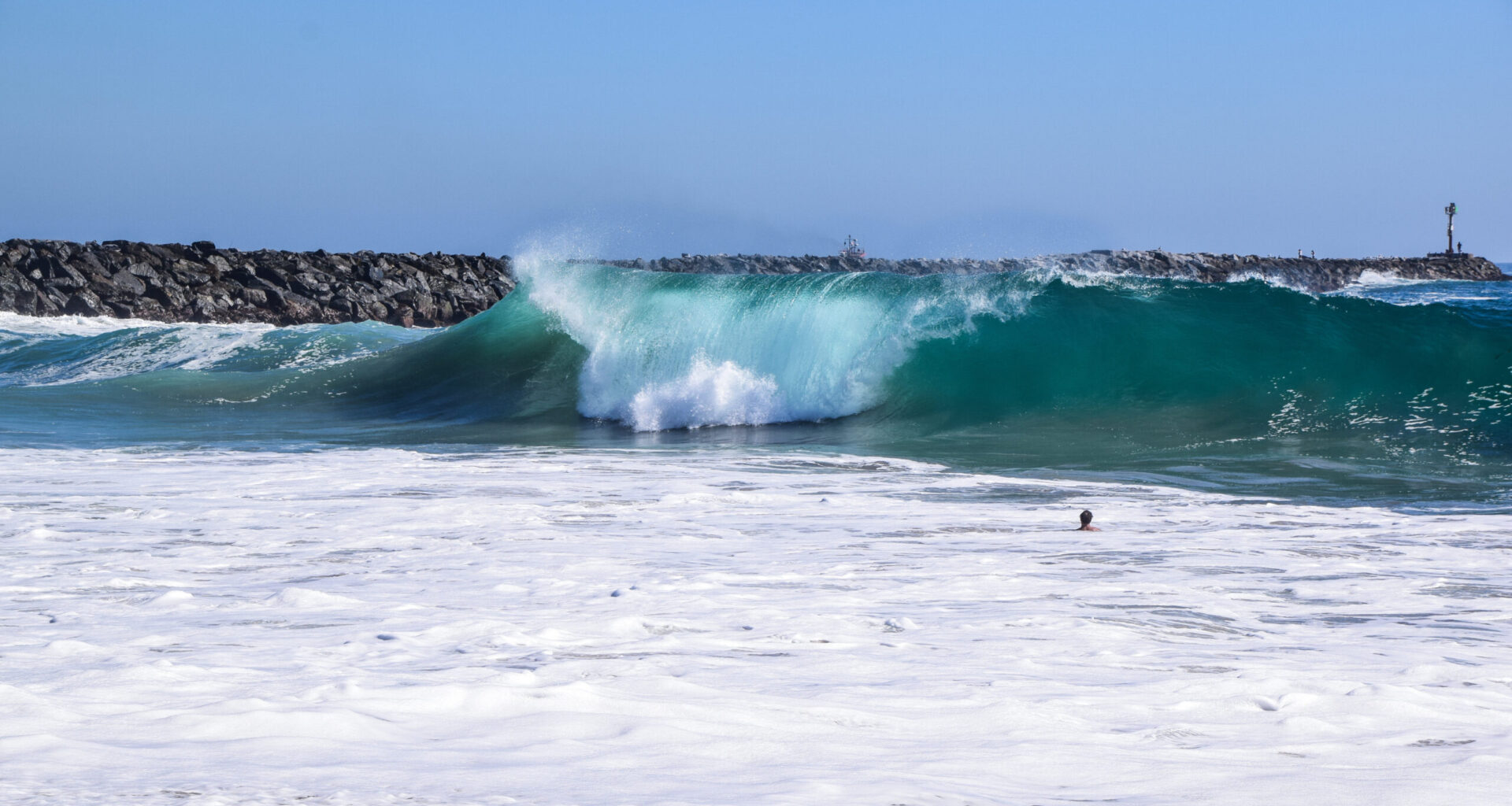
Forecasters have warned beachgoers about rip currents and rough conditions as big waves roll into Orange County, with The Wedge facing unique hazards from years of coastline loss
Surfers, swimmers and beachgoers alike are experiencing a powerful swell that may bring some of the biggest waves of the year to The Wedge in Newport Beach and other Southern California coastal areas today through Friday, according to forecasters.
Surf in Orange County could reach eight to 12 feet, delighting surfers while also serving as a warning to inexperienced oceangoers.
The biggest south swell in years is about to slam Southern California — and at The Wedge in Newport Beach, some of the locals are worried about more than the wipeouts.
Both the Global Forecast System and European weather models showed the system producing 45-to-48-foot seas in the South Pacific over the weekend, and it is propelling its energy straight at the Southern California coast. In Orange County, the peak hit this morning and will continue into Wednesday.
“It looks like the south swell we are seeing right now will briefly weaken. There will still be some decent sets for south, southwest-facing beaches,” National Weather Service meteorologist Sebastian Westerink told the Orange County Register on Saturday. “Then, once we get into Tuesday, especially Wednesday and into Thursday, that south swell is going to come back stronger than what we are experiencing now.”
Many south-facing beaches in the region are expected to have 5-to-8-foot waves, with high sets on tap at spots like The Wedge, the world-famous surf break located right at the southernmost tip of the Balboa Peninsula. Though the swell faces south, some breaks in Orange County and San Diego will see the heaviest impact, despite not facing directly south.
The Wedge has not had a proper swell in a few years because of coastal erosion. The once sandy section now exposes the rocks of the Wedge jetty, the curving structure that turns into a seawall and runs horizontally from the beach. With the sand level dropped so far, those rocks are now painfully visible in the lineup, creating the less-than-desirable Wedge Reef as deemed by locals. As rocks from the jetty break, they can scatter through the impact zone.
The jetty is wearing out, and parts are beginning to crumble from underneath. The sand underneath that was needed to support the rocks above is now gone, and the more sand that goes, the more the natural buffer that slows the surf before it reaches the seawall fades away.
Scroll to continue reading
However, this issue is not unique to the Wedge; California’s coastline has been losing sand for years. As the sea level rises, dammed and modified river systems send less sediment seaward and storm cycles pull sand offshore faster than it returns; once gorgeous California coastlines are being wiped out.
What is unique to the Wedge is the combination of the jetty, the seawall and the steep angle that creates the famous waves in the first place. These are the same structures being dismantled bit by bit, which is not natural. However, long before the jetty, the swells were magnified by the Newport Submarine Canyon, a deep underwater trench routing open-ocean swell energy directly to shore almost completely without the natural buffering most of the California coast gets, just not the Wedge.
Nevertheless, dozens of surfers are taking advantage of the strong swell and favorable waves in Newport Beach this morning, though strong southern hemisphere ground swell today and over the next few days will increase the risk of rip currents. The National Weather Service has issued warnings for Santa Barbara County, Ventura County, and Los Angeles, Orange County and San Diego, and caution is advised.
“Just be careful when you’re close to them and note that the conditions will be rough,” Westerink said. “Usually, the more energy we have with a swell, the higher the risk there is for rip currents. Watch out for those. Heed the warnings you see at the beaches.”