
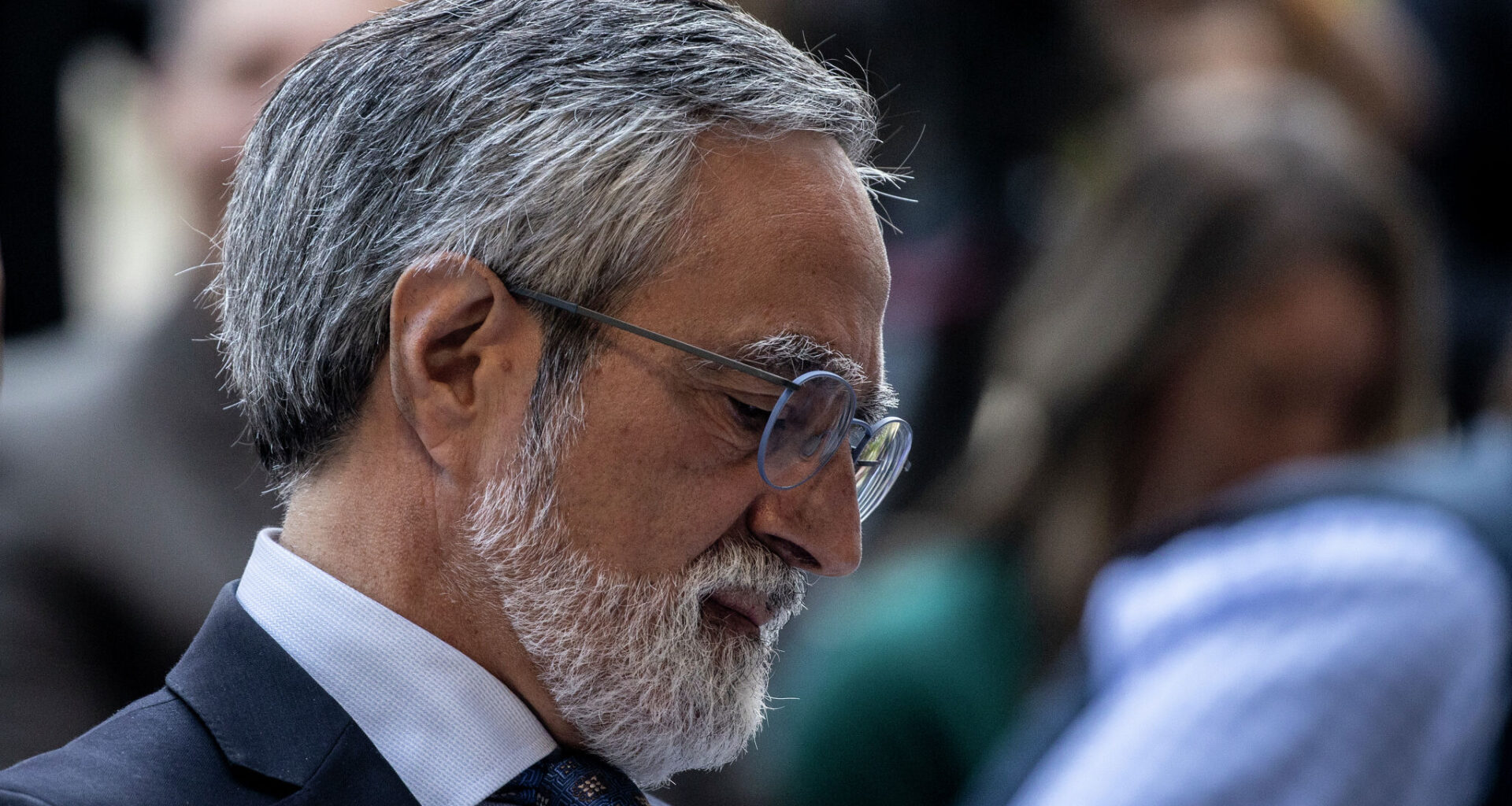
Proposition B’s lifetime maximum of two terms for San Francisco supervisors and mayors appears to be directed at Aaron Peskin. He is the only supervisor to serve more than two terms since 1990.
Stephen Lam/S.F. Chronicle
What does it feel like to have your own city’s voters effectively ban you from running for elected office?
There’s only one person in San Francisco who can answer that question: Aaron Peskin, the progressive former president of the Board of Supervisors.
That’s thanks to the passage of Proposition B, which establishes a lifetime maximum of two terms for supervisors as well as mayors. Prop B didn’t mention Peskin by name, and its supporters vehemently insisted it had nothing to do with him. But their denials were disingenuous.
Article continues below this ad
Only one San Francisco supervisor — Peskin — has won more than two terms since 1990, when voters approved a measure to limit mayors and supervisors to two consecutive terms with the option to seek reelection after at least a four-year break.
Peskin’s critics — largely moderate Democrats — didn’t want to risk him repeating this feat. For them, the stakes were existential: One of the biggest donors to the Prop B campaign, billionaire Michael Moritz, argued hyperbolically in a 2024 New York Times opinion piece that Peskin was almost singularly responsible for San Francisco’s woes by throwing up seemingly endless barriers to new housing and practically all forms of change.
San Francisco Chronicle Logo
Make us a Preferred Source to get more of our news when you search.
Add Preferred Source
I sat down with Peskin for more than an hour this week at Caffe Trieste, one of his North Beach haunts, to get his take on the June primary election.
Sipping a latte, Peskin seemed profoundly unbothered — even amused — by Prop B’s passage.
Article continues below this ad
“I’ve become fond of saying they suffer from PDS,” he told me of the measure’s backers, grinning and waiting for me to suss out the acronym.
“Peskin Derangement Syndrome.”
Peskin dismissed the notion that he’s champing at the bit to return to the Board of Supervisors. “I’ve got a very full life. I’ve got a job” — he’s president of the nonprofit Great Basin Land and Water, which works to preserve land and water resources in California, Nevada and Oregon. “I’m making up for all sorts of things that I missed for 10 years, working my ass off night and day.”
Was he just putting on a brave face? It didn’t seem like it.
He held court as if he were still in office or campaigning during his 2024 mayoral run. He regularly interrupted his train of thought to greet passersby or to respond to the flow of texts and calls to his phone.
Article continues below this ad
Watching Peskin in action, it was impossible not to think of former Mayor Willie Brown — who, decades after he last held elected office, continues to exert formidable sway over San Francisco politics.
That comparison wasn’t lost on Peskin, who told me he has a weekly standing breakfast date with Brown.
Prop B will keep Peskin off the Board of Supervisors. But it will not prevent him from being a San Francisco power broker. He remains funny and charismatic with an encyclopedic knowledge of the city’s regulations, characters and places.
How he’ll use that charm and influence remains to be seen. Peskin’s brand of progressivism was widely stomped in the June primary. Voters overwhelmingly chose moderate incumbents over progressive or housing-skeptical challengers in Peskin’s ilk, and they rejected Prop D, a labor-backed measure to significantly jack up taxes on large businesses with highly paid executives.
The longtime progressive playbook of chanting “tax the rich” isn’t enough to win. Nor is reflexively opposing market-rate housing — as demonstrated by Stephen Sherrill and Alan Wong’s landslide victories for supervisor seats over opponents who criticized their support for Mayor Daniel Lurie’s blueprint to upzone vast swaths of the city for 82,000 new housing units.
Article continues below this ad
So where does San Francisco’s progressive movement go from here?
When I put this question to Peskin, he took a moment to collect his thoughts.
“Progressivism, to me, is about having the wherewithal to not just roll over and say yes to everything, but to ask the hard questions and to step in and fight the good fight when it needs to be fought.”
This was clearly a dig at the supes, who’ve largely been in lockstep with Lurie’s agenda.
But it wasn’t exactly persuasive.
Article continues below this ad
I pointed out that voters overwhelmingly support Lurie’s agenda; the moderate mayor enjoys a whopping 74% approval rating. So why would they find Peskin’s message of contrarianism appealing?
“I mean, A, nothing lasts forever,” Peskin said. “B, you have to remind people about what makes America and San Francisco great. And it’s the separation of powers and checks and balances.”
For Peskin, local politics is a long game.
“What’s important is that neighborhood-based independent candidates, despite the tsunami of tech-bro cash, continue to run for these offices,” he said. “It shows that people are not curling up in the fetal position because Garry Tan and a bunch of junkyard dogs with cash to burn are in the game. The … pendulum swings back and forth.”
But progressives’ trouncing in June wasn’t due only to money. Progressive firebrand Saikat Chakrabarti poured millions of dollars into his congressional campaign, to no avail. And progressive billionaire Tom Steyer flooded his gubernatorial campaign with about $200 million — and is still trailing moderate Democrat Xavier Becerra and Republican Steve Hilton.
Voters may be fed up with “testosterone-poisoned billionaires,” as Peskin put it. (He said he lodged a protest vote for governor by casting a ballot for Betty Yee, who dropped out of the race in April.) But, at least in San Francisco, something more is afoot.
Moderates are telling a resonant story of a city on the rise and taking steps to make it safer, cleaner, more functional and more affordable. Progressives, reluctant to acknowledge that moderates might be doing something right, have countered that Lurie and the supes are permitting corporations and billionaires to benefit at the expense of everyday people.
But progressives haven’t yet articulated a compelling alternative vision for policy or governance.
Yes, the pendulum swings back and forth. But progressives won’t gain momentum if their main value proposition continues to be opposing a popular mayor and his popular policies.
Peskin told me that he wants “Lurie and his administration to do well. I’m not rooting against the home team.”
Yet he also seems to be waiting for Lurie and the moderate-majority board to mess up.
Guest opinions in Open Forum and Insight are produced by writers with expertise, personal experience or original insights on a subject of interest to our readers. Their views do not necessarily reflect the opinion of The Chronicle editorial board, which is committed to providing a diversity of ideas to our readership.
Read more about our transparency and ethics policies
“When revelations of corruption come to the fore because that level of accountability and checks and balances isn’t there, then people get frustrated — and then they want people who are willing to ask tough questions,” Peskin said.
I’m no political consultant, but waiting for your opponent to fail spectacularly doesn’t seem like much of a strategy.
Emily Hoeven is a columnist and editorial writer for the Opinion section.