
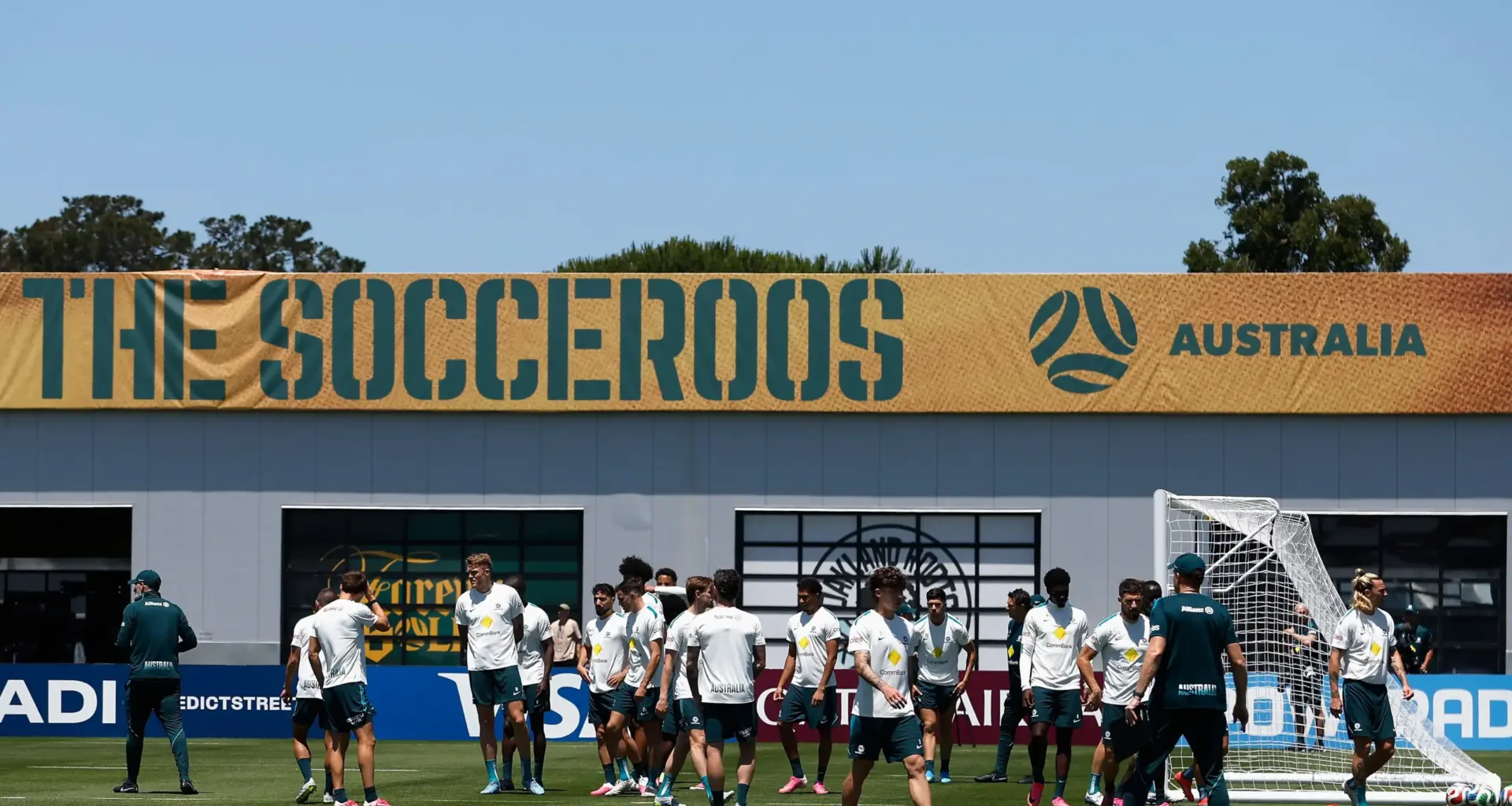
The Socceroos’ home away from home isn’t just a nice training facility. The red carpet has been rolled out for us Australians at the HQ of the Oakland Roots and Soul Sporting Club – and that hospitality tells you enough about what makes this club tick.
It is a unique story but one not without parallels in Australia.
The bit that is unprecedented is the pain suffered by the locals as three of their iconic franchises, the Oakland Raiders NFL side, Oakland Athletics baseball outfit and Golden State Warriors have left for riches further afield in Las Vegas and San Francisco.
From the rubble sprung a club that would never forget its roots – hence, the name, also a play on the Oak tree.
The way they have made their journey a success, though, does have fascinating insights for Australian football; a club built on deep fan and community engagement in a values-driven project, attracting players and coaches aligned to their ideals and averaging 8,000 fans per game, with the highest ever US sports attendance by a non major-league team (26,000) proof of their recipe.
“All strong trees need strong roots and Oakland is the land of oaks,” their co-founder and Chief Marketing Officer Edreece Arghandiwal told us on a glorious day in Oakland.
“I’ve always believed that in order to know where you’re going in life, you gotta know where you come from.”
Their crest, which features a sketch of the city of Oakland, was launched without funding in 2018, and momentum from there helped bring in the funds to develop the club.
Initially loaning the old Oakland Raiders’ world class facility, they started in Division 3 in the US Soccer structure but have developed a proud brand that is embedded in their community.
“Everything is all about belonging and where you are here,” he continued. “We live in a world where everything can become corporatised very quickly, everything is monopolised and we wanted to change that narrative as a community that has lost three major league teams, it’s unprecedented and it hasn’t happened in America if not the world.
“You’ll never see a team in Europe leave its community because there’s a a better stadium pathway in a different community. It just doesn’t happen. So when we created the club, it really was about how do we develop something that leans into our community authentically but takes its purpose very very seriously in every action that we do.
“There’s a big misconception that purpose and profit are disconnected and you have to have one or the other. What we’re developing here is a unique model that puts purpose first and when you do that the profit and the following follows and we’ve certainly been an example of that.”
An average crowd of 8,000 doesn’t happen overnight in a second tier club, but the community has responded.
He continued: “Our purpose statement is to harness the magic of Oakland and the power of sport as a vehicle for social good. It means that everything we do, the players we roster, the actions in our community reflect what our community actually wants.
“We are also community owned and $3.6 million raised by 6,000 local and global investors, making it one of the most successful community raises in American sports history.
“That happens because we show up and we say yes to things that matter. We’re in the streets and we’re in the community in a way that most professional sports teams wouldn’t necessarily care to. And we’ve done that over the years with zero paid advertising…”
The biggest lesson along the journey has been “to not compromise your core beliefs in your foundation” and being part of a community also means being even more than just a soccer club.
“I’ve always thought of us as a sports club. We’re actually not a soccer club, we’re a sports club. Barcelona was really at the core of our inspiration early days, they have a basketball team, they have a table tennis team. It was about sports, it was about the identity of the community. When you think Barcelona, you actually now don’t think about the city, you think about the club because they’re synonymous. And I really wanted to develop that mentality here in Oakland.
“We have some of the most diverse artists, musicians, athletes in the world, some at the highest level. And we deserve to have a high-level club that operates world class, and maybe one day we can go toe-to-toe with the greats of Barcelona.”
Every detail here has meaning behind it. Every time the team walks out they play Coastin’ by Oakland hip hop artist Zioni, who passed away during COVID. He performed for the club for free in its early years, a gesture they never forgot.
“Our purpose is to harness the magic of Oakland and the power of sport as a force for social good. And we take that purpose into account in every decision we make,” the club’s president Lindsay Barenz explained to us.
“How we price our ticket, what companies we do partnerships with, how we build our team, funding a development team entirely outside of the pay-to-play process.”
Even their development pathway, Project 510 – 510 being the area code – is about the local community.
“It’s a project of developing local talent and giving them a pathway to becoming professional players,” she explained.
“In the United States, youth sports is incredibly expensive. We have a pay-to-play system here. You can’t participate if you can’t pay. And that’s very unfortunate because it excludes a lot of people from participating. And we know how vital sports are for youth. They learn teamwork, leadership and most importantly resilience. When you lose a game, you don’t quit. You show up the next week and you play again.
“So it is very, very important that we have accessible youth sports in this country. And so the part we wanted to play in that, given where we are in the pyramid of development, is creating a development team, Project 510, that exists completely outside of that pay-to-play system and it gives local talented youth with ambitions of playing professionally, a professional training environment.
“We have signed seven players from our Project 510 team onto academy contracts this year, which allows them to retain their NCAA eligibility if they want to go to college, but also to play with the first team. And we have signed players from Project 510 onto Oakland Roots and we have transferred them into Mexico or into Europe.
“So we are seeing a real development pathway and pipeline develop here in the East Bay and it’s very exciting.”
The club might be grounded with its values, but it doesn’t mean they don’t have ambition.
They’ve enjoyed their best start to a USL season under head coach Ryan Martin and when they bought the Raiders’ old facility 18 months ago, they did so with a bid to become a FIFA base camp in mind.
Now, when the Socceroos depart, the Roots players will have a World Cup level pitch to enjoy as they continue to push for silverware.
“We wanted to make sure that the East Bay got to be a part of the World Cup,” Barenz added. “There are World Cup games happening in the Bay Area, but those are a couple dozen miles south of us. And we wanted to make sure that the fun and also the economic activity of the World Cup got shared with the East Bay. And the best way we could do that is become a training facility for a visiting national team.”
Not only does Martin, a US mentor with a glittering CV, whose father has won the most games in US College soccer history, now have a club with the sporting facilities to attract him, but he added that the aforementioned philosophy is something that actively attracts players and coaches, like himself, to the club.
“It was a huge attraction,” he explained.
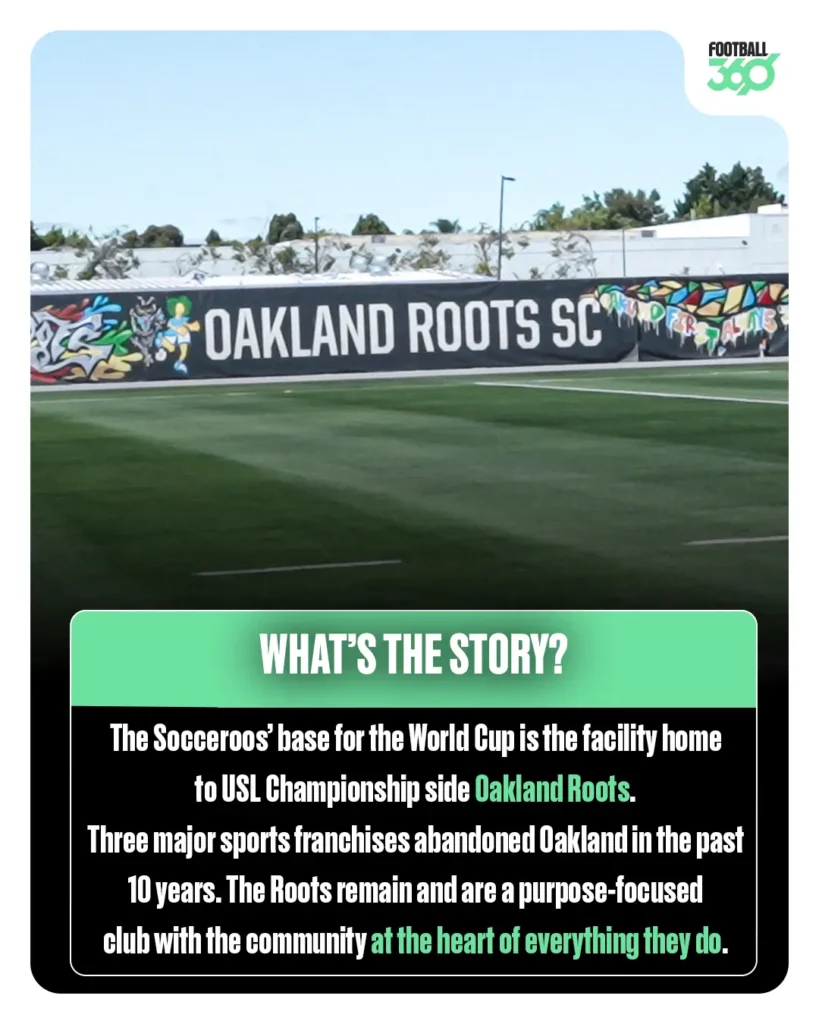
“I think when I spoke to the ownership and I spoke to the the front office, the GMs, etcetera, they talked about being a community and what they do for the city of Oakland. And when you start to look at what Oakland is as a whole, it’s an incredibly resilient, blue-collar, hardworking town and they’ve lost three professional sports teams in the past ten years and we’re the last group standing.
“We’re trying to use that to galvanise the fan base and galvanise Oakland and when we take the field, my job as the manager is to to make sure the team represents that in the way we play and that was a huge part of why I took this job and it’s been even more evident the more I’ve dug into this – it is a very big community club and it’s exciting to see and the community’s really behind us.”
The club’s approach is galvanising the community, bringing the fans through the gate, but as co-captain Tyler Gibson said, even helps build the squad, who buy into the idea.
“I think that’s the most important part, that’s how you get fans to come out – they want to know and interact with the the players and fans and and see that interaction,” Gibson said.
“Being able to connect with them, see them, talk to them, after games, going around signing autographs, seeing the kids, whether you win or lose … it’s super important
“This club is so community focused and it’s awesome to be a part of. So hopefully we continue to get out in the community, grow it, and I think they appreciate us being here. As a player and for prospective players…it is important to give back to the community, go to kids’ schools, go and interact with them. Then they they put a face with the name.”
Want World Cup news delivered direct to your inbox? Sign up for our Football360 Daily newsletter!