
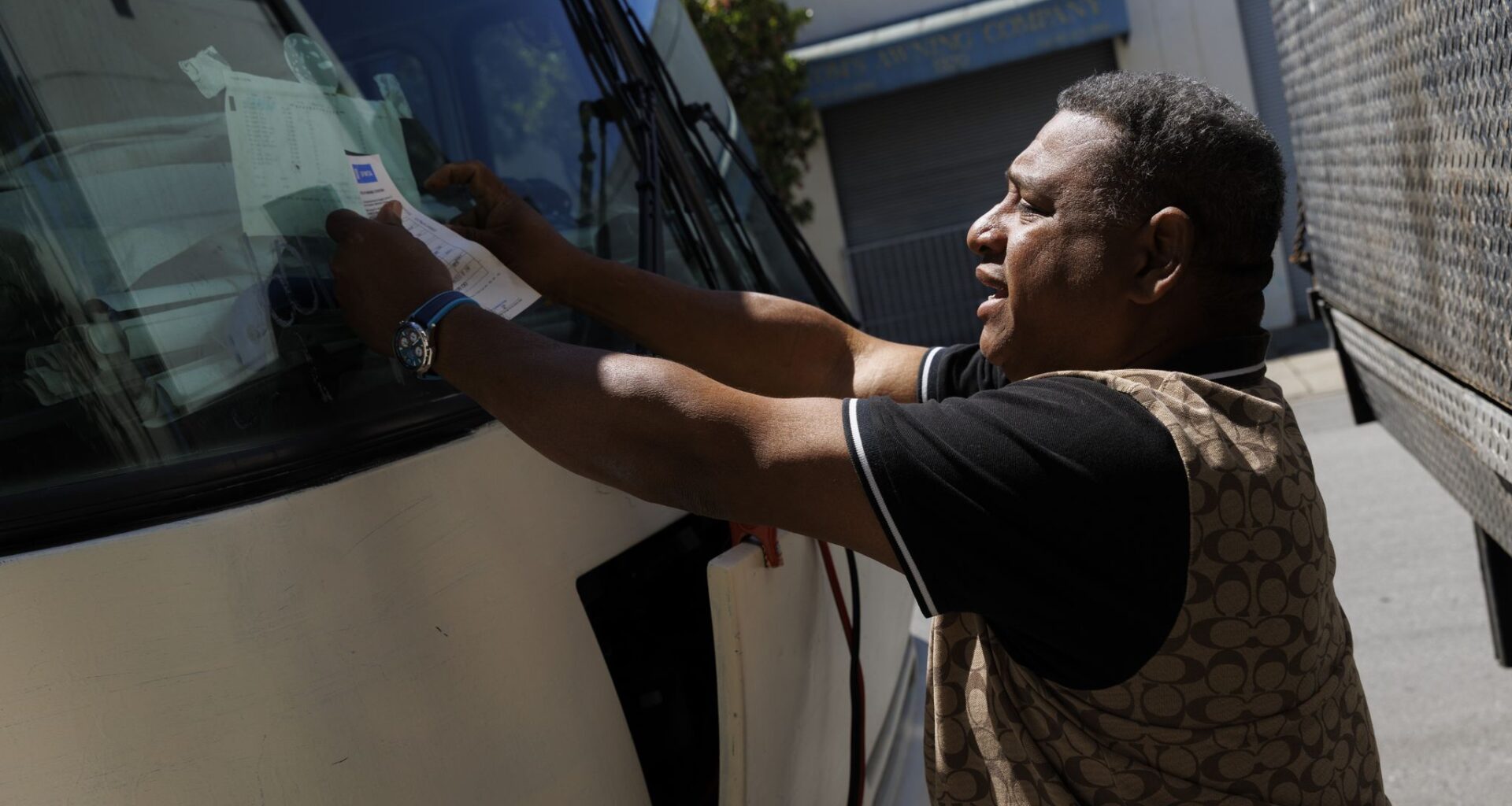
Duber Marcano checks the information on his parking ticket and compares it to his registration he displays on the front of his RV in San Francisco.
Santiago Mejia/S.F. Chronicle
On a quiet, tree-lined street near the former Hunters Point Naval Shipyard, Venezuelan music drifted from a row of RVs. A group of immigrants here on Griffith Street have created a small support network — sharing meals, trading memories of Venezuela and keeping watch over one another’s vehicles.
But their fragile community now sits squarely in the path of San Francisco’s effort to clear oversized vehicles from city streets.
While making a bowl of ceviche one recent evening, Duber Marcano, 47, periodically scanned the scene outside his window, watching for parking enforcement officers.
Article continues below this ad
“We look out for each other,” Marcano said, adding that he was scared of having his RV ticketed or towed again.
San Francisco began enforcing new rules in November barring oversized vehicles from staying parked in one place for more than two hours on any city street. Violators face a $108 ticket and potential towing. Longer-term RV dwellers were eligible for permits temporarily exempting them from the parking limits as city staff worked to move them into housing.
A row of RVs in San Francisco on Griffith Street in the Bayview.
Santiago Mejia/S.F. Chronicle
Mayor Daniel Lurie, who crafted the legislation, promised to give families living in RVs “better options” and “give our communities and small businesses safe and clean streets.” Neighbors had pressured city officials for years to address a proliferation of RVs that they argued unfairly took up valuable parking spaces and heightened trash and safety concerns.
San Francisco Chronicle Logo
Make us a Preferred Source to get more of our news when you search.
Add Preferred Source
Seven months later, the results are mixed: about half of the nearly 330 households that were living in permitted RVs have been moved into housing or shelter, while 180 remain on the street. Meanwhile, other new, unpermitted RV dwellers have arrived, with no intention of leaving.
Article continues below this ad
Lurie on Tuesday touted a record-low count of 259 oversized vehicles citywide, saying in a statement that the data “shows clearly that our new strategies are working.” But the latest enforcement push has done little to resolve the housing pressures pushing people into RVs — or to ease frustrations from homeowners and tenants in neighborhoods where RVs remain concentrated. Nearly half of all RVs tallied in the city last month were parked in the Bayview-Hunters Point neighborhood.
The Department of Emergency Management, which oversees the city’s large vehicle permit program, declined an interview request but said in a statement that the city “continues to make meaningful progress helping people experiencing vehicular homelessness transition into housing and shelter.”
From left: Alexander Urdaneta and Josmely Villar thanking Duber Marcano for a meal he made for them at their RVs in San Francisco.
Santiago Mejia/S.F. Chronicle
Lurie spokesperson Charles Lutvak echoed that sentiment, adding in a statement that the administration would be “relentless until no parent has to raise their kids in a vehicle and every community has the safe, clean streets they deserve.”
Since November, parking enforcement officers have issued about 850 citations against RVs for violating the new two-hour limit and towed about 270 RVs, according to city data. Griffith Street in the city’s Bayview-Hunters Point neighborhood has seen the most enforcement, with oversized vehicles there receiving 68 citations.
Article continues below this ad
RV dwellers who regularly park on the block say enforcement officers come by several times a week. They usually attempt to move their RV to another street to avoid getting ticketed but it’s not always possible. Some days their vehicle won’t start, can’t be moved because it’s sandwiched between two vehicles or the enforcement officer places a citation on their windshield before they realize what’s happening. Still, they plan to stay.
Alexander Urdaneta, 34, and Josmely Villar, 24, Venezuelan immigrants who moved into their RV on Griffith Street about three months ago, have been cited 10 times — the second-most of any RV in the city. Parked nearby are two RVs owned by Urdaneta’s brothers who both have permits temporarily exempting them from enforcement because they lived in the vehicles prior to the June cut-off for RVs to be grandfathered in.
When asked if Urdaneta and Villar would consider parking their RV in a different city, Urdaneta said no. “It’s safer here,” he said in Spanish. “We work in Oakland, but it’s too intense, too difficult. It’s dangerous.”
Aside from the citations, Urdaneta said the couple is comfortable and grateful to be living in the RV, with friends and family close by. The pair, who work as delivery drivers for Uber and DoorDash, spent the prior two years paying $1,200 a month for a tiny downtown hotel room with a communal bathroom. Eager for more space, they bought an RV earlier this year.
Josmely Villar tidies up the bedroom in her RV in San Francisco on Wednesday, June 03, 2026.
Santiago Mejia/S.F. Chronicle
They said they were unaware of the new parking restrictions and that they’re ineligible for the city’s permit program, which promised to provide those who agree to relinquish their vehicles with money and placement into shelter or housing.
Article continues below this ad
Only RVs that had been parked in the city prior to June 2026 were eligible for permits. The permits were initially set to expire at the end of April, with city officials hoping to buy back the RVs from their owners and help transition occupants into housing or shelter during that window.
As of the start of June, city officials have transitioned 114 households from RVs into housing and 37 into shelters. The city has bought back 104 RVs — paying owners an average of about $5,000 to take them off the streets.
More than 170 RV permits have been extended for another six months as case managers continue to try and match the occupants with housing or shelter.
Moving a household from an RV into housing requires a lengthy process, including completion of an intake assessment, enrollment into an appropriate subsidy program, identifying an available unit and conducting a required unit inspection. To successfully complete that process for more than 100 RV occupants in seven months was “actually quite fast,” said Emily Cohen, spokesperson for the city’s homelessness department.
“Because there are so many families, we can’t help them all at the same time,” Cohen said. “… But we’re working to get through them.”
Article continues below this ad
For some San Franciscans, the changes don’t feel nearly swift enough. Bayview resident Timothy Simon said he initially applauded the mayor’s RV policy, but he has yet to see any impact on his block. On any given day, he said, two or three RVs are parked on his street — some without permits or license plates. Neighbors regularly report the RVs to 311, but Simon said their reports are often closed the next day without any improvements.
Duber Marcano shows a recent video of parking enforcement attempting to ticket RVs on his block in San Francisco. Marcano said when he started recording that parking enforcement sped away without ticketing him.
Santiago Mejia/S.F. Chronicle
“There needs to be a more meaningful — and I would also say compassionate — way to enforce the laws,” Simon said. “It’s not fair to the tax-paying, mortgage-paying, rent-paying residents of my community that we have to constantly report these matters, and we don’t see any net positive results from our reporting.”
As for the RV dwellers on Griffith Street, Urdaneta and Marcano said they were making their best attempts to comply with the law and planned to seek waivers for the accumulated fines. The city’s transportation department offers a one-time-only waiver of all parking citations for people experiencing homelessness.
“I want to fight to be here,” Marcano said.