
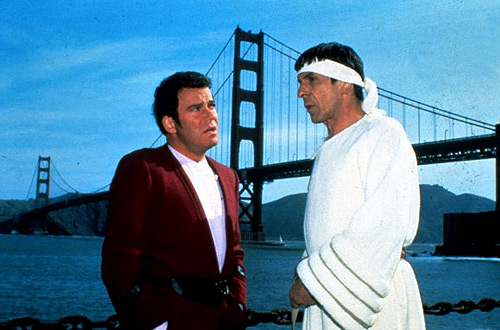
William Shatner and Leonard Nimoy stand in front of the Golden Gate Bridge in “Star Trek IV: The Voyage Home.”
Paramount 1986
Nicholas Meyer was on his way to Hollywood in 1971 when an unexpected stop in San Francisco changed everything.
“I had an aunt who lived there, so I stayed with her for a month,” the Oscar-nominated filmmaker told the Chronicle during a recent video interview. “I’d never been to California and I had heard that San Francisco was a special place. I had no idea what that really meant until I crossed the Bay Bridge and was completely clobbered by the place.”
Nicholas Meyer in person: Saturday, June 13. “Time After Time,” 2:30 p.m., followed by Q&A with Meyer and producer Steven-Charles Jaffe. “Star Trek IV: The Voyage Home,” 6:30 p.m., followed by Q&A with Meyer and Chronicle culture critic Peter Hartlaub. $25 per movie, $40 for both. Vogue Theatre, 3290 Sacramento St., S.F. voguemovies.com
Indeed, that first visit left a lasting impression — one that eventually played a major role in two of his beloved movies.
Article continues below this ad
In “Time After Time” (1979) his directorial debut, H.G. Wells (Malcolm McDowell) uses his time machine to follow Jack the Ripper (David Warner) from Victorian London to the modern-day City by the Bay.
Meyer then co-wrote the screenplay for “Star Trek IV: The Voyage Home” (1986), specifically the San Francisco section, in which Capt. Kirk (William Shatner), Mr. Spock (Leonard Nimoy, who directs) and the Enterprise crew travel back in time to save a pair of humpback whales.
San Francisco Chronicle Logo
Make us a Preferred Source to get more of our news when you search.
Add Preferred Source
He will present both films at the Vogue Theatre in San Francisco on Saturday, June 13, followed by a Q&A after each screening.
Meyer, who also directed “Star Trek II: The Wrath of Khan” (1982) and “Star Trek VI: The Undiscovered Country” (1991), has had a long and varied career. He directed “The Day After” (1983), a hard-hitting ABC TV movie that imagined a nuclear attack on America and starred Jason Robards, John Lithgow and Amy Madigan; and “Volunteers” (1985), a comedy starring East Bay native Tom Hanks and John Candy.
Article continues below this ad
He has also written six novels starring Arthur Conan Doyle’s iconic sleuth, Sherlock Holmes. The first, “The Seven-Per-Cent Solution,” was made into a 1976 movie starring Nicol Williamson, Robert Duvall and Alan Arkin; his screenplay was nominated for an Academy Award. The sixth, “Sherlock Holmes and the Real Thing,” was published last year by the Mysterious Press.
In an interview with the Chronicle before his San Francisco appearance, he reflected on his love of the city, his “Star Trek” years and the unexpected turns of his career.
This conversation has been edited for length and clarity.
Producer Steven-Charles Jaffe, left, and writer-director Nicholas Meyer on the set of “Time After Time” (1979).
Courtesy Nicholas Meyer
Q: “Time After Time” feels like it was made by someone who knows the city, which not every movie filmed here does.
Article continues below this ad
A: Well, I stayed with (my aunt) a month at 116 Cherry St., and I went exploring every day. I made a mental list about all these cool places.
Then, a couple of years later, when I found myself writing the screenplay, I was really determined to work in all the places that I loved, or as many of them as I could.
It was definitely a love note to the city.
Q: I heard you agreed to co-write “Star Trek IV: The Voyage Home” if they set it in San Francisco because you wanted to use some of the ideas you had for “Time After Time” but didn’t get to incorporate into the film.
A: That’s entirely true. One scene which leaps to mind: H.G. Wells, having already caused one traffic accident because he didn’t pay attention to the “Walk, Don’t walk” sign, is standing on a street corner next to a kid holding a boombox, blasting something terrible. He’d like to cross the street, but the sign says, “Don’t walk.” So he’s obliged to suffer.
Article continues below this ad
I didn’t shoot the scene very clearly, and it all bit the dust. But when we were doing “Star Trek IV,” which I think of as my comedy, I put (actor) Kirk Thatcher (dressed in punk style) on the bus with his ghetto blaster and Spock replies with the Vulcan nerve pinch.
H.G. Wells (Malcolm McDowell) is arrested by San Francisco Police Department officers in a scene from Nicholas Meyer’s “Time After Time” (1979).
Warner Bros.
Q: Was it because of “Time After Time” that you got “Star Trek II”?
A: Not exactly. There was a movie I wanted to make a lot, a novel by a Canadian named Robertson Davies called “Fifth Business.” I had written a terrific screenplay for it, and I spent about 16 years of my life trying to get it made, and broke my heart repeatedly. So I just sort of stopped looking at things.
I had a childhood friend, Karen Moore, who was then an executive at Paramount. We were barbecuing hamburgers in my backyard, and she said, “Nicky, if you want to learn how to direct, you should direct and not sit up here holding your breath like an infant. Why don’t you come down to Paramount and meet (producer) Harve Bennett? He’s in charge of doing the second ‘Star Trek’ movie.”
Article continues below this ad
I said, “Is that the one with the man with pointy ears?” and she said, “Don’t be such a snob. You might like him.”
I didn’t know anything about “Star Trek.” I’d see it on TV, and just kept clicking by it because it looked ridiculous to me.
It’s safe to say that I was too stupid to notice all the things that made it special. I didn’t notice the interracial cast, I didn’t notice that women were in positions of power. All of this just blew right by me.
Q: By the time you got on set, this cast had been playing these characters for the better part of two decades. Did they give you any blowback?
A: They were great. They were used to different directors coming on to direct different episodes, and they could not have been more welcoming.
The other thing was that they really liked the script. Nichelle (Nichols, who played Lt. Uhura) would say, “She doesn’t talk like this. She would never say that.” And I would say, “How would she say it?” And then we would change it.
After we had shot the death of Spock, we were shooting the last scene of the movie, where they’re all together on the bridge, looking at this new planet. I was reading the newspaper while (the crew) was setting up.
There was an article that questioned whether Raoul Wallenberg (the Swedish businessman who saved thousands of Jews during World War II and disappeared in 1947) was alive or not. They asked the famed Nazi hunter, Simon Wiesenthal, “You think he’s alive? You think he is dead?” And Wiesenthal said, “He’s not dead. As long as we remember him.”
“All right,” I thought. “Put that in the movie.”