
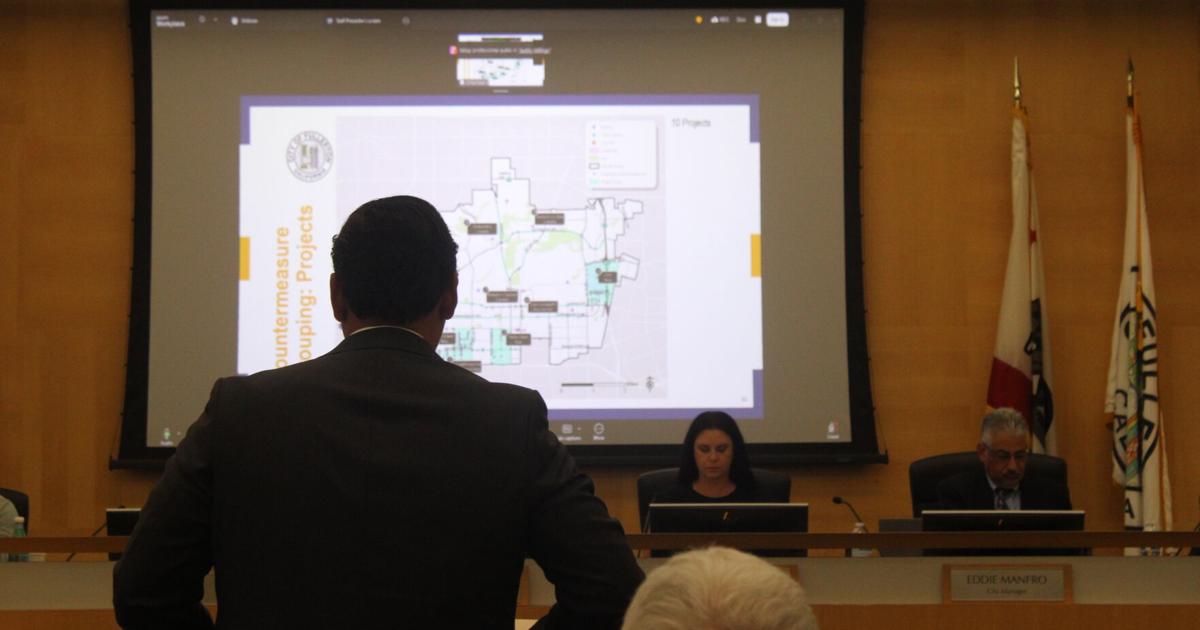
Fullerton City Council voted June 2 to adopt the Safe Streets and Roads for All Safety Action Plan, a resolution establishing a goal to eliminate all traffic-related fatalities and serious injuries in the city by 2040.
The plan identifies 390 countermeasures against traffic-related incidents, including adding curb extensions, speed feedback signs, left-turn signals and high visibility crosswalks in necessary areas.
Implementation of the plan is divided into three stages. Stage one, lasting one to five years, focuses on the Southwest, Harbor West and Euclid West areas of Fullerton.
Stage two, lasting five to 10 years, targets the Cal State Fullerton area, the Orangethorpe Avenue and adjacent area, the Commonwealth Avenue corridor and the Malvern-Chapman corridor.
Stage three, lasting 10 or more years, includes the Harbor Boulevard, Bastanchury-Brea and Gilbert Avenue corridors.
The total estimated for all recommended projects is $36,386,646, which includes construction, soft costs and inflation adjustments. Construction around the CSUF area is projected to be the most expensive individual project in the plan, with an estimated cost of $12,457,192.
The SS4A program is a federal initiative created by the Bipartisan Infrastructure Law that provides $5 billion over five years for local roadway safety efforts.
Fullerton’s plan was developed by city staff and consultant KOA — a Lochner Company — by conducting data analysis of Fullerton’s collision history starting from May 2024 and transportation guidelines. Their information was primarily sourced from the Fullerton General Plan and the Local Roadway Safety Plan.
Development of Fullerton’s SS4A plan included seven community outreach events and an online survey. Feedback from local events in the city, such as the Fullerton Farmers Market, found that 93% of survey respondents favored high-visibility crosswalks and 80% supported leading pedestrian intervals, which give pedestrians a head start at intersections.
The resolution states that prioritizing multi-model safety will require “tradeoff decisions,” which may result in loss of street parking or increased vehicle delays.
Adoption of the plan ensures the city remains eligible for federal funding and avoids the forfeiture of a $200,000 federal planning grant, which required a finalized plan by June 30. The development of the plan was supported by the federal grant and $50,000 in local Gas Tax funds.
Before reaching the council, the plan received unanimous support from the Transportation and Circulation Commission, the Active Transportation Committee and the Infrastructure and Natural Resources Advisory Committee.