
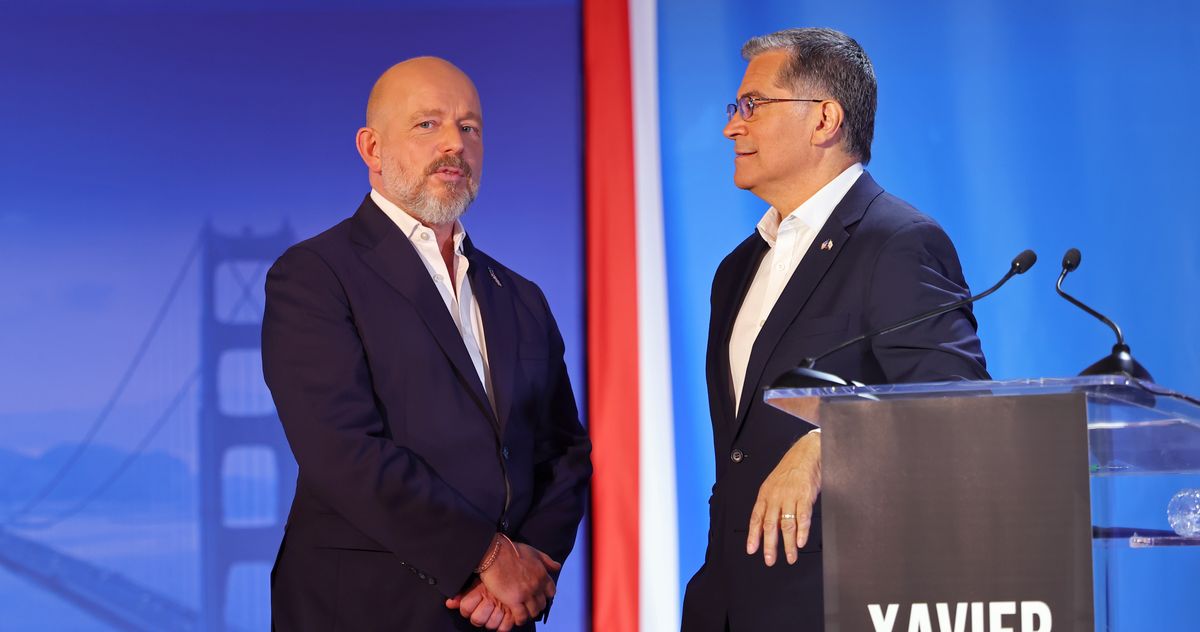

California’s surviving gubernatorial contenders, Steve Hilton and Xavier Becerra.
Photo: Leon Bennett/Getty Images
It took a week, but on June 9, the Associated Press confirmed a development that many predicted when the first returns from California’s gubernatorial primary appeared: Republican Steve Hilton finished second to Democrat Xavier Becerra and will face him in the November general election.
Unlike fellow California Republican Spencer Pratt, Hilton survived the “Blue Shift” in the vote count, which always occurs in places with heavy voting by mail thanks to the Democratic proclivity to vote late. Hilton held off progressive Democrat Tom Steyer, who spent a record-setting $213 million of his own money on his losing campaign.
Hilton’s relative success provides a good headline for California’s embattled Republicans, while wrong-footing Donald Trump’s unsupported claims that the primary was “rigged” by Democrats (Hilton said he saw no evidence of significant election fraud). But his chances of actually winning the governorship probably vanished at the very moment his strong finish was guaranteed — on April 5, when Trump endorsed him and accelerated the consolidation of GOP votes behind him at the expense of the other major Republican in the race, Riverside County sheriff Chad Bianco. Thus ended the possibility of two Republicans finishing first and second and locking out a scattered Democratic field from the general election.
Now it’s clear the overwhelming Democratic complexion of California gives Hilton little room for expanding his support in November. He won 25 percent of the primary vote (with 91 percent of the vote counted). That’s exactly what Republican John Cox won in the primary in 2018 against Democrat Gavin Newsom. In the general election that year, Cox won 38 percent. Since (like 2018) this is likely to be a Democratic-wave election, 38 percent is about as much as we can expect from Hilton, unless he really kicks out the jams and reaches the 40.8 percent that 2022 GOP gubernatorial nominee Brian Dahle won in a relatively good year for Republicans.
So paradoxically, the big winner from Hilton’s relatively strong performance is his general-election foe, Xavier Becerra, who can cruise to victory based on his partisan identification instead of facing whatever is left of Tom Steyer’s hedge-fund fortune in a Democrat-versus-Democrat fight that exposes all the factional tensions in the state’s dominant party. Yes, there’s some talk of Trump-directed federal prosecutors going after Becerra in connection with the scandalous embezzlement of his campaign funds by two former aides, landing at least one of them in the hoosegow; this possibility was avidly promoted by Steyer. But absent actual evidence Becerra was involved (and the FBI has already cleared him of complicity), that’s the longest of long shots for bringing him down.
It’s more likely that Hilton will make headlines during the long general-election campaign because of his rather unusual background as a former U.K. Tory Party strategist who immigrated to the U.S. and became a gabber on Fox News. Californians old enough to remember the governorship of Arnold Schwarzenegger won’t be shocked by the idea of a Republican governor with an exotic accent. But it’s a very different state politically than it was when Schwarzenegger won his last race in 2006 (the last year any Republican has won statewide there), in large part thanks to Hilton’s White House benefactor. So Hilton has probably hit his peak and will begin the long descent to an abject defeat very soon.
Sign Up for the Intelligencer Newsletter
Daily news about the politics, business, and technology shaping our world.
Vox Media, LLC Terms and Privacy Notice