
The 2026 San Francisco Giants have been utterly helpless when playing from behind. Faced with an uphill climb, the slightest late-ish game incline, the offense’s legs would turn into pudding, their bats into pool noodles. Winless in 30 games in which they trailed after the 6th inning, it’d be more than accurate to say this team has been as resilient as a piece of printer paper in a downpour.
Which makes the already impossible end to Wednesday’s series finale against the Nationals a fantasy. An impossibility. No team in the nearly 70 years of San Francisco baseball has ever looked up at an 8+ run mountain in the 8th inning, said I got this and actually made it over the hump. You’d have to get in a time machine and travel back to 1947, back when the Giants had New York stitched across their chest, to find a team who won a game in which they were losing by that much that late and won.
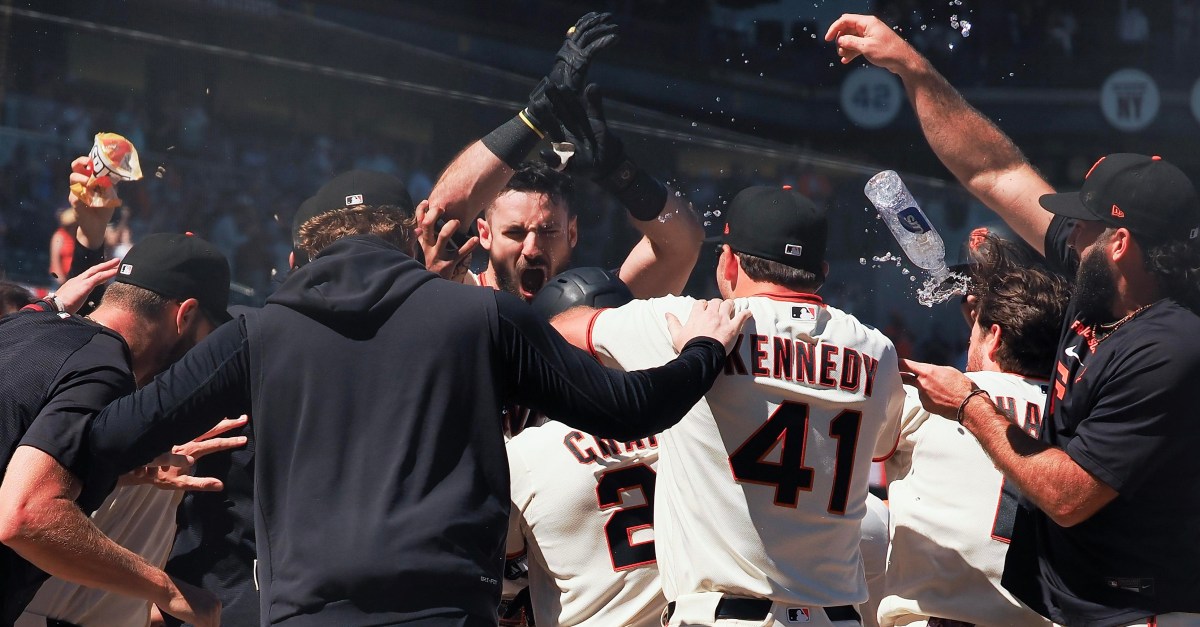
Believe it or not, this team — this team— did it. Down 9-1, with just six outs left, the San Francisco Giants stunned Washington with ten late runs scored. The flag on the summit: Bryce Eldridge’s walk-off grand slam, turning a three-run deficit into a one-run win.
This is the math embedded in all baseball kids growing up. The beautiful enoughness of four over three. The understanding that satisfaction, contentment, comes not in a garish blowout, but in getting exactly what you need. This feat has become known as an “ultimate grand slam,” and Eldridge’s on Wednesday is the 33rd on record (dating back to 1925).
The history doesn’t stop there.
This was just the second walk-off grand slam in Giants history after Bobby Thomson knocked one out at the Polo Grounds in June of 1952 against the Cardinals (another “ultimate” slam). At 21 years old, Eldridge is the youngest player in MLB history to ever call “game” with a 4-run 4-bagger. A feat that feels extra sweet considering how with the tying run at third and winning run at first on Monday night, he went down swinging as the 27th out in the 9th.
Was the slam the cherry on top, or the whole sundae? Call it a miraculous end to a miracle. Celebrate the individual achievement, but also consider how Eldridge got into that position in the first place.
A comeback like this takes a village. A village that could’ve easily pulled up stakes after Washington’s painfully drawn-out 6th in which they chased starter Robbie Ray from the game with five consecutive two out singles; or after their offense dropped another crooked number on Carson Seymour in the 7th; or after Curtis Mead’s solo home run to lead-off the 9th stole back an essential hard-earned run by the Giants in the 8th.
Instead of checking out, San Francisco’s offense finally checked in. They put their heads down and kept moving forward, one foot in front of the other, by stringing hits together, working walks, putting 2-strike pitches in play, hitting for contact and power.
Matt Chapman homered twice and lined an RBI double in the 9th. His solo shot in the 6th put San Francisco on the board. His second in the 8th served as a rallying cry. Rafael Devers immediately answered the call with a homer to center. Needing baserunners, Jung Hoo Lee (who had extended his hitting streak to 18 games in the 6th) walked for the first time in his streak, then stole second. Eldridge correctly challenged a strike-3 call that turned into another walk a pitch later. Daniel Susac then doubled on the seventh pitch of his at-bat to bring home Lee. Five Giants hitters reached base before the Nationals recorded an out in a 5-run 8th.
But after making up so much ground, the next time the Giants came up to hit they had gone backwards. A somewhat manageable 3-run deficit at 9-6 had swollen to 4 runs after Mead’s homer. The mountain had somehow grown — yet the bats didn’t seem discouraged and picked up where they left off against reliever Gus Varland.
Arraez ripped a lead-off double towards Triple’s Alley. Chapman, in an 0-2 count, punched a double off the bricks in right. After going down 0-2, Devers took four straight fastballs out of the zone for the Giants third walk in two innings (another miracle!). Manager Blake Butera swapped Varland for southpaw Mitchell Parker to face Lee, and in another 2-strike count, Lee slapped an opposite field single to load the bases and bring the winning run to the plate.
Four of Parker’s five pitches to Lee were breaking balls. The front door break of his slider against left-handed hitters ostensibly gives him an advantage, and the reliever sought that edge with the offering even when his command had been spotty. He nearly hit Lee with one. His first to Eldridge’s was way inside. The second off the plate and down. Eldridge was clearly seeing the soft-stuff out of Parker’s hand. Disciplined beyond his years, the 21 year old wasn’t chasing. Mentally, he was focused on the at-bat. He wasn’t playing-up to the situation, or letting the moment get to him even though he and everyone in both dugouts and in the stands were mathing the same baseball math: one pitch + one swing, one swing = four runs, seven runs + four runs = enough.
Eldridge is going to get Oracle’d a lot in his hopefully long and fruitful career. 105 MPH drives that would’ve been homers in every Major League park will get beat down by the wind, or frozen by the chilly air, or tracked down by outfielders with too much room to roam in right center. But suffering a career’s worth of those batted-balls, kept cruelly in the confines of the park at 3rd and King, will be worth the gift Oracle gave him today.
A swing with a 44 degree launch angle lifted a baseball straight up into the air, where a slight breeze pushing out to right (the ethereal breath of prolific grand-slammer McCovey, as Jon Miller proposed?) picked it up and floated the ball just far enough for it to ping off the metallic top of the arcade a mere 326 feet away from home. Expected batting average: .060. Over the wall in just one other park.