
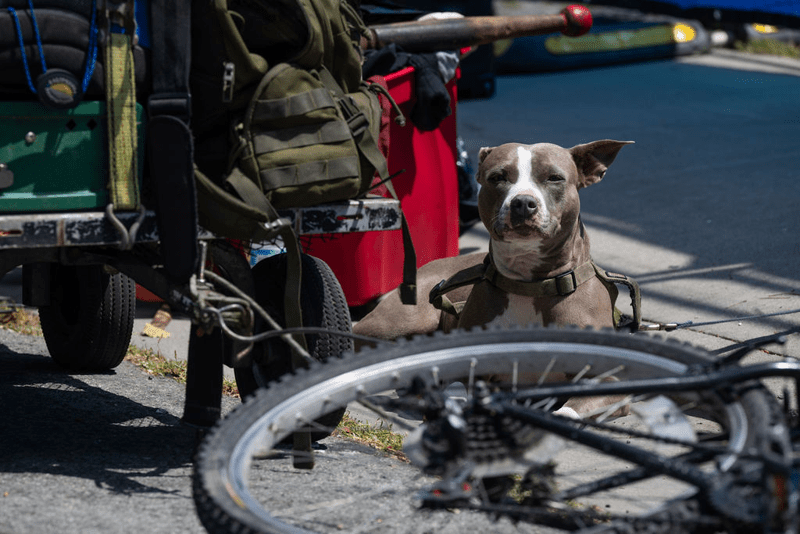
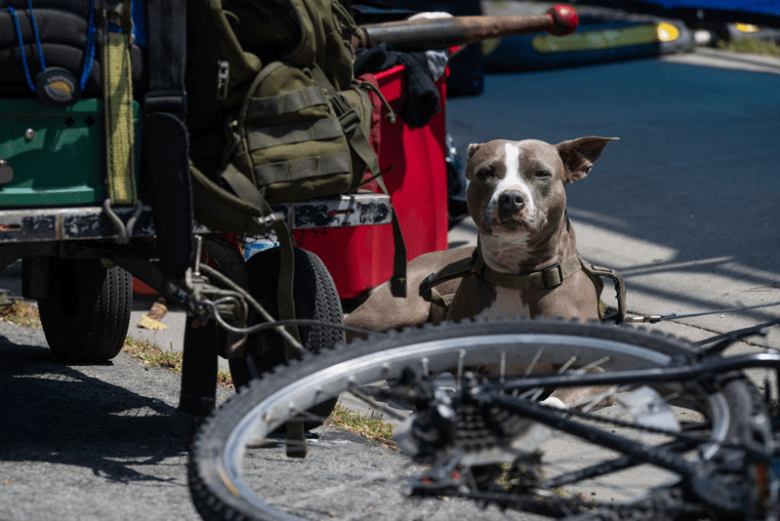
 Dogs, bikes and belongings lay on the sidewalk during a 2025 sweep of the homeless encampment at 8th and Harrison streets. Credit: Adahlia Cole for Berkeleyside
An outbreak of leptospirosis centered around a large encampment in North Berkeley has spread to at least two humans, killing one and hospitalizing the other, city officials announced Wednesday.
The patients, who lived together in an RV about a mile from the homeless encampment at the intersection of Eighth and Harrison streets, represent the first known human cases of the disease in Berkeley in over a decade.
The outbreak also seems to have spread far beyond the one-third-mile radius where health officials first warned Berkeleyans to take precautions in January following detection of the disease in rats and dogs in late 2025. Nevertheless, city health officials believe that the risk to housed city residents is still “extremely low,” since they are less likely to be in contact with rats and can take other steps to avoid the bacteria, though people who live in camps or RVs or otherwise have more exposure to rats are in greater danger.
The most common way the disease moves is by infected rats. Their urine can infect standing water and pass on to other animals by consumption or absorption into open wounds.
The two people who are known to have contracted the illness were using their RV to trap, feed and breed wild rats, City Manager Paul Buddenhagen wrote in a memo to the City Council. Buddenhagen did not say where the two people lived or when one of them died. The city has not publicly identified the patients. Public health officials said the cases were confirmed in May.
The two people “fell sick, but they did not seek medical care for weeks and possibly months,” Buddenhagen wrote. That long wait to seek care “is thought to have contributed to the severity of their disease.” Public Health Officer Dr. Noemi Doohan and Health, Housing and Community Services Director Scott Gilman said the patient who survived needed a “lengthy hospitalization” before recovering.
Leptospirosis infects about 1 million people a year globally, about 60,000 of whom die from it, according to the Centers for Disease Control and Prevention, though human cases are rare in developed countries. Dogs are generally regarded as the most common domesticated animal to contract it. There are vaccines for dogs, cats and many common livestock animals.
Health officials recommended that dog owners make sure their animals are up to date on leptospirosis vaccines.
While rats remain the main conduit for the disease, “the general public should not attempt to exterminate rats,” but rather should call Alameda County Vector Control Services at 510-567-6800, Doohan and Gilman wrote in Wednesday’s memo. County officials and contractors are working to exterminate infected rats.
Health officials advised camp and RV residents to keep food and water in sealed containers, police their trash so that rats do not create nests and to stay away from rats or their excretions as much as possible.
More general suggestions for keeping infection-free include:
Wash fruits and vegetables picked from gardens or farms in the area
Wear protective clothing
Cover scratches and cuts with waterproof bandages
Do not wade or swim in water that may be contaminated
Wash or shower immediately if you fear possible exposure
Clean wounds
Do not touch sick or dead animals
Consume only clear, clean drinking water
The city has removed approximately 40 tons of trash from the Harrison Street camp since February in an attempt to keep rat populations down, according to the Wednesday memo. UC Davis researchers have tested 14 dogs there, all of whom tested negative, and owners were offered free vaccines. (Two dogs tested positive late last year.) Berkeley public health workers handed out protective gear, clothing and information on the disease to people living in the camp.
Related stories

Berkeley can clear encampment at 8th and Harrison — with a few caveats, judge rules
April 8, 2026April 8, 2026, 11:32 a.m.
Leptospirosis outbreak in Berkeley: What’s the risk to people and pets?
January 23, 2026Jan. 23, 2026, 4:19 p.m.
Leptospirosis outbreak detected near Eighth and Harrison encampment
January 13, 2026Jan. 13, 2026, 5:53 p.m.
“*” indicates required fields