
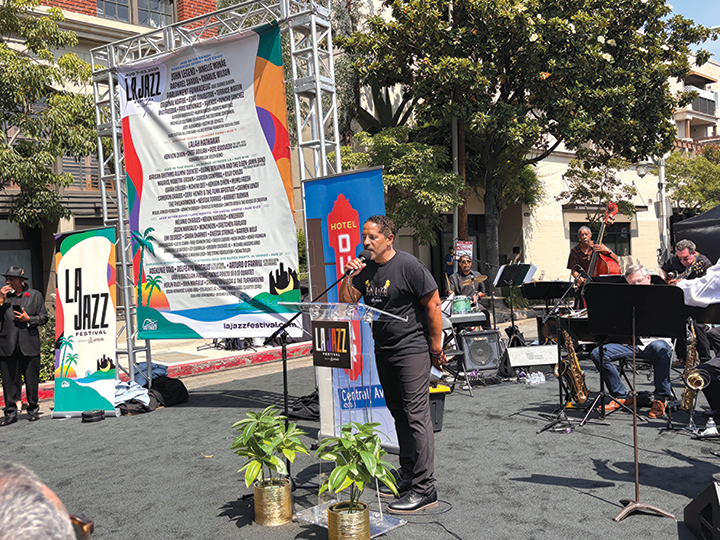
Festival founder and former L.A. City Councilmember Martin Ludlow announced the lineup of more than 160 artists at the historic Dunbar Hotel on June 4. (photo by Tabor Brewster)
This August, the streets, parks, clubs and beaches of Los Angeles will come to life with a city-wide celebration of jazz in the inaugural L.A. Jazz Festival. Headlined by artists including John Legend and Janelle Monáe, the 17-day festival will illuminate the story of jazz, the genre’s pervasive influence and its connection to Southern California.
“L.A. has its own unique relationship and story with jazz from the early days of the founding of jazz in Congo Square, New Orleans,” festival founder Martin Ludlow said. Ludlow is a music promoter, labor activist and former L.A. City Council member who represented the 10th District from 2003-2005. In 2012, Ludlow created Bridge Street, an events production company focused on promoting social justice causes.
“Musicians traveled to L.A. along the Union Pacific rail line to come out to work in entertainment, work in Hollywood,” he said. “This was a time when Hollywood was really beginning to make a major shift with orchestras and big bands, and there’s all kinds of incredible film history around some of the legendary directors and big bands that were really changing the context of Hollywood. As Creole musicians came out for a better life to get away from Jim Crow racism and to try to earn a decent living for their family, they would work Hollywood by day and be able to begin playing in dinner and supper clubs that were really beginning to flourish along Central Avenue and throughout South L.A.”
The Great Migration saw the mass movement of Black Americans from the South to cities like Chicago, Philadelphia, Detroit, New York and Los Angeles, and with it, the jazz music that was birthed from African rhythms in New Orleans began to take shape in nightclubs across America’s cities. In Los Angeles, jazz clubs sprung up along Central Avenue – a center for Black residents when racial covenants segregated the city. The Dunbar Hotel, a safe haven for Black travelers during segregation, acted as the jazz scene’s beating heart in South Central Los Angeles, hosting artists like Duke Ellington, Louis Armstrong, Billie Holiday and Count Basie at its club.
Ludlow said the inaugural festival aims to celebrate the art form while shining light on the important history of jazz and Black culture in Los Angeles. The announcement of the festival’s lineup – which includes more than 160 artists spanning many other genres influenced by jazz and the music of the African diaspora – was made at the Dunbar Hotel on June 4, with an emphasis on the site’s history. The lineup features artists like Raphael Saadiq, Charlie Wilson, Parliament Funkadelic, Original Koffee, Ezra Collective, Big Freedia, Lalah Hathaway, Cory Henry, Jason Marsalis, Warren Wolf, Adekunle Gold, Herlin Riley and Irvin Mayfield, among many others.
“There’s no way to tell the story of jazz without telling the story of pain and joy, struggle and triumph,” Ludlow said. “When you talk to some of the great jazz legends, that narrative is part of their storyline, and we have tried to make sure that that core conversation is what we are driving with the festival, so you’ll see it play out in not only the musical acts that are coming in from all over the world with a heavy presence of New Orleans musicians on our New Orleans stage, but you really see it in the construct of the major elements of the festival.”
The festival kicks off with an opening night concert in Leimert Park on Aug. 7, followed by Jazz in the Park – a series of free outdoor concerts in 24 different parks across the city, Jazz After Dark – late-night shows in L.A. venues that honor the history of the supper clubs, a free Caribbean Street Carnival in Venice on Aug. 21 and a two-night Jazz on the Beach finale concert at Dockweiler Beach on Aug. 22 and 23. Programming also includes a jazz youth camp bringing together more than 2,000 students from L.A. County for workshops and master classes, and State of Jazz Conference hosting leaders of the global jazz industry. The festival will also offer Coastal Cultural Tours – walking tours of places on L.A.’s beaches where Black and Brown communities gathered amid segregation. Overall, the festival will highlight the story of jazz and its global impact, while emphasizing the genre’s place in the struggle for Civil Rights.
“As you can tell from the construct of the festival, it really is designed to be emblematic of those great and legendary international jazz festivals from Montreaux to Montreal, from Newport, Rhode Island, to New Orleans, and really bring it together in a way that everybody in the community can go,” Ludlow said. “Seventy-five percent of our tickets are free, everybody in the community can benefit from it … we want to make L.A. a stage.”
The festival is currently looking for corporate sponsors to help sustain the community-focused global jazz festival in Los Angeles for years to come.
For information and to view the full lineup, visit lajazzfestival.com.