
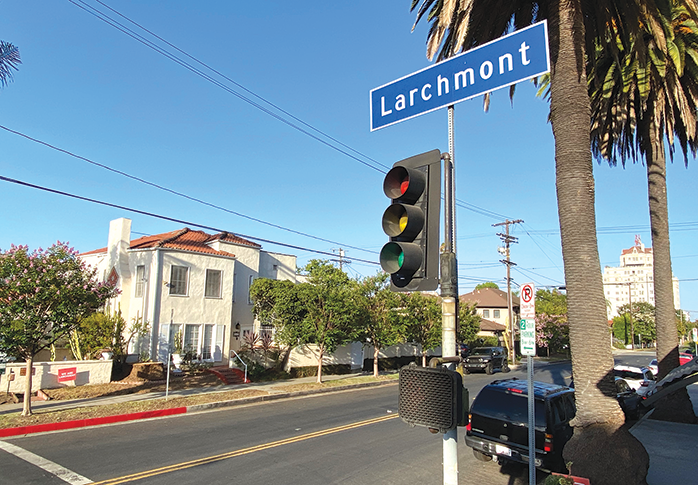
Some residents in Larchmont Village, Hancock Park and the Miracle Mile are concerned about the impact state laws may have on historic neighborhoods. (photo by Edwin Folven)
The Los Angeles City Council approved measures on June 3 as part of a plan to delay implementation of Senate Bill 79, which allows larger multi-family housing developments around transit stations.
The state law was opposed by Los Angeles Mayor Karen Bass, the Los Angeles City Council and many local homeowners groups because it limits the city’s power to make zoning decisions. Homeowners believe the law will negatively impact single-family and historic neighborhoods such as Windsor Square, Hancock Park and the Miracle Mile because of their proximity to transit stations on Metro D Line subway extension.
A transit-oriented development map released on June 1 by the Southern California Association of Governments – a requirement of SB 79 – shows communities around the Wilshire/Western, Wilshire/La Brea, Wilshire/Fairfax and Wilshire La Cienega subway stations where larger housing project could be built under the law. The map shows the zones extend as far north as Third Street and farther south than Olympic Boulevard in some areas. To view the map, visit scag.ca.gov/search/node?search_api_fulltext=SB+79+maps.
The measures approved by the Los Angeles City Council allow the city to largely delay SB 79 until 2030, giving the city time to come up with alternatives to satisfy projected goals for affordable housing. If the city had not taken steps to delay the state law, it would have taken effect on July 1.
While efforts to lessen the local impacts of SB 79 have been successful, some residents in the community believe new threats are looming. They cited Assembly Bill 2005, by Assemblyman Patrick Ahrens (D-Silicon Valley), which makes changes to a previously enacted bill to remove barriers for lot splits – situations where a property owner splits their lot and builds two or more houses. Under the current law, the property owner is required to reside in one of the residences. AB 2005 shifts the owner-occupancy requirement from the applicant to a homebuyer, while still requiring the new owner to remain as an occupant in one of the units for three years.
“We need to do everything we can to make housing more affordable for Californians. Current law needs amending to facilitate more split lot development and build more affordable housing. I am authoring AB 2005 to reduce unnecessary bureaucracy to promote small-scale housing production by homeowners, helping create new housing stock to alleviate affordability issues and support long-term wealth building for California families,” Ahrens said in a statement.
Some residents believe AB 2005 will open the door for developers to buy single-family properties, split the lots, build new structures out of character with neighborhoods and then sell the properties.
“My principal fear is this will simply lead to more land speculation and has nothing to do with providing sorely needed affordable housing,” said Greg Goldin, president of the Miracle Mile Residential Association. “It allows investors to buy land and upzone without building affordable housing. This will only let the hogs feed more voraciously at the trough. I don’t understand why the state legislators are playing this dastardly game.”
Residents in Larchmont Village are also concerned and are disseminating information about the new state law.
“AB 2005 is yet another attempt to destabilize R-1 single family neighborhoods,” said Sam Uretsky, president of the Larchmont United Neighborhood Association. “This bill apparently now allows LLCs, and possibly other corporate structures, to buy lots, divide them, build multiple dwellings on each lot ¬and sell them. It’s simply a way to engineer adding density into neighborhoods that have no need and pretty much have no infrastructure to bear them. For me, all this is performative land management by the state.”
Other residents and housing advocates support AB 2005. Scott Epstein, director of policy and research for Abundant Housing L.A. and former chair of the Mid City West Neighborhood Council, said it is important to note that the new state law does not completely remove the owner-occupancy requirement, instead creating “more flexibility around the requirement.”
“I can confirm that Abundant Housing LA supports AB 2005,” Epstein said. “The bill’s passage would benefit L.A. and California. It would allow more homeowners to be part of the housing solution, help homeowners who are income poor and asset rich remain in their homes and foster multigenerational living arrangements that benefit all involved.”