
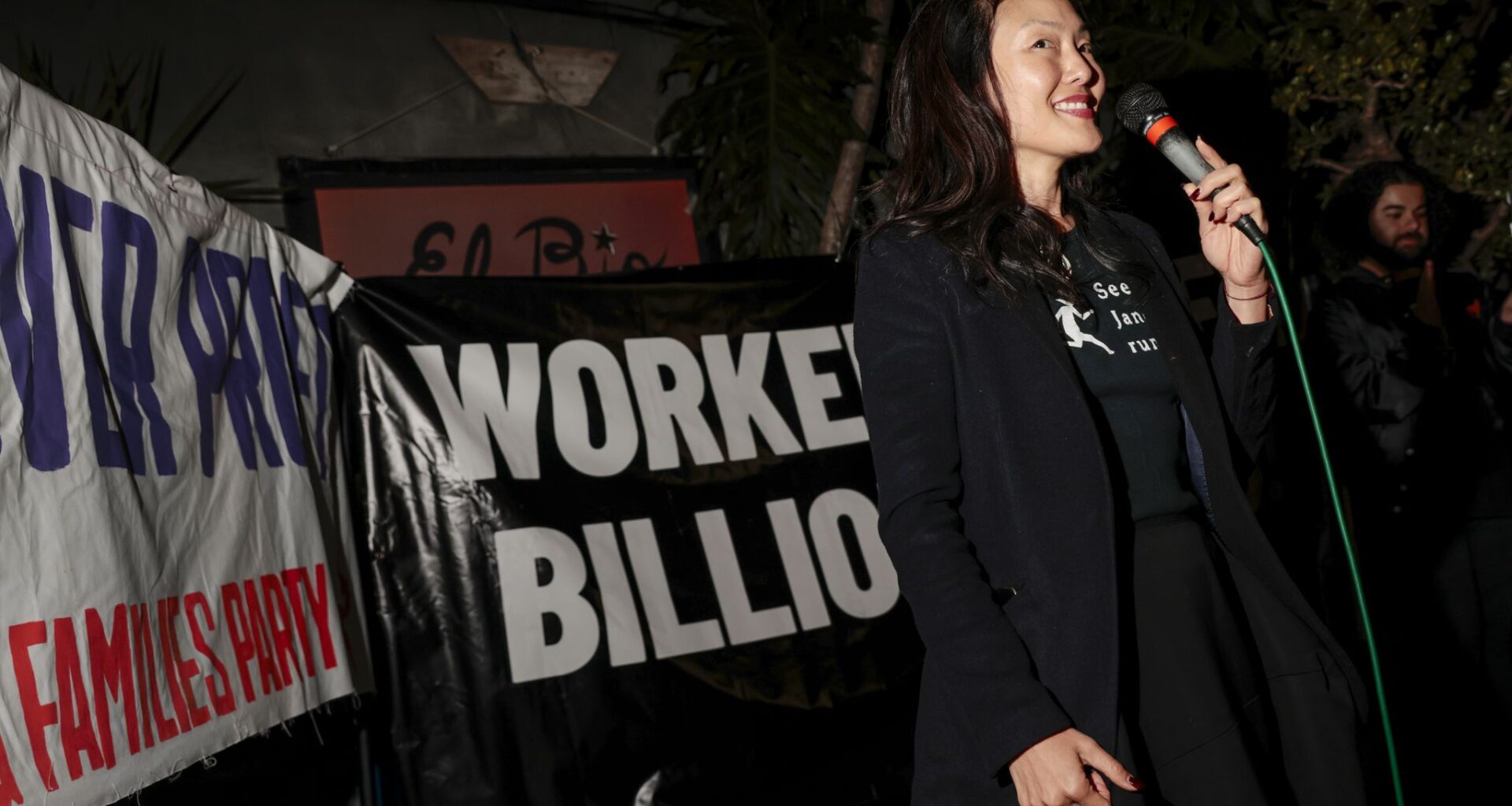
Jane Kim speaks to supporters at El Rio in the Mission on Election Night in San Francisco on June 2, 2026.
Brontë Wittpenn/S.F. Chronicle
The progressive Working Families Party is having a moment.
In its sixth year in California, the party notched some impressive results in last week’s primary:
Former San Francisco Supervisor Jane Kim was the leading vote-getter in the statewide race for insurance commissioner, Randy Villegas advanced to the general election in a nationally watched swing House district in the Central Valley and Sacramento City Council Member Mai Vang got the most votes in a Sacramento-area House race, besting incumbent Democratic Rep. Doris Matsui.
Article continues below this ad
But those three and other Working Family Party candidates on the ballot in November have a tough balancing act to do over the next six months: They need to use this moment to raise the party’s profile and help voters understand how it differs from the Democratic Party, while running as Democrats.
Conversely, top Democrats and Democratic Party institutions may reverse course in November and back Working Family Party candidates — as long as they’re taking on Republicans and not fellow Democrats.
San Francisco Chronicle Logo
Make us a Preferred Source to get more of our news when you search.
Add Preferred Source
“It’s safe to say this is the biggest election day in the history of WFP,” Jorge Contreras, interim California Director of the Working Families Party, told supporters on a post-election call Tuesday night.
A sign for Randy Villegas is seen in Arvin, Calif., on May 16, 2026.
Jenna Schoenefeld/For the S.F. Chronicle
But is the WFP ready for its close-up? It’s looking that way, as some top “corporate Democrats” — those who accept corporate political action committee campaign contributions — are lining up behind the WFP candidates who defeated the Democratic Party’s chosen candidates in the June 2 primary.
Article continues below this ad
Unlike the Republican, Democratic and Green parties, the Working Families Party is not a ballot-line party in California. Achieving that status could be years down the road and would take millions of dollars. The timeline for doing that is “still to be determined,” said party spokesman Victor Suarez. It currently endorses and supports (through its dues-paying members) candidates who share their progressive values — including Bay Area Reps. Lateefah Simon, D-Oakland, and Ro Khanna, D-Fremont — in the name of getting their ideas enacted into law.
The party is on the ballot in only three states — New York, Connecticut and Oregon — and has chapters in 18 states. For now, its candidates are emphasizing their differences from the major parties: They don’t take corporate PAC contributions, they support single-payer healthcare and taxing the wealthy. It plans to ramp up from its efforts in the primary where it made 1 million calls to voters, sent 2 million texts, mailed 250,0000 mail pieces and organized 150 canvasses and phone banks.
But most Working Family Party candidates, like Villegas, are registered Democrats. The Democratic Party may support some of them, but not all.
“I am a proud Democrat,” Villegas told me. “But I’m a proud Working Families Party Democrat. And that means that I’m going to be fighting for universal healthcare, I’m going to be fighting for universal childcare, I’m going to be fighting to get corporate PAC money out of politics, I’m gonna be fighting to ban members of Congress from trading stocks. I’m a Democrat who is going to be going to the mat for every single one of these issues.”
Villegas’ race offers a case study in the tensions at play between the Democratic Party and the Working Families Party, which in this case both want to oust Republican Rep. David Valadao and help Democrats retake control of the House.
Article continues below this ad
Sen. Bernie Sanders and Rep. Alexandria Ocasio-Cortez endorsed Villegas in the primary. The Democratic Congressional Committee endorsed Assembly Member Jasmeet Bains after pledging to remain neutral in the race. In the wake of Villegas’ win, some Democrats are now threatening to withhold their DCCC dues over its meddling.
Villegas pointed out that he was also endorsed by four local Central Valley Democratic Party county chairs and the Republican mayor of Mendota, Victor Martinez.
Maria Pantoja, 16, center, and Elisa Lopez, 15, right, talk to a community member while canvassing for Randy Villegas in Arvin, Calif., on May 16, 2026.
Jenna Schoenefeld/For the S.F. Chronicle
What that shows, Villegas said, is that “these aren’t necessarily progressive issues, these are popular issues that resonate with voters across the political spectrum. It’s not this fight of left and right, it’s really us versus them. We are for working families in the Central Valley who’ve been left behind by politicians in both parties who would rather cater to corporations.”
That may explain why Kim, who has run for San Francisco mayor and the state Senate previously, won the counties of Trinity, Butte, Lake, Merced, San Bernardino and Riverside, all of which supported a Republican for governor. That could also mean that the Democratic vote was consolidated behind Kim while the GOP vote was split. She is unlikely to receive the state party’s support as she faces Assembly Member Ben Allen, a fellow Democrat, in November.
Article continues below this ad
Kim saw the red county support differently.
“It tells me that our message about running against the status quo that has contributed to wealth inequality and economic insecurity, and running on a vision that government can work and that it can make California more affordable for everyday residents resonated across the state,” Kim told me.
Now that the fog of California’s vote-counting is clearing, the Democratic Party is lining up behind at least one Working Family Party candidate.
On Tuesday, Speaker Emerita Nancy Pelosi, California Sens. Adam Schiff and Alex Padilla and Reps. Zoe Lofgren and Pete Aguilar endorsed Villegas. Lofgren was one of 10 California Democratic House members who endorsed Bains.
It’s unclear how far the DCCC might be willing to go in reversing course and supporting Villegas. It sent an email blast Wednesday that railed on Valdadao but didn’t mention Villegas. But it did add Villegas to its competitive “red to blue” program that could mean giving his campaign organizational and financial support. Villegas sees no conflict in accepting the support of three Democrats who have taken corporate PAC contributions and one, Pelosi, who previously supported the ability of House members to make stock trades, but now supports a ban.
Article continues below this ad
It’s unlikely that Kim or Vang will attract similar support from top Democrats or the state party since they are taking on other Democrats. Villegas said any support from the DCCC won’t change the way he’s going to run.
“I am still going to stay true to who I am and my values and the way that we’re going to run this campaign, and I’ve made that clear since day one,” Villegas said. “Our campaign will not be receiving corporate PAC donations. We’re going to continue to stay fighting for working families, and we’re going to continue to call out corruption wherever it exists.”