
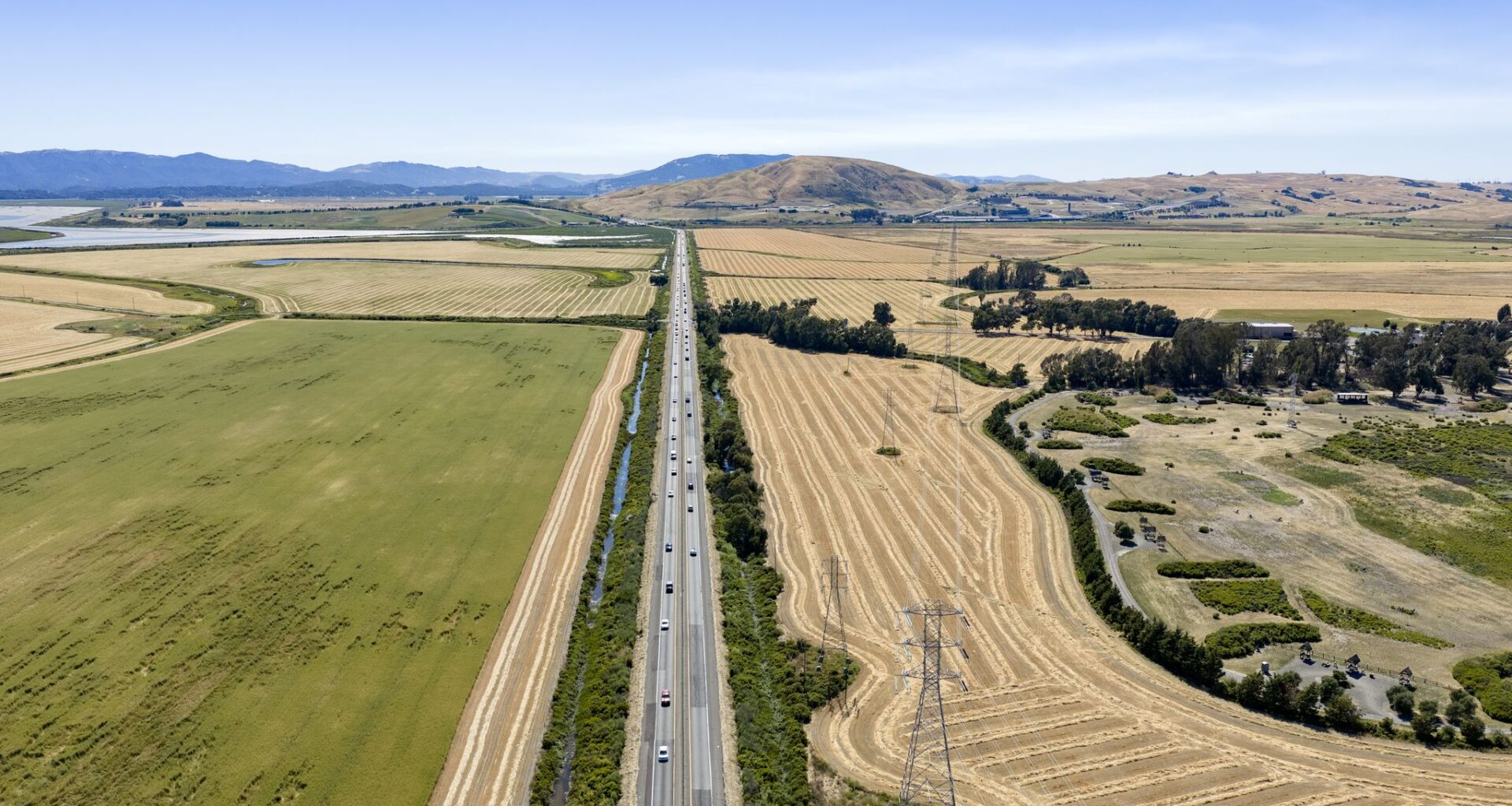
Highway 37, shown in Sonoma County, is a key artery for Bay Area commuters. A multi-billion dollar, 20-year project to enhance the road is under consideration.
JOSH EDELSON/Josh Edelson / For the S.F. Chro
Two hours is far too long to spend driving from Santa Rosa to Vallejo, partly on a single-lane highway with your tires at water level.
Halfway home, Robert Donohoe had suffered enough. He really needed to pee.
Parking his truck at a turn-off called Vista Point, he got out and shaded his eyes. It was a scorching June afternoon, wind whipping the thistles and cordgrass on a spit of land that dipped into San Pablo Bay. Traffic had slowed to a glacial crawl on Highway 37, the artery that carries Donohoe to his hospital job, alongside thousands of other people bound for schools, construction sites, pools that need cleaning or gardens that need landscaping.
Article continues below this ad
Donohoe was unable to suppress a sigh.
An aerial view shows “The Lone Toilet,” a famous, doorless roadside outhouse landmark located in the muddy marshlands along Highway 37 near Sears Point in Sonoma County.
JOSH EDELSON/Josh Edelson / For the S.F. Chro
If California’s transportation department would widen the highway, he said, “I wouldn’t have to stop here.”
San Francisco Chronicle Logo
Make us a Preferred Source to get more of our news when you search.
Add Preferred Source
In fact, Caltrans is doing just that.
Article continues below this ad
It’s an interim step as the agency, and its partners, prepare for a big-swing megaproject that would overhaul the whole Highway 37 corridor, 21 miles from the Highway 101 junction in Novato to Interstate 80 in Vallejo.This includes a stretch where the road narrows to a lane in each direction, at one time so notorious for head-on crashes that locals gave it the nickname “Blood Alley.” (Engineers alleviated the problem by adding a center median in the 1990s, though the name stuck.)
Now, crews are grappling with periodic floods that force road closures and traffic that clots the westbound lanes every morning and the eastbound side every afternoon. Their proposed solution would transform this commuter route into an elevated causeway, while also repairing bridges, imposing tolls, restoring tidal habitat and maybe erasing a dark history — all at a cost of up to $11 billion. Dividing the work into eight discrete projects, officials hope to start construction next year and finish by 2050. Their timeline is so ambitious, the budget forecasts so daunting, that it makes a recent rebuild of Highway 101 look like child’s play.
Drivers say it can take up to two hours to drive on Highway 37 from Santa Rosa to Vallejo, during rush hour commutes.
JOSH EDELSON/Josh Edelson / For the S.F. Chro
And already, people aren’t happy.
Article continues below this ad
Among the dissenting voices is Marin County Congressman Jared Huffman. Though he praises the overall goal of raising the highway at least 20 feet to protect it from sea-level rise, he’s critical of the “near-term” work that Caltrans is set to begin this year on the erstwhile Blood Alley segment. The agency plans to expand the road by converting shoulders on either side into toll lanes, a redesign that would ease congestion but keep the highway at its current grade.
Caltrans leaders say it’s important to make temporary fixes while they grind away at the larger megaproject, which could take another decade to design and build. But Huffman and many of his constituents are baffled.
“We’re spending $600 million to build a widened freeway that will be under water 16 years after it’s done,” he told the Chronicle. “And we’ll be stuck with this hardened, vulnerable project. And the solution in year 16 and year 20 and year 30 will always be just to slather more asphalt on top of it.”
Bart Ney, a spokesperson for Caltrans, strongly disagrees. He grew up in Vallejo and has spent many hours of his life slogging through gridlock on 37.
“The trick here is to understand megaproject delivery,” he said. “It’s going to take more than a decade to figure out the design before you put columns in the ground.” And in the meantime, he added, people who routinely drive from Vallejo to the North Bay will be trapped in miserable bottlenecks.
Article continues below this ad
To really experience the beauty and dysfunction of Highway 37, a person needs to set out from, say, Vallejo’s Harry Floyd Terrace neighborhood at around 7:30 a.m. Head west on the freeway, packed among tradespeople in work trucks and teachers already running late for work in Novato school districts. Past Mare Island the roadbed constricts to one lane, surrounded everywhere by marshland. Ducks and starlings hobble on the cracked earth, unperturbed by the squall of horns or the thrum of collective anxiety. During high tide drivers might feel like the water is right upon them, nature pressing in as they sit in traffic.
Parts of Highway 37, shown in Sonoma County, could be transformed into an elevated causeway, while also repairing bridges, imposing tolls and restoring tidal habitat — all at a cost of $11 billion.
JOSH EDELSON/Josh Edelson / For the S.F. Chro
“It’s constantly sinking,” said Fraser Shilling, co-director of the Road Ecology Center at UC Davis. He expects that as the coastal plane erodes and becomes a mud flat, drivers will notice waves lapping at the highway, which “will be even more unnerving.” Shilling, however, opposes the elevated causeway design, saying it would be smarter to tunnel the highway, replace it with a bridge or move it inland.
But the water sloshing around Highway 37 is not invading so much as returning. Long before asphalt and bridges and commuter traffic, the Bay Area was a vast quilt of thick grass and woody sloughs that spread from San Pablo Bay to the Delta. Indigenous communities lived in this abundance for thousands of years, fishing in ponds and gathering materials from the shoreline to build dwellings. Then the European settlers arrived, bringing ranches, wagons and a very different idea of what the marsh was for. Over time, they laid roads over the mud and diked the wetlands. Tidewater pools gave way to farms and pastures. Highway 37 opened in the 1920s, a busy toll road on a berm that cut right through the baylands.
Perhaps the humans who remade this landscape also cursed it. Over the next 150 years the marsh environment degraded, as did the freeway. The “Blood Alley” strip of Highway 37 became notorious for deadly collisions. (Twenty-seven people were killed on the dangerous eastern section between 1966 and 1970.) Adding a center median did not stop the next series of challenges. Population growth in Solano County and job opportunities to the west have mounted pressure on Highway 37, making it one of the most punishing commutes in the region. Meanwhile, storms flood the highway in winter and rising seas threaten to swallow it by the end of the century.
Article continues below this ad
Transportation planners hope to solve all of that by investing billions to reimagine the corridor. Initially, Caltrans hopes to launch several projects in tandem, including the 10-mile road-widening and expansion of the Tolay Creek Bridge just east of the 37 interchange with Highway 121 in Sonoma County. By replacing the current 60-foot bridge with a larger 400-foot structure, crews will stimulate the flow of water, sediment and nutrients between San Pablo Bay and the Sonoma Baylands. Officials at Caltrans and their counterparts at the Transportation Authority of Marin also seek to replace a bridge over Novato Creek that has been subject to flooding, and which lies just west of the 10-mile segment in the near-term project.
Parts of Highway 37, shown in Sonoma County, are prove to flooding and sea level rise.
JOSH EDELSON/Josh Edelson / For the S.F. Chro
Last month Caltrans installed the first piece of its bottle-neck relief effort in Vallejo: a diverging diamond interchange near the fairgrounds, where 1,100 commuters head south during rush hour every morning. Drivers inching towards on-ramps to State Route 37 mix with others cutting toward Interstate 80, or day-trippers bound for Six Flags Discovery Kingdom. The new street geometry aims to quickly move commuters through a many-pronged crossing, a major quality-of-life improvement that signals how good things could be once Caltrans delivers the larger megaproject.
Skeptics fear that issues with funding, politics and logistics will prevent that from happening. Some, including Huffman, have little faith that Caltrans will finish modernizing the highway before it is submerged in the bay. Even the first phase will cost north of $500 million, Ney said, and decision-makers do not have all of that money in hand.
One motorist who struggles to picture a wider, taller freeway is Donohoe, who acknowledged he probably wouldn’t have to stop for a pee break if the highway had two lanes on either side and the traffic flowed faster. Nonetheless, he expressed doubt that construction would start any time soon.
“It’ll get tied up for four years,” Donohoe insisted. “And then,” he said with a scoff, “they’ll want to collect tolls.”
Berenice Armenta is similarly wary. Commuting from Vallejo to the North Bay each day, she’s experienced the back-ups and glimpsed the Bay Area’s predicament with sea level rise through her car window. Yet Armenta is not a fan of road-widening, and hopes that regional policymakers might consider a more basic solution to their congestion problem: Move jobs to areas where people live, and they won’t have to drive long distances.
Are toll lanes the answer to correcting the Highway 37 commute? How would you fix the problem?
Highway 37 is slated for a massive overhaul that could bring toll lanes, years of construction and major changes for commuters. Are toll lanes the right answer, or is there a better way to fix the highway?