
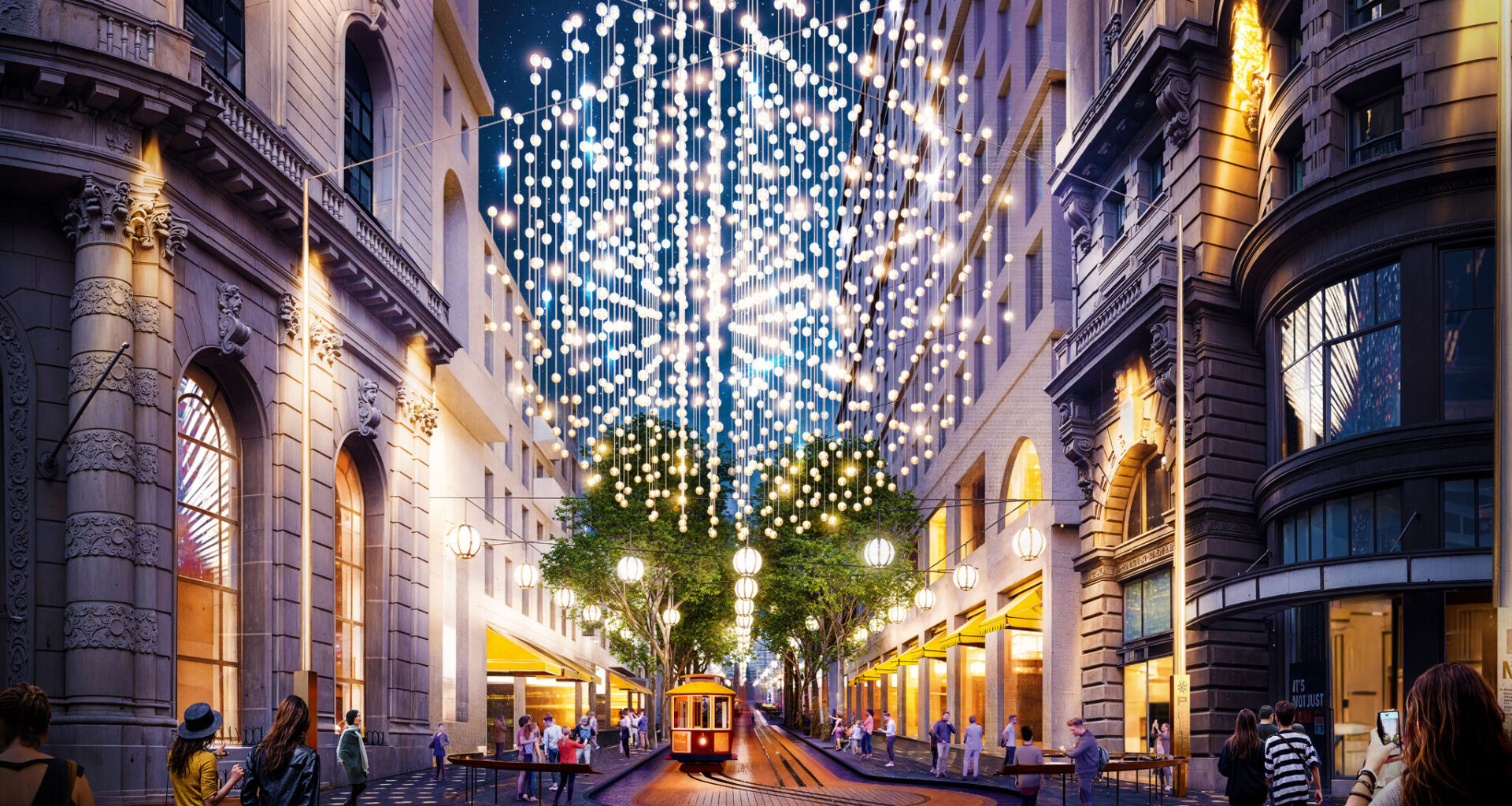
A rendering of the Powell Street transformation proposed by Field Operations and Sitelab Urban Studio. A new design, programs to attract businesses and rising tourism should enliven the corridor.
Field Operations
I always feel bad for the tourists lining up to ride the cable car at the Powell Street turnaround in San Francisco. They’re about to have an experience that — even for someone like me who has lived in the city almost my whole life — is filled with joy. But in the interim, they’re stuck, often for a long time, surrounded by blight.
Once so busy with pedestrians that it forced the city to figure out how to accommodate foot traffic on its crowded sidewalks, this stretch of Powell has become a poster child for the post-COVID doom loop.
Fortunately, that’s about to change.
Article continues below this ad
A line of people waits to ride the cable cars in 2024 at the Powell Street turnaround in downtown San Francisco.
Brontë Wittpenn/S.F. Chronicle
On a warm and sunny Wednesday, Mayor Daniel Lurie announced the city’s commitment — and the enactment of legislation to accept a $14.5 million private grant — to transform three blocks of Powell Street from the cable car turnaround at Market Street to Geary Boulevard “into a world-class gateway.” Construction is due to begin later this year.
“San Francisco will have 24 million visitors this year, surpassing 2019 levels,” Lurie said, addressing a clearly energized crowd at the cable car turnaround, noting that many of them begin their experience there, and that they should see “a corridor that reflects the optimism of our city.”
San Francisco Chronicle Logo
Make us a Preferred Source to get more of our news when you search.
Add Preferred Source
Voters initially funded the refurb via the passage of Proposition B in 2024, and I’m pleased to report that their money has thus far been well spent.
Article continues below this ad
Eleven teams competed to design this small but significant project (if only nearby Embarcadero Park had undergone a similarly rigorous design competition). The winning team of Field Operations, which designed the Highline in New York and Tunnel Tops in the Presidio, and Sitelab Urban Studio, which had a hand in transforming everything from the Stonestown Galleria to Pier 70, is perfectly suited to take on the challenge of Powell Street.
A rendering of what a redesigned sidewalk on Powell Street could look like.
Field Operations
The team understands that though the project is relatively small in scale, the location is big in terms of perception. As Field Operations’ Richard Kennedy told me, “If there is a place to show that the city is coming back, that would be a great place to start.”
There really are so many constraints here — older city streets with basements below, a mosaic of textures, different levels of quality and repair, not to mention a uniquely San Francisco obstacle: historic lampposts, which have delayed many a project in the past.
Article continues below this ad
Yet the design team has overcome them. There are places you want to linger in, others you want to get through as quickly as possible. Seeing what Field Operations and Sitelab have proposed, I’m confident that Powell Street can become the former.
The old parklet on Powell, designed by MacArthur Award-winning landscape architect Walter Hood, was shiny and modern in its day but was never meant to last this long. It will be removed, and new plantings will be installed. The sidewalk will be widened to allow for outdoor dining and other programming. (Dandelion Chocolate announced plans for a sidewalk cafe at the press conference.) All three blocks will be illuminated with large-scale “Golden Lantern” features embedded with vintage cable car tokens. There will even be some extra “sparkle” in the pavement via metallic inlays.
Cable cars stop at the Powell Street turnaround in 2024. Tourism is up in the city, but the Powell Street corridor is not as busy as it was in the past.
Carlos Avila Gonzalez/S.F. Chronicle
Meanwhile, below ground, Muni will replace critical cable car mechanical and electrical infrastructure — including components of the underground machinery and powerhouse systems that keep the cables moving. This will help ensure the system’s reliability for decades to come.
Yet the real significance of the redesign may be less about the lanterns, sidewalks or chandeliers than about the coalition behind it.
Article continues below this ad
As the Chronicle reported earlier this month, an investor group has provided millions in additional funding to supplement public dollars — a boost that will help things to move forward quickly.
“This is more than redesigning a street,” Marisa Rodriguez, CEO of the Union Square Alliance, said Wednesday at the announcement, “it’s reinvesting in San Francisco.”
This reflects a growing belief that downtown San Francisco remains worth betting on. Yet whether that bet pays off will depend on much more than a few blocks of streetscape improvements.
Powell Street is a design story, but it’s also a story about public/private partnerships — which can be great with caveats.
Remember that the parklet that’s being replaced, installed back in 2011, was paid for by the car company Audi. But Audi did not commit to the upkeep of the parklet — something we need to think about as we embrace more private/public endeavors in the city.
Article continues below this ad
Right now, downtown is benefiting from an energetic and well-funded consortium of public and private sector actors. Private money is filling gaps in a city budget that is under duress.
But urban conditions change — and so do funders. Policymakers need to implement long-term strategies that foster ongoing support.
Shola Olatoye, CEO of the San Francisco Downtown Development Corp., which raised the $14.5 million for this project, told me she believes that’s what’s happening and that they’re committed for the long haul.
“We’re at a different phase of this recovery,” she said. “I love pop-ups, but this is the time to build and create conditions for continued recovery.”
Olatoye shared with me that in July, we could expect to see announcements about new businesses that will bring jobs to downtown, activate Powell and reflect the authenticity that is San Francisco.
“It’s super important to demonstrate to San Francisco residents and the public that we can get stuff done,” she said. “That’s what people want to see.”
That’s certainly positive news if it all comes to fruition. Because design alone — no matter how distinctive — can’t fill retail vacancies, clean streets or change behaviors.
You can quickly activate a street with food and beverage carts, and movable tables and chairs. But a long-term strategy is key. Efforts like these live or die based on ongoing support. And we too often don’t follow up to see how projects fare after the jubilation over their initial completion.
Olatoye told me the city is collaborating with a consortium of stakeholders to develop a 20-year plan for downtown, focused on a vision for a true 24-hour mixed-use district. She noted it has been 40 years since the last formal plan was issued.
“We’ve had some well-thought and amazing pieces, but nothing as comprehensive as we’re hoping to put together,” she said. “We are just at the beginning of it.”
Guest opinions in Open Forum and Insight are produced by writers with expertise, personal experience or original insights on a subject of interest to our readers. Their views do not necessarily reflect the opinion of The Chronicle editorial board, which is committed to providing a diversity of ideas to our readership.
Read more about our transparency and ethics policies
“The ballet of the good city sidewalk never repeats itself from place to place,” urbanist Jane Jacobs wrote in 1961, “and in any one place is always replete with new improvisations.”
I’m optimistic that is what we’re seeing on Powell Street. And with what seems like a perhaps unprecedented level of collaboration here, I especially hope the recognition of design’s importance continues throughout the neighborhood.
Allison Arieff is a columnist and editorial writer for the Opinion section.